Showing posts with label Iranian Photography. Show all posts

Monday, 8 February 2016

‘To each his own weapon, I have my camera’: Iran's 1979 revolution – in pictures

It took Maryam Zandi more than three decades to get her photos of the revolution published

An Iranian revolutionary with a flower in his rifle. Photograph: Courtesy of Maryam Zandi and the Guardian.
by Tehran Bureau correspondent, The Guardian

I met Maryam Zandi last spring in the cherry-coloured hallways of downtown Tehran’s House of Artists, a prestigious gallery, auditorium and theatre inaugurated under the administration of the reformist president Mohammad Khatami. Zandi was ‘in conversation with’ photographer Nader Davoodi, but I was looking forward to interview her about her book, Enqelab-e 57, published more than three decades after the 1979 revolution.

Zandi fought long and hard to have the book, which spans the turbulent winter of 1978-9 when people gathered to topple the Shah, published in the form she wanted, with nearly 200 photos. Under the administrations of President Mahmoud Ahmadinejad, the authorities said it could be allowed only with some parts removed - something she refused.

“This is a record of the rising of a people, it should be seen in its entirety,” she told me. After the victory of Hassan Rouhani in the 2013 presidential election, the culture minister agreed the book could be published whole.

The photographs run from the citywide demonstrations of November 1978 to 1 April 1979, the day of the national referendum with the simple question: ‘The Islamic Republic, Yes or No?’. They capture such momentous events as the mass march to Mohammad Mossadegh’s home in Ahmadabad, and Ayatollah Ruhollah Khomeini’s first media interview upon his return to Iran, at Alavi School. It was published in October 2014.

In the introduction, Zandi describes asking - almost negotiating - with a man at the door to let her into the school where only men were allowed that day. Aptly, the book begins with her plea: “To each his (or her) own weapon, I have my camera, and I have my cry.”

She recalled the frenzy of the revolutionary protests as a time of “inclusion, when divisions were momentarily set aside”. On one occasion, having found no one to take care of her baby daughter, she carried the infant in her arms and asked people to hold her as she took photos.

Thursday, 17 December 2015

Abbas Kiarostami on his fixation with doors, the still image and carpentry

The Iranian film-maker is showing a photographic series he’s worked on for 20 years at Toronto’s Aga Khan Museum
Abbas Kiarostami. Photo: Janet Kimber/Aga Khan Museum. Courtesy The Art Newspaper. 
by David D'Arcy, The Art Newspaper

Doors Without Keys, by the Iranian film-maker Abbas Kiarostami, is a maze-like installation of 50 photographs, all showing locked doors fr om buildings in Iran, Italy, France, and Morocco, printed life-size on canvas. The pictures, which have never been exhibited before, are now on view at the Aga Khan Museum in Toronto until 27 March 2016. The show, which is expected to travel, is co-curated by  Peter Scarlet, the former director of the Tribeca and Abu Dhabi Film Festivals and Amirali Alibhai of the Aga Khan Museum. At the show’s opening in November, 76-year-old Kiraostami, one of Iran’s best-known artists, talked about the still photograph and the visual nuances of wood.

Did you take still photographs before you started making films?

It happened afterwards. I owe it to the 1979 Revolution, because it was very hard to make films. I had to go on producing images, so I started taking still pictures. It became a parallel activity to filmmaking. They interact. There’s a mutual influence.

In the contemporary art world, the moving image seems to be replacing everything. Why do you remain drawn to still photography?

I guess it’s a defense mechanism, but also kind of a protest against all this—in my view—unwelcome movement in images. Some of my latest works are experimental films that last four or five minutes. But each still image can last four or five minutes. If an image is worth seeing, it takes concentration and contemplation. The reason why there is so much movement is probably that nothing is worth being seen in what is actually shown. This is my way of protesting against that.

Look at how people relate to the pictures shown here. They choose the best position, and they stand still in front of it, and they stare at it. This is the kind of opportunity that is given less and less in contemporary art.

Thursday, 29 October 2015

Retrospective

Shadi Ghadirian’s Evocative Photos of Iranian Women in Lyon
Too Loud a Solitude | 2015, Copyright Shadi Ghadirian. Courtesy Silk Road Gallery and BLOUIN ARTINFO.

by Nicholas Forrest, BLOUIN ARTINFO

“Shadi Ghadirian: Retrospective” at the Lyon Municipal Library (La Bibliothèque municipale de Lyon) is a major exhibition celebrating the work of influential Iranian photographer Shadi Ghadirian. Presented in association with the Silk Road Gallery in Teheran, the exhibition surveys Ghadirian’s entire photographic oeuvre from 1998 to the present day and includes a new video work titled “Too Loud a Solitude” which the artist describes as “a slice of instants, similar to photography, in which the subjects move.”

Since graduating from Azad University in Tehran with a B.A. degree in Photography, Ghadirian has established herself as one of Iran’s leading creative talents. She is best known for her evocative staged portraits which address a wide range of issues including female identity, censorship, and gender roles. Drawing inspiration from her own life experiences, Ghadirian uses humour and parody as the points of departure for poignant investigations into the paradoxes of women’s lives in Iran.

According to Anahita Ghabaian Etehadieh, associate curator of the exhibition and Director of the Silk Road Gallery, in the late 1990s Ghadirian became one of the first Iranian photographers to change people’s perceptions of Iranian art and contemporary society. “Using a unique style of expression, she began contradicting the harsh and brutal images commonly seen and associated with Iran, challenged Eastern social dilemmas and how the world saw Iran, through the language of art.”

Tuesday, 12 May 2015

Balancing humour and gravity

A small woman with a brilliant smile, photographer Gohar Dashti is among Iran’s established talents, conjuring art from a culture run ragged by years of war, internal tensions and conflict between traditional beliefs and the modern world.

Untitled work from Gohar Dashti’s series Today’s Life and War (2008), part of the exhibition Iran at the Australian Centre for Photography in Sydney. © Gohar Dashti. Courtesy the artist and ACP.
by Rosalie Higson, The Australian

During the past decade Dashti’s surrealist photo-fictions have been shown in solo exhibitions in Tehran, the US, France, Italy and Britain, and in many group shows from Berlin to Rio de Janeiro.

In Sydney at the Australian Centre for Photography selections from two of Dashti’s series, Today’s Life and War and Iran, ­Untitled, are on show under the title Iran, part of the centre’s examination of dialogue between East and West in the year of the centenary of the Gallipoli campaign during World War I.

Dashti was never interested in straight documentary photography. Instead, she makes a kind of absurdist theatre, set against a dreary yet threatening desert landscape, balancing humour and gravity. “My work is about social issues and also about historical social issues, and also about myself and my experience of the world,” Dashti says. “My work reflects my face, what I feel about life, what’s my experience. I think all artists trust themselves so they can express something. Not particularly as a woman — it doesn’t matter. Just as an artist.”

War was constantly in the background for the first eight years of Dashti’s life. She was born in 1980, the year after the Islamic Revolution, just when Iran and Iraq went to war. She grew up with three brothers in Ahvaz, a small city on the border between Iran and Iraq: “And that’s exactly where the war happened. My father was from there, and so we stayed there, and we grew up in the wartime.

“It was just part of life. We had good and bad memories — the birthday parties, shopping, going to school — everything like normal. And we grew up in this kind of life. One of the normal games for us, after the red alarm (all clear siren) we went to the roof and took the bullets and ‘Who has more?’ At the time I really enjoyed it, but now thinking about it — oh. But it was a game for children.”

Gimme Some Truth

Living the high life and telling it like it is: Sassan Behnam Bakhtiar
Once Upon a Time, There Was Saddam (from the A Reason to Fight series). Courtesy REORIENT.

What interest could a stylish, twenty-something artist-cum-businessman living it up in the French Riviera and Monaco have in a tiny village in central Iran? In a tribe supposed to be as old as time itself? In a war he never experienced, fought for, or at the time understood? Quite a bit, apparently.

Born in Neuilly-sur-Seine, France, in the early 80s, Sassan Behnam Bakhtiar has a lot to be happy about. Despite having been dubbed the ‘new kid on the block’ (among other things) by some, he has, in a very short time, seen his work shown in solo exhibitions in London, major charity galas, international art fairs, and on prestigious online platforms; not bad at all, one could well say. Although he comes from a business background and is known for his entrepreneurial flair and drive, it isn’t money that’s driving Sassan’s artistic practice, but rather a simple love for his homeland, and a journey through the many facets of his identity. Combining traditional Persian motifs with black-and-white photography, fashion aesthetics, and archival material, Sassan strives to reveal through his work not only his own true self, but also that of Iran.

Who is Sassan Behnam Bakhtiar? What does he believe in? Who is this ‘man on a mission’ everyone’s been talking about recently?

I have often been called a self-styled purveyor of the truth by different major organisations and players in the contemporary art world during the past two years, which is due to the nature of my work – from my portraiture and art films, to installations and photographs such as those of the A Reason to Fight and The Real Me series – as well as my background. As an artist, one of my objectives is to show the world what the true nature of my country – Iran – and its culture, heritage, and people is. It has been too long that the majority of international media outlets have portrayed my fellow nationals, country, and heritage as something that is clearly false, and I think it is long overdue to start showing the truth and factual realities of Iran instead of all this negative propaganda circulating everywhere.

Today, I am using my practice to better educate the masses on a global level about Iran and everything that it involves, and my biggest satisfaction is when I see audiences of various ages and races understanding the message behind my work all in the same way. My work deals with a potent blend of nostalgia, history, and national cultural identity.

All about me nicknamed Crown Giver

Contemporary Iranian Photography 
The Silk Road Art Gallery based in Tehran, presents its new solo exhibition by Tahmineh Monzavi titled "All about me nicknamed Crown Giver" until May 18th, 2015.
All about me nicknamed Crown Giver, 2014 © Tahmineh Monzavi. Courtesy The Eye of Photography.
by La Rédaction, The Eye of Photography

In a dusty decadence, forgotten and rusty crowned people portrait the lacklustre nightmare of a damp house for me. I search for a familiar sign in the strangeness of the faces. They want to get far away. Like these very same old brass crowns, they want to be a remote sign of what they have once been. The houses in Grape Garden Alley, the houses of dust. The aristocratic houses are dust covered memories, and suspicious looking.

Miss Beauties run to prove their merits and their unsuccessful effort is to win the lost rank of beauty and vanity. Life becomes a chair, it becomes a stare, it becomes staring at their whirling, and a sneer and a chortle that there is always one chair short for the best ones. There is always someone who fails in occupying the chair, and she falls apart.

In the real world, Miss Beauties appear on the stage to display their best in a predefined framework, in an imposed space, with a beaming smile, with a doll-like face devoid of inner feelings. Individuality of these girls is castrated and the portrayal of the appearance is the sole element of their attraction.

The way Miss Beauties are chosen seems somehow similar to our childhood game. Whoever sits on the chair faster deserves the loftiest status. Regarding the hidden capabilities of every woman in the society to be a chosen one, and disregarding looks, culture, and even social class, meritorious Iranian girls and women can be seen easily on the city’s pavements and squares.

Tuesday, 31 March 2015

Portrait of a Nation

From the harems of the Qajars to the Iran-Iraq War – a history of photography in Iran

Image by Bahman Jalali. Courtesy REORIENT.
By Sanaz Jamloo, REORIENT

The emergence of photography in Iran dates back to the mid-19th century, shortly after its invention in Europe in 1839. There have been academic debates regarding the exact date, but according to the remarkable collection of historic photographs in the Golestan Palace in Tehran, the very first photographic images taken in Iran can be dated between 1839 and 1842. The Iranian Qajar monarch, Mohammad Shah (1808 – 1848), was the first person to be gifted a camera by Queen Victoria. After a few training sessions with the instrument, the monarch’s young son – 11-year old Nasereddin Mirza – showed great enthusiasm for it, and became passionate about learning everything about the magic box that captured light.

In the following years, the young prince mastered the technique, and took his camera everywhere with him in the palace, capturing pictures mostly of himself, his jesters and clowns, members of the harem, his servants, royal events, and local monuments, in addition to people of lower social ranks serving the royal family. With his photographs, Nasereddin Mirza brought a certain personal and candid quality to the art of portraiture and self-portraiture in Iran. The future Shah’s passion for photography and documenting everyday life played a crucial role in promoting modern art and the science of photography in Iran as a new form of visual contact with the rest of the world. Not only did Nasereddin Shah promote a new ‘magic’ art in Iran, but also embraced photography’s power as a limelight for his social status as a ‘modern’ monarch.

Since the development of photography in Iran, the camera has been loyal as a means towards political ends. The Qajars relied deeply on the visual arts to confirm and solidify their new positions, and also tried to create an identity for themselves as modernisers and reformers, as well as give a completely new picture of Iran to the Western world. Nasereddin Shah established a contemporary iconography of Iran through his own actions and imagination, drastically different from what European travellers to the ‘Orient’ usually depicted. Although the photographs taken by the young monarch did not portray a genuine image of Iran, they introduced to viewers the dominant visual traditions of the long-ruling Qajar dynasty, and also opened a dialogue between two different representations of Iran and the surrounding region: one presented by local artists, and the other depicted by European travellers.

Thursday, 19 March 2015

An anthology of the final decade: exploring Iran's past through art

A series of exhibitions from curator Vali Mahlouji examine the ‘lost decades’ of pre-revolutionary Iran
Polaroids by Kaveh Golestan Photograph: Kaveh Golestan/Courtesy of Vali Mahlouji and The Guardian.
by Natasha Morris for Tehran Bureau, The Guardian

Polaroids by Kaveh Golestan

A lizard-headed strongman and a nineteenth-century noblewoman pose together on a chaise lounge. Outstretched before a crowd of Qajar dignitaries lies a nude woman. A monstrous birdman clutches a bunch of bloodied and shrivelled heads, which dangle from his fist like a cluster of screaming mandrakes.

Such are the surreal and provocative scenes in the sepia-hued Polaroids by Iranian photographer Kaveh Golestan, who entitled these collages Az Div o Dad (Of Beast and Wild, quoted from the classical Persian poetry of Rumi). Golestan – a figure who lived and died by his photojournalism, killed in 2003 while documenting the Iraq war for the BBC - created this innovative series in 1976 by moving collaged fragments in front of an open shutter under long exposure. The images are experimental visions of modern and later Qajar-era (c.1844-1925) photography spliced with the tails and heads of wild animals and the curved flesh of nude figures.

These images are just some of the artistically radical - and temporally pre-revolutionary – materials recently recovered from Iran’s “lost decades”, rarely glimpsed or even known by those both inside and outside the country itself. This spring, three exhibitions reveal the photographic evidence of Iran’s largely forgotten cultural climate of the 1960s and 70s to audiences in London and the UAE. The first show takes place this March, as Golestan’s Az Div o Dad Polaroids are unveiled at Art Dubai, and will expand on the exposure of Kaveh Golestan’s diverse oeuvre. It is a significant moment to premiere these photographs, which have been unseen for over forty years since Golestan first debuted his surrealistic series at the Seyhoun Gallery in Tehran.

Monday, 9 March 2015

Iran in Photographs

Beautiful Photos of Everyday Life in 19th and 20th Century Iran
Girls Weaving a Carpet. Courtesy Smithsonian Institution.
by Ali Breland, NPR

Since 1979, tens of thousands of Iranians have lived in exile in the United States. The Iranian Revolution forced large numbers of the population out of the country, and many have never returned. As Persian New Year, referred to by Iranians as Nowruz, approaches, many look back on old photos and remember an Iran they used to know. The holiday happens annually on the spring equinox and symbolizes a rebirth in Persian culture. Iranians in the U.S. now experience new lifestyles and culture that make Nowruz's themes of rebirth more real than they had imagined.

The Freer and Sackler Galleries of the Smithsonian are giving Iranian-Americans in exile access to a rich history that they left decades ago. The gallery is home to hundreds of photographs by Antoin Sevruguin, a late 19th and early 20th century Iranian photographer. It is one of the most prominent collections of Iranian works in North America. Some of the photos will also be on display during the Freer and Sackler's Nowruz celebration. The entire collection is also viewable online.

"[Nowruz] is something that I grew up with in Iran," said Massumeh Farhad, chief curator at the galleries and an Iranian-American. "I think [the event] is a wonderful way to celebrate the beginning of a new year. You realize how important it is to have something to look forward to and to celebrate the idea of renewal."

In addition to giving Iranian-Americans a space to connect with their past, the event also benefits the Freer and Sackler Galleries' research.

"During Nowruz, we display the images on a large screen and we frequently get people telling us they recognize people and places that help the museum with research," said Allison Peck, head of public affairs at the Freer and Sackler Galleries.

Tuesday, 17 June 2014

The Fetish of Staring at Iran’s Women

A woman in colourful chador against the Eiffel Tower, photographed by Haleh Anvari. If the chador is the icon for Iran, let it meet the icons for some other nations. Chado- dadar became a live installation in every city it was photographed and ultimately revealed as much about the nature of the people it visited that it did about itself. Courtesy of the artist.

by Haleh Anvari, The New York Times

I took a series of photographs of myself in 2007 that show me sitting on the toilet, weighing myself, and shaving my legs in the bath. I shot them as an angry response to an encounter with a gallery owner in London’s artsy Brick Lane. I had offered him photos of colorful chadors — an attempt to question the black chador as the icon of Iran by showing the world that Iranian women were more than this piece of black cloth. The gallery owner wasn’t impressed. “Do you have any photos of Iranian women in their private moments?” he asked.

As an Iranian with a reinforced sense of the private-public divide we navigate daily in our country, I found his curiosity offensive. So I shot my “Private Moments” in a sardonic spirit, to show that Iranian women are like all women around the world if you get past the visual hurdle of the hijab. But I never shared those, not just because I would never get a permit to show them publicly in Iran, but also because I am prepared to go only so far to prove a point. Call me old-fashioned.

Ever since the hijab, a generic term for every Islamic modesty covering, became mandatory after the 1979 revolution, Iranian women have been used to represent the country visually. For the new Islamic republic, the all-covering cloak called a chador became a badge of honor, a trademark of fundamental change. To Western visitors, it dropped a pin on their travel maps, where the bodies of Iranian women became a stand-in for the character of Iranian society. When I worked with foreign journalists for six years, I helped produce reports that were illustrated invariably with a woman in a black chador. I once asked a photojournalist why. He said, “How else can we show where we are?”

How wonderful. We had become Iran’s Eiffel Tower or Big Ben.

Monday, 12 May 2014

Unedited History: Iran 1960-2014

Poster: © Aria Kasaei {StudioKargah}. Courtesy MAM.
From 16 May - 24 August 2014 the Musée d'Art Moderne de la Ville de Paris presents UNEDITED HISTORY, Iran 1960-2014 at ARC, the museum's research and exhibition area. Comprising over 200 works for the most part never shown in France before, the exhibition brings a fresh eye to art and visual culture in Iran from the 1960s up to the present. Its survey of the contemporary history of the country is arranged in sequences: The years 1960-1970, the revolutionary era of 1979, the Iran-Iraq war (1980-1988), and the postwar period up until today.


Bringing together twenty artists from the years 1960-1970 and representatives of the new generation, the exhibition focuses on painting, photography and cinema, as well as key aspects of Iran's modern visual culture: posters and documentary material ranging from the Shiraz-Persepolis Festival of the Arts to the revolutionary period and the Iran-Iraq war.


Whether already historic figures (Bahman Mohassess, Behdjat Sadr, Kaveh Golestan, Bahman Jalali) or members of the contemporary scene (Barbad Golshiri, Arash Hanaei and others), all the artists base their work on a critical approach to form and media. Down the generations, they have played their part in a reassessment of the way the political and social history of their country has been written. The exhibition and its accompanying book invite us to broaden our perception of Iran and its modernity.


Artists on show: 

Morteza Avini (1947-1993), Mazdak Ayari (né en 1976), Kazem Chalipa (né en 1957), Mitra Farahani (née en 1975), Chohreh Feyzdjou (1955-1996), Jassem Ghazbanpour (né en 1963), Kaveh Golestan (1950-2003), Barbad Golshiri (né en 1982), Arash Hanaei (né en 1978), Behzad Jaez (né en 1975), Bahman Jalali (1944-2010), Rana Javadi (née en 1953), Khosrow Khorshidi (né en 1932), Bahman Kiarostami (né en 1978), Parviz Kimiavi (né en 1939), Ardeshir Mohassess (1938-2008), Bahman Mohassess (1931-2010), Morteza Momayez (1935-2005), Tahmineh Monzavi (née en 1988), Mohsen Rastani (né 1958), Narmine Sadeg (née en 1955), Behdjat Sadr (1924-2009), Kamran Shirdel (né en 1939), Kourosh Shishegaran (né en 1944), Behzad Shishegaran (né en 1952), Esmail Shishegaran (né en 1946).

Archaeology of the Final Decade presents Festival of Arts, Shiraz-Persepolis and Kaveh Golestan - Shahr-e No

Wednesday, 23 April 2014

Political landscapes, personal details

A photograph from Gohar Dashti’s “Volcano” series, 2012. Courtesy Robert Klein Gallery and Boston Globe.
by Cate McQuaid, Boston Globe

Iranian photographer Gohar Dashti was born in 1980, in the midst of conflict. The Iranian Revolution had occurred the year before. The Iran-Iraq War began in 1980, and lasted eight years.

Dashti’s carefully constructed color photographs reflect the societal tensions she grew up with. Her show at Ars Libri, presented by Robert Klein Gallery and collector Azita Bina-Seibel, is filled with telling dissonances.

The title for Dashti’s “Volcano” series comes from the percolating threat of active and semi-active volcanoes in the region, which can be taken, too, as a metaphor for war. People laugh and enjoy life, but there’s something awry: The rough tail of a giant reptilian beast curls out from a hidden place, suggesting a sleeping giant.

One of the series takes place at an art gallery. A man and woman lean together in the center, giggling over a folded paper bird he holds. Others look to them, or gaze at the art, except for one man, wearing a red motorcycle helmet and facing away from everyone else. There, behind his feet, is the tail, lolling out a doorway. The beast is just in the next room.

For “Me, She, and the Others,” Dashti photographed individual women dressed for work, for home, and for a night out. Each image features all three shots, with the woman looking straight at us, without expression. The clothes do all the talking.

Tuesday, 15 April 2014

Picture This: The secret meaning of Iranian photographs

Sadegh Tirafkan, "Untitled" from the Endless series, 2009 digital photo collage. Courtesy The Estate of Sadegh Tirafkan and The Huffington Post. The images communicate something sexual and at the same time violent," says curator Abbas Daneshvari, "but it's rather difficult for a system to see it as purely sexual and the violent aspect, of course, isn't something that they would object to."
by , KPCC

When you're an artist in Iran, you live a harsh reality.

Make a politically subversive sculpture and you're censored. Create a painting that challenges religious norms and you're censored.

But a new art exhibition showcases how Iranian photographers are able to create images into social and political commentary that fly under the radar.

"The government of Iran is a religious theocratic government. And therefore it controls every facet of creativity in Iran," says Abbas Daneshvari, curator of a collection of Iranian photography at the Fine Arts Gallery at Cal State Los Angeles.

"[But artists] have arrived at the point that they can express themselves in symbolic and metaphoric terms wherein it's rather difficult to decipher their messages."

For example, "Untitled" is a photo collage of two men who look like they're locked in a bloody fight. However, one could also say they're drawn together in a passionate embrace. The image is by Sadegh Tirafkan, who is gay.

"The images communicate something sexual and at the same time violent," says Daneshvari, "but it's rather difficult for a system to see it as purely sexual and the violent aspect, of course, isn't something that they would object to."

Wednesday, 9 April 2014

Atrocities revisited: conflict and cruelty in Iran

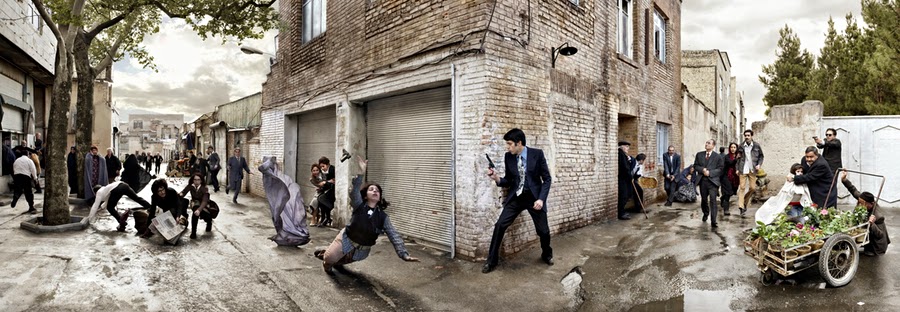
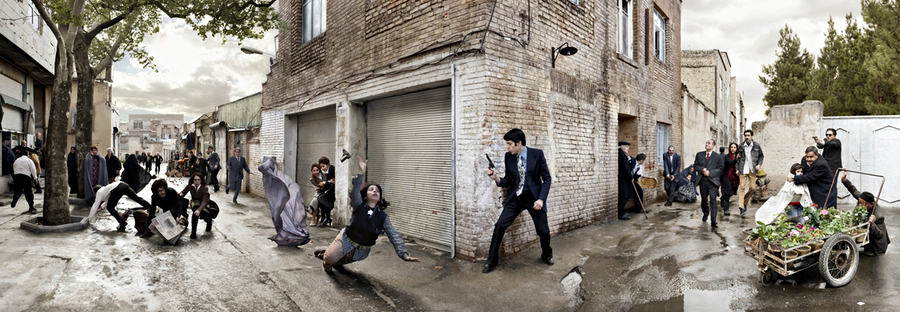
Azadeh Akhlaghi: the photographer who stages murders in Iran:
Akhlaghi recreates Iran's most notorious death scenes from the time before cameraphones, becoming an eyewitness to her nation's past. From the controversial poet who swerved her car to avoid a school bus and died in the process, to the mysterious end of Iran's beloved gold-medal wrestler, here's a selection of images from her astonishing series By An Eyewitness
 
Sean O'Hagan meets the Iranian photographer who is restaging infamous murders from her country's history
A restaging of the shooting of student activist Marzieh Ahmadi Oskuie by secret police (SAVAK). Tehran – 26 April 1974. Photograph: Azadeh Akhlaghi. Courtesy The Guardian.
by , The Guardian

In June 2009, a young philosophy student called Neda Agha-Soltan was shot dead by security forces in Tehran during protests against the Iranian elections. The death of Neda, an innocent bystander, was captured by several eyewitnesses on their mobile phones and swiftly posted online – becoming, according to Time magazine, "probably the most widely witnessed death in human history".

In death, Neda was transformed into a global symbol of the Iranian protest movement and an icon for the country's young. She also became the invisible – but powerful – presence in an ambitious conceptual art project by the Iranian photographer Azadeh Akhlaghi. "After the death of Neda," she says, "I started thinking about others who had died in tragic ways, but whose deaths had not been recorded because there was no camera present."

So began four years of research to create By An Eye Witness, a series that meticulously reconstructs 17 deaths from Iranian history using ordinary people and actors. It is one of the highlights of an exhibition of contemporary Iranian photography about to open at London's Somerset House. Entitled Burnt Generation (the name given to Iranians born between 1963 and 1980, who have lived through the social and political fallout of the overthrow of the Shah and the Iran-Iraq war), the show gathers the work of eight young photographers selected by Iranian-born curator Fariba Farshad.

"The work looks at the deep social effects of the long war with Iraq," she says, "as well as the sense of isolation and desolation felt by many young people in Iran. It reflects the contradictions of a society where there are deep tensions between traditional and contemporary culture, between urban and rural tradition, and between the older generation and a young, middle class who are increasingly expressing themselves through art and photography. One of the underlying questions is: how is this nation still united and functioning despite everything?"

Tuesday, 25 March 2014

Rare Glimpses of Iran’s Lost Underworld

An untitled photograph from Mr. Golestan’s 1975-1977 series showing some of the prostitutes who were confined to Tehran’s red-light district  known as the Citadel of Shahr-e No (New City), before the 1979 revolution. Kaveh Golestan, Courtesy Kaveh Golestan and NY Times.

by Elaine Sciolino, The New York Times

Kaveh Golestan was 52 on the bright spring day he died. He was killed in a minefield in northern Iraq in 2003 while working as a cameraman with the BBC.

Many journalists who encountered Mr. Golestan over his long career (including me) knew him as a hard-news photographer and cameraman. He was one of the finest chroniclers of the 1979 Islamic revolution that overthrew the shah of Iran, his native country; the nearly eight-year Iran-Iraq war; and Saddam Hussein’s gassing of the Kurds. His photographs of the revolution won him the Robert Capa Gold Medal.

What is less known is that in the years before the revolution, when Iran was still a Westernized monarchy, Mr. Golestan recorded in stark black-and-white the daily lives of Iran’s dispossessed. An exhibition of one of his most dramatic subjects — prostitutes confined to Tehran’s red-light district known as the Citadel of Shahr-e No (New City) — opens in the Foam Photography Museum in Amsterdam on Thursday and runs through May 4. The complete collection of 61 images will appear as part of a larger photographic, painting and film exhibition on Iran entitled “Unedited History: Iran 1960-2014,” at the Musée d’Art Moderne in Paris from May 16 to Aug. 24.

The Citadel was an old neighborhood of filthy alleyways in Tehran that was established in the 1920s as a red-light district to house scores of prostitutes. In the 1930s and 1940s, the neighborhood became a thriving sex quarter with rampant crime. Female prostitutes walked the streets seminaked. One of the side streets became famous for its young male prostitutes.

After the 1953 C.I.A.-led coup that reinstated the shah, the authorities walled off the area, turning it into a ghetto whose inhabitants were almost exclusively female prostitutes and their children; only men were allowed to access it through an iron gate.

By the 1970s, about 1,500 prostitutes worked, and most of them lived, in the Citadel. Their daughters often followed them into prostitution; their sons often turned to drugs. Sometimes men came for sex, sometimes to drink, do drugs, watch films or sightsee.

Wednesday, 5 March 2014

Iranian artist Shirin Neshat on art, politics and changing the world

Interview: Iran’s foremost female artist tells Art Radar how she uses art to explore fundamental human truths.

Shirin Neshat in her studio, 2014. Photo by Christine Lee. Courtesy Art Radar.

by Christine Lee, Art Radar

Iranian-born artist Shirin Neshat and Christy MacLear, the Executive Director of the Robert Rauschenberg Foundation, speak to Art Radar about the Foundation’s new One-to-One artist initiative, the current exhibition Our House is on Fire in New York City, and Neshat’s internationally acclaimed works on culture, gender and politics.

On 30 January 2014, New York visitors attended the opening of the exhibition Our House is on Fire, which showcased works by Shirin Neshat for the new One-to-One initiative. The project was created by the Robert Rauschenberg Foundation (RRF) to “support contemporary artists as they create work in the service of advancing human rights, cultural understanding, and international peacekeeping.”

The foundation selected Neshat as their first artist for this initiative. Known for photography, video installations and films on Islamic culture, religion and politics Neshat chose to travel to Cairo and conceive a new series of photographs depicting “personal and national loss” by Egyptians after the failed revolution for the initiative. The exhibition runs until 1 March 2014.

Rauschenberg’s legacy and how art can change the world


Could you tell Art Radar about the history of the Robert Rauschenberg Foundation? When was the Rauschenberg Project Space founded and for what purpose?

Christy MacLear [CM]: The Robert Rauschenberg Foundation was actually founded by Bob during his lifetime. The Foundation was one of many ways in which the artist was philanthropic – the others including grants he gave to artists in emergency needs, his advocacy for artist rights throughout his life, and his record of developing work to benefit causes such as the environment or social justice. After Bob’s death, the Foundation received the assets from his estate which expanded the role to now include: managing his artwork and legacy; fulfilling a larger philanthropic programme; and starting up a residency for artists of all disciplines on his estate in Captiva.

The Rauschenberg Project Space used to be a warehouse which stored artwork but sat largely under-utilised. We converted it from a warehouse into a project space in order to pilot a number of ideas, strategic directions, which the Foundation was considering as we were developing our programmatic plan for how to serve artists and our community best.

Saturday, 1 March 2014

Shirin Neshat on Kaveh Golestan’s Humanistic Portraiture

A portrait from Kaveh Golestan’s series of photographs of prostitutes in Tehran’s Citadel, 1975-1977. Courtesy of the Kaveh Golestan Estate, and T Magazine.

by Carol Kino, T Magazine The New York Times

Since the late ’90s, Shirin Neshat has been lauded for photographs, films and videos that explore the lives of Iranian women. Her first video, “Turbulent” (1998), featured a face-off between a male and a female singer in Islamic Iran, while “Women Without Men,” her 2009 feature film, focuses on the problems experienced by four women during the 1953 coup that brought the last shah to power. More recently, her work has addressed other countries in the Arab Spring, as in “Our House Is on Fire” (at Chelsea’s Rauschenberg Project Space, closing March 1), a group of poignant portraits of ordinary men and women in Cairo, survivors of the Egyptian revolution. “I wanted to humanize the people we think of as the other,” Neshat says.

One of her most powerful influences has been the renowned Iranian photographer Kaveh Golestan, who was killed in 2003 by land mines in northern Iraq while covering the war for the BBC. A veteran of conflicts from the Belfast Troubles to Saddam Hussein’s gassing of the Kurds, he won a Robert Capa Gold Medal in 1979 for his coverage of the Iranian revolution. He also pursued his own documentary projects, like the portraits of prostitutes he made from 1975 to 1977 in Tehran’s red-light district, a walled ghetto known as the Citadel of Shahr-e No. These 61 black-and-white prints show the women in every conceivable attitude, from confrontational and preening to dejected and cowering. They are among the few extant photographs of the Citadel, which was burned down by fundamentalists during the revolution, killing many of the women in Golestan’s pictures.

The series hasn’t been shown in public since 1978. But 45 images will soon go on view in “Kaveh Golestan: The Citadel” at the Foam Photography Museum in Amsterdam from March 21 to May 4. The full group will appear in “Unedited History: Iran 1960-2014,” at the Musée d’Art Moderne in Paris from May 15 to Aug. 24.

Wednesday, 12 February 2014

Persian Visions exhibition to shed new light on Iran

Bahman Jalali, Image of the Imagination series, 2002/7, Digital print on paper, 65 x 65 cm. 
by Tyler Murphy, The DePauw

Walking through the Persian Visions Exhibit in the Low Gallery of Peeler Art Center, visitors are invited to look at a less-explored side of Iran. High contrast prints and mysterious videos contrast the war-torn Iran the media shows with a more beautiful version.

The exhibition, which illuminates 20 Iranian artists and 58 original works of art, was made possible in part by the Ilex Foundation, the University of Minnesota McKnight Arts and Humanities Endowment and the Department of Art and Regis Center for Art at the University of Minnesota. These institutions have been working with DePauw University since February 2012 to bring the exhibit to campus.

Though the artists come from different parts of Iran, the works seem to flow as one consistent show that brings together black and white prints, color prints, video and audio elements.

Craig Hadley, curator of exhibitions and university collections, hopes the exhibit will shine a new light on Iran that many students are unaware of.

“For many Americans, our familiarity with Iran is colored almost exclusively by conflict, political instability and the threat of nuclear weapons,” Hadley said. “The photography and film in Persian Visions provides a completely different perspective on how we might come to try and understand life in Iran.”

The sound of a man walking over crunchy gravel can be heard throughout the high-ceilinged room, matching the footsteps of those observing the pieces.

Many of the works feature high-contrast black and white colored pieces such as those by artists Ebrahim Khadem Bayat and Koroush Adim.

 Their pieces feature up-close views of Iranian people, as well as panoramic views of urban landscapes. Their works also overlap different photos to create multi-layered prints.

Saturday, 18 January 2014

Recalling The Future

Post-revolutionary Iranian art at the SOAS
Masoumeh Mozaffari’s ‘Table’. Courtesy Financial Times.

by Gareth Harris, Financial Times

After a long political freeze between Iran and the UK, a cultural entente is quietly under way in London with the launch of Recalling the Future: Post-revolutionary Iranian Art, at the School of Oriental and African Studies (SOAS). Four curators including Hamed Yousefi, an Iranian culture critic, and David Hodge, a London-based art historian, have presented trends, ideas and techniques shaping the Iranian art scene today through the works of 29 established, emerging and late artists.

The 1979 revolution, which overthrew Mohammad Reza Shah Pahlavi, the country’s last royal ruler, provides the provocative impetus for the show. Participating artist Mahmoud Bakhshi says that his generation are often referred to as “children of the revolution”, adding that the tumult of 1979 presents “a rupture point not just for the art history of Iran but for the society at large”.

Most of the artists are based in Iran. “The [Iranian] diaspora is part of an international world scene,” says Hodge, pushing the point that artists located outside Iran are trained differently, living and working in different circumstances. Pivotal and populist art market darlings such as Farhad Moshiri (his crystal-encrusted “Eshgh (Love)” assemblage from 2007 fetched $1m at Bonhams Dubai in 2008) are noticeably absent. Hodge emphasises that the exhibition “is not an all-encompassing survey of Iranian artists”.

“The artists all reject the idea that ‘Iranian-ness’ is a single, fixed identity that remains the same throughout history,” he adds. The press blurb goes even further, boldly claiming that “the work [on show] calls for a complete rethinking of modern Iranian art history”.

Saturday, 4 January 2014

Iran’s Reinvention Through Modern Art

Rana Javadi, “Breaking into the Police Station. 32 Brahman 1357 (February 12, 1979)”, (1979), gelatin silver print, 20 x 24 in. (50.8 x 61 cm). Private Collection, courtesy of Rana JavadiNicky, Asia Society and Hyperallergic.

In the history of civilization, Iran plays one of the starring roles, not only because of its geography at the crossroads of many empires, its ancient and largely uninterrupted history to the modern day, but also because it is a dynamic multicultural civilization that has produced some of the world’s most outstanding art. Yet, within the last few decades the reputation of Iran has been tarnished and distorted by a fundamentalist revolution in 1979, and a former leader who used the insane denial of the Jewish Holocaust as a dangerous political football. What we’re faced with today when looking at Iran is a country in transition, slowly morphing from a nation lead by a very conservative leadership to a slightly more liberal one, but a nation, nonetheless, that is still hampered by extensive trade sanctions from Western governments that have largely failed to topple a regime they don’t like.

Asia Society’s Iran Modern is a fascinating exhibition that begins in 1948 and ends with the 1979 Revolution (with a noticeable focus on the latter decades), and the show is a must-see exploration of a period little known in the West but infinitely interesting for numerous reasons, including its non-Western responses to modernity, the prevalence of prominent female artists at a time when the same wasn’t true most elsewhere, and its pushing of boundaries in an era where its experiments in culture could be seen as cutting edge.