Thursday, 29 May 2014

The Iranian Kerouac: Ali Eskandarian and the great punk Beat novel

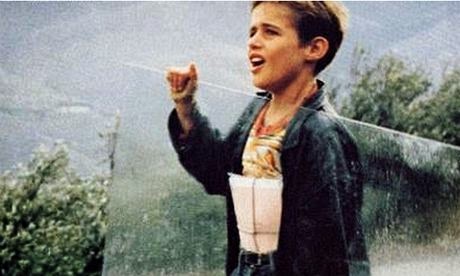
Singer Ali Eskandarian was gunned down in New York last year with members of punk band the Yellow Dogs. He had just written Golden Years, an On-the-Road style novel that's now being hailed as a cult classic


The year before he was murdered, alongside two members of the rock band the Yellow Dogs, the Iranian-American singer-songwriter Ali Eskandarian wrote to the man he hoped would become his publisher. He was working on a novel about someone like himself, he explained – "immigrant, war child, rock'n'roller, artist trying to live in a modern world he finds infuriating/exhilarating". There was, he promised, "an insurgent political bent to the writing, also lots of sex, drugs and rock'n'roll". And there were "characters very similar to the Yellow Dogs" because he "lived with the Dogs for almost two years and we got to have some fun".

"I think it could be the great Iranian-American novel, or at least that's what I'll call it until someone proves me wrong," he finished.

The killings in New York last November of Eskandarian, 35, and brothers Arash and Soroush Farazmand echoed around the world. Ali Akbar Mahammadi Rafie, a fellow musician whose relationship with the band had "frayed", as the New York Times put it, climbed into their Brooklyn home and shot the men with an assault rifle, before killing himself.

The Yellow Dogs had fled from Tehran to New York in 2010, wanting to be able to play their music freely. In Iran, according to a US state department cable released by Wikileaks, they were part of Tehran's "small but crazy" underground club scene. In the US, they were "building a national following with [their] furiously intense post-punk", in the words of Rolling Stone.

Eskandarian, who lived in the flat above the brothers in East Williamsburg, grew up in Tehran before moving to Dallas with his family as an adolescent. He'd released an album, Nothing to Say, on Wildflower Records, and toured the US with the Yellow Dogs. He was also, it turns out, writing that semi-autobiographical novel, Golden Years.

Wednesday, 28 May 2014

Iranian art in Dubai

Shiva Balaghi in conversation with Stephanie Bailey
Art Dubai 2014: Global Art Forum 8

by Stephanie Bailey, Ibraaz

In March 2014, Ibraaz and the Kamel Lazaar Foundation launched an online media partnership with Art Dubai 2014 for the eighth iteration of the Global Art Forum.  

In this exclusive interview from Art Dubai, Ibraaz Managing Editor Stephanie Bailey talks to Shiva Balaghi, a scholar in Iranian cultural history, about Balaghi's work with the collection of Mohammed Afkhami and the practice of collecting Iranian art.

Stephanie Bailey: We are here with Shiva Balaghi, a scholar in Iranian cultural history who has just spoken at the Global Art Forum on her work with the collection of Mohammed Afkhami. Shiva, one thing I wanted to ask you about was the notion that you put forward: the collection as an archive. I wanted to ask you how this then relates to what you said about Mohammed Afkhami’s collection having the potential to show an alternative Iranian history.

Shiva Balaghi: Well, Mohammed has been collecting Iranian art in Dubai now for a decade, and he is particularly interested in Iranian politics and Iranian history, so in his collection he tends to gravitate towards those types of works of art. This book that Venetia Porter and I are writing about his collection – and the talk today was a little preview of that – really takes his collection as an archive of Iranian history, and says: what are the moments that Iranian artists from the 1960s to the contemporary period think are important? How do these artists reflect that history? And how does that history manifest itself in their artwork? So we really think of the art collection as an archive that presents an alternative history of Iran.  

SB: This leads on quite nicely to a date that you mentioned in your talk, 1962, which was the year that the Museum of Modern Art (MoMA) acquired – was it two works?

Thursday, 22 May 2014

Persian classical music mourns a master

The death of virtuoso Mohammad Reza Lotfi marks the end of an era.
Shajarian and Lotfi, Shiraz Art Festival, 1976

The recent death of Iranian master musician Mohammad Reza Lotfi (1947-2014) on May 2 at the age of 68 marks a crucial turning point in the history of classical Persian music and its spectacular rise and fall as a performing public art. 

Lotfi was a Tar and Setar virtuoso who had collaborated with prominent Iranian vocalists Mohammad Reza Shajarian, Shahram Nazeri, and others and along with a handful of other master musicians of his generation had transformed Persian music from its slumbering, sedate and secluded courtly and mystical milieu into a massive scale public and vastly popular art form. It is impossible to imagine the social history of Iran of the last half a century and through the thick and thin of a cataclysmic revolution and a bloody war without thinking of the definitive presence of classical Persian music as reconceived by Lotfi's generation of master musicians. 

Mohammad Reza Lotfi was part of a generation of classical musicians who exponentially expanded the public sphere upon which Persian classical music found and performed itself. This proud possession of a rich and diversified culture entered the public sphere in earnest in the course of the Constitutional revolution of 1906-1911, and with the establishment of Tehran Radio in 1940s and subsequently Iranian National television in 1960s and the Shiraz Art Festival in the 1970s reached its spectacular zenith.

Today lovers of Persian music remember the young Lotfi and Shajarian and their fellow musician Naser Farhangfar's confident and ambitious visages from their legendary performance of the tasking Rast Panjgah scale in Shiraz Art Festival in 1975. From that iconic moment at the mausoleum of Hafez in Shiraz Persian classical music began a long and loving rendezvous with contemporary Iranian social history.

Saturday, 17 May 2014

Black Hand, Iran’s Underground Banksy

Black Hand condemns the hunting of the endangered Persian leopard with colours of the national flag.
Courtesy IranWire.
by Ayeda Nik Farjam, IranWire

Graffiti is not only an ancient and controversial way of conveying a message to the public but also a continual contest between  the sender of the message and those who do not wish the message to be heard.

The messages on the walls of the Islamic Republic are not exception. State-sponsored graffiti covers many buildings and walls in Tehran and other cities, but the government is unwilling to cede any urban space to anything it has not produced itself, let alone messages that directly challenge its authority. Spray paints and markers however have made the battle less unequal.

In April of this year a street artist who goes by the pseudonym “Black Hand” held an exhibition of his work in an old house in central Tehran. The property was under the protection of the Historical Preservation Society for its unique architecture but the authorities concluded that it was too small and decided to tear it down, presumably to make space for a new development.

Black Hand’s signature tag becoming familiar in Tehran, and his work often pops up in various corners of the city. He chooses his locations cleverly so that his graffiti can be seen immediately and people record the sight on their mobiles before the city workers arrive with their paint cans.

Black Hand’s exhibition uses the rooms in the condemned but beautiful house to explore the social themes that engage him.

For example in one of the rooms, called the Shirin (sweet) room, every object is printed endlessly with its own name, the sofa, the framed painting, the table, the cigarette box, the lighter and the dresser, and a harsh strobe light completes the nightmare. Black Hand seems to suggest that we live in a society where everything introduces itself by labels with no regard for content and meaning. As in the famous painting by Belgian painter René Magritte, The Treachery of Images, in which a pipe is labeled “This is not a pipe”, a dresser can easily be not a dresser and even the house can be a piece of land destined to become a high-rise. In contemporary Iran the label can be changed quickly and the form can remain without content.

Monday, 12 May 2014

Unedited History: Iran 1960-2014

Poster: © Aria Kasaei {StudioKargah}. Courtesy MAM.
From 16 May - 24 August 2014 the Musée d'Art Moderne de la Ville de Paris presents UNEDITED HISTORY, Iran 1960-2014 at ARC, the museum's research and exhibition area. Comprising over 200 works for the most part never shown in France before, the exhibition brings a fresh eye to art and visual culture in Iran from the 1960s up to the present. Its survey of the contemporary history of the country is arranged in sequences: The years 1960-1970, the revolutionary era of 1979, the Iran-Iraq war (1980-1988), and the postwar period up until today.


Bringing together twenty artists from the years 1960-1970 and representatives of the new generation, the exhibition focuses on painting, photography and cinema, as well as key aspects of Iran's modern visual culture: posters and documentary material ranging from the Shiraz-Persepolis Festival of the Arts to the revolutionary period and the Iran-Iraq war.


Whether already historic figures (Bahman Mohassess, Behdjat Sadr, Kaveh Golestan, Bahman Jalali) or members of the contemporary scene (Barbad Golshiri, Arash Hanaei and others), all the artists base their work on a critical approach to form and media. Down the generations, they have played their part in a reassessment of the way the political and social history of their country has been written. The exhibition and its accompanying book invite us to broaden our perception of Iran and its modernity.


Artists on show: 

Morteza Avini (1947-1993), Mazdak Ayari (né en 1976), Kazem Chalipa (né en 1957), Mitra Farahani (née en 1975), Chohreh Feyzdjou (1955-1996), Jassem Ghazbanpour (né en 1963), Kaveh Golestan (1950-2003), Barbad Golshiri (né en 1982), Arash Hanaei (né en 1978), Behzad Jaez (né en 1975), Bahman Jalali (1944-2010), Rana Javadi (née en 1953), Khosrow Khorshidi (né en 1932), Bahman Kiarostami (né en 1978), Parviz Kimiavi (né en 1939), Ardeshir Mohassess (1938-2008), Bahman Mohassess (1931-2010), Morteza Momayez (1935-2005), Tahmineh Monzavi (née en 1988), Mohsen Rastani (né 1958), Narmine Sadeg (née en 1955), Behdjat Sadr (1924-2009), Kamran Shirdel (né en 1939), Kourosh Shishegaran (né en 1944), Behzad Shishegaran (né en 1952), Esmail Shishegaran (né en 1946).

Archaeology of the Final Decade presents Festival of Arts, Shiraz-Persepolis and Kaveh Golestan - Shahr-e No

Thursday, 8 May 2014

The Design Poet

From Tehran to New York and now Dubai, Iranian artist Shirin Ehya talks to Rima Alsammarae about how jasmine trees and crisp autumn nights inspired her first furniture collection, Isfahan.
Diyar (bench) by Iranian designer Shirin Ehya, 2013, 130 x 40 x 45 cm. Description: This very sleek and elegant bench has been manufactured from wood and Persian toreutics on copper (ghalam) with high gloss lacquer finish. The intricate metal works have been carried out by a master coppersmith in Isfahan under the supervision of Shirin Ehya. Courtesy J+A Gallery.
by , DesignMENA

Born in Tehran in 1984, it would be 18 years until Shirin Ehya left her country to study in the United States at the renowned Interior Designers Institute in America. Upon graduation, she was offered the opportunity to work with the Design Bureau of Tony Chi & Associates in New York, where she would spend the following several years working on projects around the world from New York, to China, to Australia.

In 2010, Ehya left New York and returned to Iran, where she began working on various retail projects. Upon her return after a long hiatus, she immersed herself in Iranian culture and found herself attracted to the sweet balance between contrasts commonly found in Iranian art.

It wasn’t long until she formed her first furniture collection, which happened organically rather than as a planned step forward.

Isfahan, named after the artistically driven town of its namesake, is a collection of contemporary furniture pieces that infuse subtle elements of Iranian culture. Available at J+A Gallery in Dubai, the Isfahan collection is powerful, dynamic and artistic.

With so many contemporary designers and artists attempting to fuse juxtaposing cultures into their designs, we wondered how Ehya managed to do so seamlessly.

Raised in Iran with a western education provides an interesting backdrop to approaching the designer’s work. And when it comes to Ehya, it seems we must go to the way, way back if we want to know her story, because as she thinks of her childhood, Ehya’s face grows into an undeniable smile. It’s a childhood filled with scents and colourful visions.

Friday, 2 May 2014

Mohammad-Reza Lotfi

A silence has fallen now Lotfi has gone, but only till the next time we listen to his music, which is where he has always lived. 


Thursday, 1 May 2014

Art's 'Meeting Point'

The Leila Heller Gallery Opens a New Space on 57th Street
One of the rooms in Leila Heller's new 16,000-square-foot, six-floor art gallery. Photo by Keith Bedford, courtesy The Wall Street Journal.

For almost 30 years, Leila Heller ran her gallery from the Upper East Side, making a name for herself as an art dealer and for her support of emerging and midcareer Middle Eastern artists, before setting up shop in 2010 on a gallery-lined stretch of West 25th Street.

Now, Ms. Heller is returning uptown with a 16,000-square-foot, six-floor space in Midtown Manhattan that she will operate in addition to the Chelsea location. The new gallery will open on Tuesday, with an inaugural exhibition on portraiture that will run through August.

"It's been my whole life," said Ms. Heller of being uptown. "I always knew I was going to go back."

The new location on West 57th Street will be headed up by Thomas Arnold, who spent 14 years as director of Mary Boone Gallery's locations in Chelsea and Midtown before leaving in 2012 to set up his own consulting firm.

The exhibition, titled "Look at Me … Portraits: Manet to the Present" is organized by Ms. Heller as well as Paul Morris, the founding director of the Armory Show, and Beth Rudin DeWoody, a curator and collector who has worked with the gallery in the past. It will include works by more than 170 artists, including Edgar Degas, Henri Matisse, Pablo Picasso, Andy Warhol, Jean- Michel Basquiat and Shoja Azari, an Iranian-born filmmaker and artist whose work featured in Ms. Heller's Chelsea gallery last year.

Tuesday, 29 April 2014

Music and Power in Iran: An instrument of propaganda and control

In her essay, Maria Koomen examines the important role played by music in the history of Iran, in particular since the Islamic revolution of 1979
Mohammad Reza Shajarian, middle, performs with Mojgan Shajarian, 2nd left, and Majid Derakhshani composer, 2nd right, during a concert with Shahnaz Ensemble band in Dubai, United Arab Emirates, Thursday, Feb. 17, 2011. The concert ends with about 2500 audience chanting anti Iran's government slogans. (AP Photo/Kamran Jebreili). Courtesy Qantara.
by Maria Koomen, Qantara

The permissibility of music has been contested in Iran since the onset of Islam in the seventh century AD when Muhammad passed and his companions sought to keep men's minds away from malahi (forbidden pleasures): wine, women and song. While the Koran doesn't condemn music per se, it claims that music can lead to a loss of reason resulting in "uncontrollable behaviour" and an "inflammation of passions".

After the Prophet's death, Islamic purists began to collect his sayings, or hadith. One ancient hadith says: "Listening to music leads to discord, just as water leads to the growth of vegetation." Hadith were then used by legists to effectively forbid music, save that tolerated by Muhammad. Music in Iran was to uphold these Islamic standards and abide by the Islamic moral code established by the Koran and the hadith.

However (in)compatible it may be with Islam, music is deeply rooted in the country's rich and diverse history. In addition to the practice of halal (compatible) music, Iranians have historically maintained the practices of makruh (blameworthy yet tolerated) and haram (incompatible) music.

Before the advent of music reproduction and other information communication technologies (ICT), music – underground or not, halal or haram – was confined to physical locations in real-time, historically controllable by authorities with centralised power in a physically and temporally confined country.

Friday, 25 April 2014

Diverse themes characterize UCLA Celebration of Iranian Cinema

'The Snow on the Pines,' about a piano teacher who discovers her husband's affair, opened the UCLA Celebration of Iranian Cinema.
Bending the Rules (Iran, 2013) is part of the UCLA Celebration of Iranian Cinema. Courtesy UCLA Film & Television Archive.
by Saba Hamedy, Los Angeles Times

Tumultuous marriages, father-son relationships and film censorship are just three of the themes explored in the 12 Iranian films featured at this year's UCLA Celebration of Iranian Cinema.

Beginning Thursday (April 24), the series will show the films at the Billy Wilder Theater at the Hammer Museum in Westwood Village through May 14. Four of the screenings will be accompanied by Q&As with the movies' directors.

Iranian cinema is "one of the most exciting on Earth," said Paul Malcolm, programmer at UCLA's Film & Television Archive, which presents more than 200 professionally curated public screenings each year.

The Iranian series opened with "The Snow on the Pines," a 2013 film directed by Payman Maadi, the star of the Academy Award-winning foreign film "A Separation" who spoke following the screening.

Shot in black and white, the 92-minute film follows an Iranian piano teacher who finds out that her husband has been hiding an affair. The well-received film took home audience favorite at the Los Angeles-based Noor Iranian Film Festival in October.

Wednesday, 23 April 2014

Political landscapes, personal details

A photograph from Gohar Dashti’s “Volcano” series, 2012. Courtesy Robert Klein Gallery and Boston Globe.
by Cate McQuaid, Boston Globe

Iranian photographer Gohar Dashti was born in 1980, in the midst of conflict. The Iranian Revolution had occurred the year before. The Iran-Iraq War began in 1980, and lasted eight years.

Dashti’s carefully constructed color photographs reflect the societal tensions she grew up with. Her show at Ars Libri, presented by Robert Klein Gallery and collector Azita Bina-Seibel, is filled with telling dissonances.

The title for Dashti’s “Volcano” series comes from the percolating threat of active and semi-active volcanoes in the region, which can be taken, too, as a metaphor for war. People laugh and enjoy life, but there’s something awry: The rough tail of a giant reptilian beast curls out from a hidden place, suggesting a sleeping giant.

One of the series takes place at an art gallery. A man and woman lean together in the center, giggling over a folded paper bird he holds. Others look to them, or gaze at the art, except for one man, wearing a red motorcycle helmet and facing away from everyone else. There, behind his feet, is the tail, lolling out a doorway. The beast is just in the next room.

For “Me, She, and the Others,” Dashti photographed individual women dressed for work, for home, and for a night out. Each image features all three shots, with the woman looking straight at us, without expression. The clothes do all the talking.

Thursday, 17 April 2014

Poetry of protest gives view into distant worlds

by Maya Weeks, Index on Censorship

A few weeks ago, 13,000 writers swarmed Seattle for the annual Association of Writers and Writing Programs conference. In the seaport city known for its ideal reading (and writing) weather — and home to poet Maged Zaher – writers filled hotel rooms and bars. On official panels they debated the state of contemporary literature, and at offsite readings and parties, they celebrated the written word.

The song of the nightingale / Is not up for sale
Ziba Karbassi, Gravequake

On the other side of the hemisphere, Ziba Karbassi doesn’t need to attend a conference to know what contemporary literature looks like. Born in 1974 in Tabriz, Iran, this rising star of Persian poetry, who also writes in her first language of Azeri Turkish, has been living in exile in London since leaving her country in 1989. Karbassi has published eight books of poetry in Persian, and with Stephen Watts, she has translated much of her work into English.

Taken from an incident close to the author’s family in the 1980s, her poem “Death by Stoning” depicts a young pregnant woman taken to prison, tortured, and stoned to death:

I am not a scaffold to be toppled
not a felled tree to be sunk in the flood

I am only a bag of bones and skin
smashed about


The heavy consonants in the nouns and adjectives and the scattered form of the poem demonstrate the mother-to-be’s “anguished, loving, and crazed” state of mind. “Death by Stoning” shows how poetry can give us a view into worlds distant from — but not entirely unlike — our own. Poetry can also play a part in shaping our world.

Tuesday, 15 April 2014

Picture This: The secret meaning of Iranian photographs

Sadegh Tirafkan, "Untitled" from the Endless series, 2009 digital photo collage. Courtesy The Estate of Sadegh Tirafkan and The Huffington Post. The images communicate something sexual and at the same time violent," says curator Abbas Daneshvari, "but it's rather difficult for a system to see it as purely sexual and the violent aspect, of course, isn't something that they would object to."
by , KPCC

When you're an artist in Iran, you live a harsh reality.

Make a politically subversive sculpture and you're censored. Create a painting that challenges religious norms and you're censored.

But a new art exhibition showcases how Iranian photographers are able to create images into social and political commentary that fly under the radar.

"The government of Iran is a religious theocratic government. And therefore it controls every facet of creativity in Iran," says Abbas Daneshvari, curator of a collection of Iranian photography at the Fine Arts Gallery at Cal State Los Angeles.

"[But artists] have arrived at the point that they can express themselves in symbolic and metaphoric terms wherein it's rather difficult to decipher their messages."

For example, "Untitled" is a photo collage of two men who look like they're locked in a bloody fight. However, one could also say they're drawn together in a passionate embrace. The image is by Sadegh Tirafkan, who is gay.

"The images communicate something sexual and at the same time violent," says Daneshvari, "but it's rather difficult for a system to see it as purely sexual and the violent aspect, of course, isn't something that they would object to."

Monday, 14 April 2014

Not so secret salsa nights in Tehran

In the posh neighborhoods of the Iranian capital, things are happening behind closed doors. Among a tightly-knit group of youth, dancing is the new thing.
Salsa is happening in Tehran © Your Middle East
by Lana Olinik, Your Middle East

This warm February evening we were walking down the streets in one of the areas in Shahrak-e Garb, a district in northwest Tehran, known for it’s “modernity” and readiness to embrace gharbzadegi – so called “poisonous influence of the West” – as well as some sort of self-imposed isolation from less fortunate areas of Tehran.

You can only guess what’s going on inside those compounds. Outside one home, a girl in colorful rusari, barely covering her long brown hair, and in loose manto, turned around as we rang the doorbell. “Eh, you came to dance too, right? I’m here for the first time,” she said.

Familiar vibes of passionate Latin dance reached us as soon as we went out of the elevator. The doors were open. Armchairs and sofas has been removed or placed near the walls to create an open space for dancers. Unlike similar events outside Iran, the room was full of light and that atmosphere of intimacy and relaxation, common for salsa evenings elsewhere, was gone. Those most daring danced while others just watched.

A limited choice of drinks (vodka, whiskey or aragh – drinks which are the easiest to order from dealers of this forbidden pleasure in Iran) was put on a table in the corner of the room. From time to time, dancers or those who watched them would come to the table and pour themselves some vodka or aragh, mixed with juice or tonic.

Unlike a few years ago, parties like this one are less vulnerable to possible police intrusion – on the condition that young people keep the volume and noise on a reasonable level, and refrain from wild patio discos on the top floors. Before, however, police would raid any house, even in securely guarded residential complexes around Shahrak-e Gharb. But nowadays everything seems relatively calm. I noticed some people across the street having a loud party in the courtyard of the heavily protected mansion while “green” (crime) police, who were stationed just in the top of Iranzamin street seemed to pay very little attention to such “deviant” behavior.

Sunday, 13 April 2014

Shining a light on inner conflicts

"Darband" and "Sar be Mohr" are two new Iranian films that offer profound insights into the lives of young urban Iranians, highlighting their inner conflicts and the turmoil that is tearing many of them apart. Massoud Schirazi went to see both films in Teheran
Darband. Courtesy Qantara.

Iranian films have long been popular in Europe among fans of innovative international world cinema. These films, such as Asghar Farhadi's successful drama "Nader and Simin", are regularly lauded for their authentic portrayal of life's realities. Many Iranian films have become successful abroad because of their critique of society, although this critique can sometimes seem quite stereotypical – for example when it comes to addressing the situation of women in the Islamic Republic.

Yet to this day, there are plenty of worthwhile Iranian films that don't win awards at international film festivals. Two of them, which were shown in Teheran cinemas last winter, deal with subjects that have not received much attention to date: the clash of Western and Iranian cultures and the inner turmoil of many young Iranians.

In Teheran, the word "Darband" stands for fun, a party atmosphere and a taste of freedom. It is the name of the canyon on the northern edge of the city that is a favourite socialising spot for couples, hip Teheran cliques and young families. It is also the name of a film made by Parviz Shabazi, a previously relatively unknown director who won the "Crystal Simorgh" at Iran's Fajr film festival last year for this film.

Contrasting lifeworlds

"Darband" is a carefully staged drama that centres around a young female student who moves to Teheran after completing school. Naznin was born and raised in the country, only 80 kilometres away from the city, and yet hers is a very different world. When she finds out that the university students' residence has no spaces left, she rents a room in the apartment of a Teheran perfume saleswoman.

Saturday, 12 April 2014

The Cinema of Childhood

Willow and Wind: a prose-poem of a film. Directed by Mohammad-Ali Talebi, 1999. Courtesy  The Guardian

The most famous fictional character in the world in the last generation was a child, Harry Potter. When the films of JK Rowling's books came to be made, they helped define a new type of CGI fantasy cinema. In the era of the camera phone, children are being filmed more than ever before, by their relatives and friends. A vast digital visual archive of childhood is being created. And yet, in our same era, we are more wary of filming other people's children than ever before. Images of childhood are escapist, multiple, personal and contested.

But beyond the fantasy child, the everywhere child, and the policed image of children, we are living in a golden age of films about children, and haven't quite noticed. Movie directors in Iran, Japan, the UK, Holland and elsewhere are releasing masterpieces about childhood. Why is this golden age happening, and why does it matter?

In the era of the Hollywood studio, child actors like Shirley Temple and Mickey Rooney, both of whom died recently, gave plucky, stylised, showbiz performances. Shooting in a studio, they were surrounded by scores of technicians, large cameras and forests of light stands. Under such circumstances it was hard for a kid to behave naturally. They had to be highly directed, puppeteered almost.

In recent decades, by contrast, the radical miniaturisation of shooting equipment has meant that child performers can be far less intimidated by the movie making process. Of course the Harry Potter movies are still big studio production numbers, but in smaller budget movies, children can be filmed anywhere, with few people behind the camera and no light blasting them. As a result of this, child performances in films like Clio Barnard's recent The Selfish Giant have become more honest; young characters have more agency than at almost any other time in the history of the movies. Children are ad-libbing in front of the camera more, and, in a string of masterpieces made in Iran, improvising. In this golden age of children's cinema, the movies feel as if they are being co-directed by the child and the filmmakers.

Wednesday, 9 April 2014

Atrocities revisited: conflict and cruelty in Iran

Azadeh Akhlaghi: the photographer who stages murders in Iran:
Akhlaghi recreates Iran's most notorious death scenes from the time before cameraphones, becoming an eyewitness to her nation's past. From the controversial poet who swerved her car to avoid a school bus and died in the process, to the mysterious end of Iran's beloved gold-medal wrestler, here's a selection of images from her astonishing series By An Eyewitness
 
Sean O'Hagan meets the Iranian photographer who is restaging infamous murders from her country's history
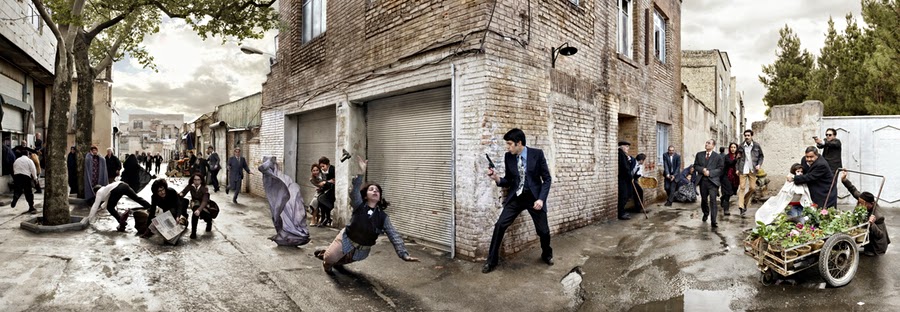
A restaging of the shooting of student activist Marzieh Ahmadi Oskuie by secret police (SAVAK). Tehran – 26 April 1974. Photograph: Azadeh Akhlaghi. Courtesy The Guardian.
by , The Guardian

In June 2009, a young philosophy student called Neda Agha-Soltan was shot dead by security forces in Tehran during protests against the Iranian elections. The death of Neda, an innocent bystander, was captured by several eyewitnesses on their mobile phones and swiftly posted online – becoming, according to Time magazine, "probably the most widely witnessed death in human history".

In death, Neda was transformed into a global symbol of the Iranian protest movement and an icon for the country's young. She also became the invisible – but powerful – presence in an ambitious conceptual art project by the Iranian photographer Azadeh Akhlaghi. "After the death of Neda," she says, "I started thinking about others who had died in tragic ways, but whose deaths had not been recorded because there was no camera present."

So began four years of research to create By An Eye Witness, a series that meticulously reconstructs 17 deaths from Iranian history using ordinary people and actors. It is one of the highlights of an exhibition of contemporary Iranian photography about to open at London's Somerset House. Entitled Burnt Generation (the name given to Iranians born between 1963 and 1980, who have lived through the social and political fallout of the overthrow of the Shah and the Iran-Iraq war), the show gathers the work of eight young photographers selected by Iranian-born curator Fariba Farshad.

"The work looks at the deep social effects of the long war with Iraq," she says, "as well as the sense of isolation and desolation felt by many young people in Iran. It reflects the contradictions of a society where there are deep tensions between traditional and contemporary culture, between urban and rural tradition, and between the older generation and a young, middle class who are increasingly expressing themselves through art and photography. One of the underlying questions is: how is this nation still united and functioning despite everything?"

Wednesday, 2 April 2014

Minoo Emami: An Iranian Artist on War and Its Victims

Minoo Emami, 120x80, 1998. Courtesy of the artist.
by Emma K.A. Rogge, The Harvard Crimson

“I would like to share the story of two best friends studying architecture at Tehran University in the 1980s. They enjoyed their life, they were active as Social Democrats in the [Iranian] revolution…. In the first month of the revolution, the Iran-Iraq War started, and both were sent to the front to fight for their country. Within six months, both of the friends were injured in battle; and each of the men lost a limb. When I was 18, I married one of them.” Minoo Emami, an Iranian visiting artist, narrated this story at the beginning of a discussion of her work Thursday at Arts @ 29 Garden, explaining how her personal experience of the Iran-Iraq War has inspired her art. War was a universal experience for Iranians who lived through it, Emami said: “Friends, neighbors, relatives; everyone I knew had somehow been impacted. I never expected that my husband [would be] a casualty of war. Many people in my country experienced this violence and it continues to be part of our lives.”

Emami’s paintings, part of a series called “The Monuments,” are arresting, each depicting a prosthetic limb in stark relief against a pitch-black background. Explaining her choice to focus on the artificial leg, Emami said, “For the last 15 years, I have been working on a series of paintings focusing on the physical, emotional, and mental damage [war] causes. The damage is symbolized by an artificial leg.” Each painting is differentiated by some element of what the amputee has lost to the war beyond the amputated leg. A haunting woman’s face within the leg represents a woman who has lost her beauty and will now never be married. A swirling hemorrhage from the prosthesis in another painting is indicative of a woman’s miscarriage due to a landmine. Another leg, with a slender, disembodied wrist wrapped around it, conveys that the soldier whose limb was lost will now never experience his lover’s touch. Landmines saw extensive use in the Iran-Iraq War, to the extent that Iran’s government had to build a central prosthesis factory in Tehran. In her talk, Emami emphasized how strongly artificial limbs remind her of the war’s impact on her country: “It isn’t just about my husband. It can be anyone.”

Exchanging culture: Iranian rhythm meets British sound

Sound artist Soosan Lolavar uses music to encourage a cultural collaboration between British and Iranian artists and audiences
Image courtesy of IAM.

I launched Stay Close because I wanted to foster an artistic exchange between Iran and the UK. The yearlong project will result in a new piece of music that considers ethnic identity through the lens of the British-Iranian community.

Stay Close began with my trip to Iran in July last year. I met with composers at Hermes Records, a Tehran-based label that releases cutting edge music by homegrown artists. During my time there, I learnt a great deal about the practicalities of Iranian music – for instance the use of fluctuating microtones, the role of melody types called ‘dastgah’, how rhythmic cycles are built and the important role of the soloist in the ensemble.

More broadly, I discovered a genre of sorts in which musicians regularly draw from both Iranian and Western classical music in their work, and in doing so, they consider and explore their identity as Iranians.

On my return to London, I led a series of workshops at IYDA (Iranian Youth Development Association), a community group for Iranian diaspora and migrant Farsi-speakers in South-East London.

Participants, ranging from four to 70 years old, were encouraged to consider their British-Iranian identity through sound, language and performance, using the Iranian children’s story The Little Black Fish as a starting point. Through these sessions it became clear that IYDA members were highly creative and had a strong affinity with music, as is common in Iran. However, in general they rarely attended mainstream arts events and were particularly disengaged with classical music in the UK.

These research periods were the starting point for a new work that would bring together Iranian and Western musical styles. I formed an ensemble, including Iranian and Western classical musicians from London Philharmonic Orchestra and Nava Arts, and encouraged them to stretch the boundaries of their own musical practice.

Tuesday, 1 April 2014

Festival of Iranian short films connects a fragmented people

Annual LA event tries to promote Iranian heritage 
Kajart at work in their studio Photograph: /Kajart. Courtesy Guardian.
by for the Tehran Bureau, Guardian

“I really hate to talk about politics,” said Kajeh Mehrizi, one of the four principals of the Toronto-based Kajart arts collective. Sporting a dapper mustache, he was every inch the artist doing his polite best to overcome an introverted nature and answer the questions of an inquisitive Afghan.

We were at the Los Angeles County Museum of Art, where Kajart were declared winners of the Sixth Farhang Foundation Short Film Festival held earlier this month. Mehrizi and one of his colleagues – Taravat Khalili, a beautiful, reticent and soulful young woman – had told me that they had spent half of their lives in Iran and the other half in Canada. When I asked Mehrizi if he had returned to Iran since moving abroad, he said yes. But when I inquired what the experience was like, he clearly didn’t want to go into detail.

Kahlili was more forthcoming. She fought back tears as she recalled her trip to Iran two years earlier. “You know what it’s like,” she said. “People are angry about the sanctions and perpetually in a bad mood.” It was clear that the return had been bittersweet.

Kajart’s prize-winning animated short, Aghaye Past (Mr. Mean), addresses the misogynist patriarch, that cultural archetype that has haunted many an Iranian family through the generations. In this deeply spooky film, we see the patriarch’s son leave home at night, kerb crawling in Tehran’s red light district and picking up prostitutes in his car. We see that the effect of misogynistic abuse is neither confined within the family nor the mark of a particular generation. It’s an infectious disease that makes the whole society sick.

Sunday, 30 March 2014

Iranian Americans unite, share culture for New Year celebration

Iranian New Year, Nowruz, celebrates spring and nature's rebirth, bringing L.A.'s Persian community together to share its tradition.

Dancers dressed in traditional Persian garments are surrounded by celebrants during an Iranian New Year celebration at the Los Angeles County Museum of Art. (Christina House, For The Times / March 23, 2014). Courtesy Los Angeles Times.
by Los Angeles Times

Wearing a dark blue traditional Iranian garment, Roxanna Ameri followed the rhythm of the music as she marched with others outfitted in festive shades of red, green and purple.

Ameri, 18, was among hundreds of Iranians who flocked to the Los Angeles County Museum of Art last weekend for the sixth annual Iranian New Year celebration, hosted by the Farhang Foundation, a nonprofit that celebrates Iranian art and culture in Southern California.

March 20 commemorates both the first day of spring and the Iranian holiday Nowruz, which translates to "new day." The holiday, which ends Sunday in the U.S. and on Tuesday in Iran, is a time for Iranians across the globe to gather with family and friends to celebrate spring and the rebirth of nature.

In Southern California, the holiday gives the Iranian community, one of the largest outside of Iran, an opportunity to celebrate together. The LACMA event included performances by traditional Iranian dancers as well as live music.

"I feel that there is a great sense of unity that comes with this holiday," said Ameri, a Stanford University freshman. "It is not affiliated with any religion or any one race. Instead, the ancient tradition is rooted in a set of universal ideas such as purity, health and cleansing."

Thursday, 27 March 2014

Pop Goes Persepolis

Interview With Manou Marzban


Courtesy Huffington Post

I visited Iranian-American artist, Manu Marzban at his home/studio, in the hills above Cannes and was delighted to see the interesting turns his art has taken since I first reviewed his work. I like the unpretentious and playful quality of his work and thought it was time that I let him explain the way his mind and his art work.

Me: I see that you have done many new things since the last time I visited. Tell me what you have been up to as far as you art goes since the last time I saw you? How has your art been received and what does it feel like to be known better?

Manou: These last twelve months have been quiet a ride, an eye opening experience in the art world. I have come to realize how hard it is for an artist to break through. I found the whole experience to be quiet educational. For my art, the key element was the reaction that my art drew from different audiences. That reaction made me want to cater more, in a more popular fashion, to a responsive audience.The reaction to the first works, 'Streaks', which did not include faces or narratives, was very positive -- but what bothered me was that people would look at them, seem to enjoy them, and just move on. I felt that I didn't' engage my audience enough. I realized then that I am a story teller and making decorative art was not enough for me, I needed to speak and provoke my audience. I had a 'eureka' moment when I was walking around Berlin, after an exposition, and was captivated by the street art. The street art in Berlin is full of energy and tells volumes. You literally go on a visual journey that works because the series of words and images are juxtaposed in such way that make you ponder stories rather than just be stimulated visually. It occurred to me, during one of my meditations on the walls of Berlin, that it is a shame that you cannot physically take the graffiti home with you. And that is what made me decide to do the 'Streets' and the 'Pop Collage' series. I wanted to make street art that you could take home with you and hang in your living room.

Me: What do you think made these paintings such a hit?

Tuesday, 25 March 2014

Rare Glimpses of Iran’s Lost Underworld

An untitled photograph from Mr. Golestan’s 1975-1977 series showing some of the prostitutes who were confined to Tehran’s red-light district  known as the Citadel of Shahr-e No (New City), before the 1979 revolution. Kaveh Golestan, Courtesy Kaveh Golestan and NY Times.

by Elaine Sciolino, The New York Times

Kaveh Golestan was 52 on the bright spring day he died. He was killed in a minefield in northern Iraq in 2003 while working as a cameraman with the BBC.

Many journalists who encountered Mr. Golestan over his long career (including me) knew him as a hard-news photographer and cameraman. He was one of the finest chroniclers of the 1979 Islamic revolution that overthrew the shah of Iran, his native country; the nearly eight-year Iran-Iraq war; and Saddam Hussein’s gassing of the Kurds. His photographs of the revolution won him the Robert Capa Gold Medal.

What is less known is that in the years before the revolution, when Iran was still a Westernized monarchy, Mr. Golestan recorded in stark black-and-white the daily lives of Iran’s dispossessed. An exhibition of one of his most dramatic subjects — prostitutes confined to Tehran’s red-light district known as the Citadel of Shahr-e No (New City) — opens in the Foam Photography Museum in Amsterdam on Thursday and runs through May 4. The complete collection of 61 images will appear as part of a larger photographic, painting and film exhibition on Iran entitled “Unedited History: Iran 1960-2014,” at the Musée d’Art Moderne in Paris from May 16 to Aug. 24.

The Citadel was an old neighborhood of filthy alleyways in Tehran that was established in the 1920s as a red-light district to house scores of prostitutes. In the 1930s and 1940s, the neighborhood became a thriving sex quarter with rampant crime. Female prostitutes walked the streets seminaked. One of the side streets became famous for its young male prostitutes.

After the 1953 C.I.A.-led coup that reinstated the shah, the authorities walled off the area, turning it into a ghetto whose inhabitants were almost exclusively female prostitutes and their children; only men were allowed to access it through an iron gate.

By the 1970s, about 1,500 prostitutes worked, and most of them lived, in the Citadel. Their daughters often followed them into prostitution; their sons often turned to drugs. Sometimes men came for sex, sometimes to drink, do drugs, watch films or sightsee.

Tuesday, 18 March 2014

Rumi’s Norouz Greeting

Text from the facsimile edition of the oldest extant manuscript of the Masnavi, dated 577 AH/ 1278 AD, folio 281A, in the Konya Mavlānā Museum, published by the Turkish Ministry of Culture, 1993. Image courtesy of Alan Williams.


Now leave this, father, New Year’s Day is come,         
the creatures’ mouths are sweetened by our Maker.
Back to our river came the spirit’s water,                     
our King has come back to our neighbourhood.
Fortune parades herself and trails her skirts,                 
and beats the drum to break vows of repentance.
Once more the flood has swept away repentance,      
our chance has come now sleep has got the watchman.
The drinkers quaffed the wine and all got sloshed!    
Tonight we’re going to wager our possessions!
From ruby life-increasing spirit-wine                               
we’re ruby in a ruby in a ruby.
The place has come alive again – delightful!                
Go burn esfand against the evil eye!
I hear the noise of happy revellers!                               
Beloved, we must always be like this!...


Translated by Alan Williams from the Sixth book of Rumi’s Masnavi, ed. R.A. Nicholson vv. 939-946 (ed. M. Este‘lami 944-951).

Alan Williams is British Academy Wolfson Research Professor 2013-2016 and is also Professor of Iranian Studies and Comparative Religion at the University of Manchester, England. 

Thursday, 6 March 2014

Poetry as Life, Life as Poetry

Fifty years ago, Forugh Farrokhzad’s 'Another Birth' modernized and scandalized Iranian poetry with its radical feminine voice.

Image via Wikimedia, courtesy Guernica.
by Shaj Mathew, Guernica

“Poetry is my God,” Forugh Farrokhzad once wrote in a letter to her father. “I am happy when my soul is content and poetry satisfies my soul, whereas if I have all these good things that people kill themselves for and am deprived of writing poetry, I will kill myself.” Farrokhzad encapsulates this life-or-death relationship to her art in “Another Birth,” the titular poem of a collection that by turns modernized and scandalized literary Tehran when it was published 50 years ago in the spring of 1964. Its first line—“My whole being is a dark chant”—affirms the Persian littératrice’s artistic credo: poetry as life, life as poetry.

This was a revolutionary stance for a woman living in mid-century Iran. After all, men dominate the entire Middle Eastern literary tradition, so much of which is organized around the tension between the active male lover and the passive female beloved. The paradigmatic example of this is of course the centuries-old story of Leyli and Majnun, a sort of proto-Romeo and Juliet that figures prominently in the history of Middle Eastern and South Asian art and literature. (Briefly: The two are forbidden to marry, leading Majnun, which literally means mad, to go crazy, move to the woods, and write poetry; in the end, Leyli dies, as does Majnun.) Originating in the verse of the 12th-century Persian poet Nizami, this legend of star-crossed lovers still permeates Middle Eastern literature. But many later interpretations of the story dwell on the point-of-view of the moon-struck Majnuns and never the Leylis with whom they are helplessly besotted.

Here’s where Farrokzhad offers a corrective: Another Birth, as well as her three earlier collections, The Captive, The Wall, and The Rebellion, inverts this patriarchal dynamic, privileging Farrokhzad’s own feminine voice above all others.

Many scholars take Farrokhzad to be the speaker of “Another Birth,” which begins by observing how poetry has the power to preserve the people who make a life so meaningful—and painful: “in this chant / I grafted you to the tree, / to the water, to the fire,” she writes, probably alluding to one Ebrahim Golestan, doubtless the “E.G.” to whom the volume is dedicated. That’s at least the interpretation of Michael Hillman, the professor of Persian whose excellent book, A Lonely Woman, is one of the few English-language treatments of Farrokhzad’s life and poetry.

Wednesday, 5 March 2014

Iranian artist Shirin Neshat on art, politics and changing the world

Interview: Iran’s foremost female artist tells Art Radar how she uses art to explore fundamental human truths.

Shirin Neshat in her studio, 2014. Photo by Christine Lee. Courtesy Art Radar.

by Christine Lee, Art Radar

Iranian-born artist Shirin Neshat and Christy MacLear, the Executive Director of the Robert Rauschenberg Foundation, speak to Art Radar about the Foundation’s new One-to-One artist initiative, the current exhibition Our House is on Fire in New York City, and Neshat’s internationally acclaimed works on culture, gender and politics.

On 30 January 2014, New York visitors attended the opening of the exhibition Our House is on Fire, which showcased works by Shirin Neshat for the new One-to-One initiative. The project was created by the Robert Rauschenberg Foundation (RRF) to “support contemporary artists as they create work in the service of advancing human rights, cultural understanding, and international peacekeeping.”

The foundation selected Neshat as their first artist for this initiative. Known for photography, video installations and films on Islamic culture, religion and politics Neshat chose to travel to Cairo and conceive a new series of photographs depicting “personal and national loss” by Egyptians after the failed revolution for the initiative. The exhibition runs until 1 March 2014.

Rauschenberg’s legacy and how art can change the world


Could you tell Art Radar about the history of the Robert Rauschenberg Foundation? When was the Rauschenberg Project Space founded and for what purpose?

Christy MacLear [CM]: The Robert Rauschenberg Foundation was actually founded by Bob during his lifetime. The Foundation was one of many ways in which the artist was philanthropic – the others including grants he gave to artists in emergency needs, his advocacy for artist rights throughout his life, and his record of developing work to benefit causes such as the environment or social justice. After Bob’s death, the Foundation received the assets from his estate which expanded the role to now include: managing his artwork and legacy; fulfilling a larger philanthropic programme; and starting up a residency for artists of all disciplines on his estate in Captiva.

The Rauschenberg Project Space used to be a warehouse which stored artwork but sat largely under-utilised. We converted it from a warehouse into a project space in order to pilot a number of ideas, strategic directions, which the Foundation was considering as we were developing our programmatic plan for how to serve artists and our community best.