Friday, 8 March 2013

Whispers of Love

One man’s quest to translate the great poetry of Persia.

Hafez, Iran’s ubiquitous poet, as depicted in 16th Century painting by Sultan Muhammad. Courtesy The Metropolitan Museum Of Art/President And Fellows Of Harvard College and The Daily Beast

by Brad Gooch, The Daily Beast

When Dick Davis, the preeminent translator of Persian poetry of our time, was a boy in Portsmouth, England, in the 1950s, he found on his parents’ bookshelf a copy of Edward FitzGerald’s swooning Victorian translations of The Rubáiyát of Omar Khayyám. Its presence was not so unusual, as those verses (“A Jug of Wine, a Loaf of Bread—and Thou”) had set off a minor craze. If an English middle-class family owned just three books, along with the Bible and Shakespeare would be FitzGerald. “It was a kind of universal badge of culture,” Davis jokes. Yet he absorbed so much of what he later described as “the candied death-wish of FitzGerald” that he knew most by heart. Instead of anxiety of influence, he experienced an opiated hit of influence.

Teleport forward 60 years, and Dick Davis, white-haired, spectacled professor emeritus of Persian at the Ohio State University and fellow of the Royal Society of Literature, is still adding tile by colored tile to a busy mosaic of translation that former National Endowment for the Arts chairman Dana Gioia insists is the “most remarkable poetic translation project in the last 20 years.” He began with epics the equal of The Iliad in Persian civilization—the Shahnameh, or Book of Kings, and The Conference of the Birds, Attar’s flight of Sufi fancy about various birds in search of the eternally elusive Bird of Birds. Now Davis has succeeded at the enigmatic 14th-century poet Hafez, along with his contemporaries female poet Jahan Malek Khatun and dirty-minded Obayd, in Faces of Love: Hafez and the Poets of Shiraz. Hafez is so beloved in Iran that cabdrivers recite his lyrics by heart and families at holidays tell fortunes by opening to random lines of his poems—attesting to both their seductive beauty and their Sphinx-like ambiguity. Davis reminds us by folding in these two other court poets that Shiraz in Hafez’s lifetime was a poetry genius cluster.

Thursday, 7 March 2013

When Censorship Turns Against Itself: The Story of Artistic Residence in Iran

by , Foreign Policy Blogs

Last Days of Cafe Prague. Courtesy Amir Darafsheh and FPB

Strict censorship of arts and culture in Iran emerged shortly after the victory of the Islamic Revolution of 1979. Through various tactics, rules and regulations the Islamic Republic managed to successfully instill fear and control mainstream arts and culture in an attempt to “purify” the society of westernization and bring back Islamic and revolutionary values into the Iranian life. Decades later, despite its expansive and forceful tactics, the Islamic Republic still struggles to control Iranian contemporary arts and culture.

In the past 34 years of the Islamic Republic, despite the fluctuation and magnitude and severity of censorship in different political eras, the fundamental nature of control and suppression has impacted the lives and works of many Iranian artists, writers and journalists. The detention and trial of artists and journalists in Iran come in waves. Just recently, in a new wave of crackdowns and arrests that began in January 2013, 18 journalists have been detained and sent to the Evin Prison. While a few of them have been let go on bail, the rest remain under arrest. Calling them spies, mobs and affiliates of Western networks, the authorities have vowed to continue these arrests and crackdowns. As Iran gets closer to the June presidential elections, censorship and repression will reach yet another climax aimed at controlling the country’s political atmosphere during these sensitive times.

Crackdowns against freedom of expression have become a part of life in today’s Iran. Censorship is often employed to restrain arts and any form of self-expression that challenge the central power. Ironically, however, the very censorship and repression aimed at maintaining a homogeneous and closed society often result in the mastery of intricacy, subtlety, creativity and innovation in the arts and self-expression at large. Moreover, the kind of expansive and invasive censorship and repression that we see in today’s Iran move into people’s private and daily lives so much so that living an ordinary life becomes a form of art in its own rights.

Tuesday, 5 March 2013

Exiled From Iran, A Singer Makes The Case For Beauty

Strict laws made it impossible for the Iranian singer Hani to pursue her dream in her home country. Courtesy of the artist

by Roxana Saberi, NPR

A petite woman prances across the stage at Kurdistan TV in Erbil, northern Iraq, with her long, brown hair bouncing behind her.

A band begins to play, the studio audience falls quiet, and the woman starts to sing. Her voice is powerful and her message is personal: It's about fleeing to a foreign land to find freedom.

"Hani," as she calls herself, grew up in next-door Iran, where she learned to sing traditional Iranian music. Eventually, she formed a group with other Iranian women and they started singing in shows. Iran's Ministry of Culture and Islamic Guidance allowed them to perform, but only if no men were in the audience.

"Every time we did our work, it was only for women," Hani says. "We didn't even have permission to take pictures, to take photos to keep for ourselves."

One Small Suitcase, Many Big Dreams

In the Islamic Republic, a woman is typically not allowed to sing solos in public unless she performs for an all-female audience and is accompanied by an all-female band. Strict rules are in place for women singing to mixed-gender audiences. The reason, some conservative Muslims say, is that a woman's voice can arouse improper sexual thoughts in men.

Friday, 1 March 2013

Behind Closed Doors

Iran's International Fajr Festival
Smog covers the Milad telecommunications tower as it appears behind traffic lights in northwestern Tehran. Courtesy of AFP/Getty Images and Qantara.

The organizers at this year's Fajr Festival appear to have been chiefly concerned with issuing the mandatory conclusion that in view of the countless protest movements, the West is at the end of its tether. But even at this state-sponsored cultural event, Iran's very own crisis is tangible.

by Amin Farzanefar, Qantara.de

The Iranian capital Tehran is one of the most polluted cities in the world. At an altitude of 1,500 metres, the thinning air is exacerbated by the fact that due to fuel supplies limited by sanctions, three-and-a-half million cars run on home-brewed diesel. On good days, you can just about make out the Milad Tower – the film festival took place on the ground floor of the 6th tallest tower in the world in the world – through the haze of smog. But even here, Iran's crisis is tangible.

For a while, it was touch and go whether the festival would take place at all, due to concerns that there was barely enough celluloid material to make the film copies. Organisation was more chaotic than usual: The catalogue wasn't ready until three days after the festival had had begun, few of the films had been subtitled, and simultaneous interpretation for foreign correspondents and curators, of which there only appeared to be a handful on this occasion, also came to an end at some point.

There were nevertheless a few choice films for local audiences: Michael Haneke's "Amour", Volker Schlöndorff's French resistance film "The Morning Sea" and Roman Polanski's biting comedy "God of Carnage".

Discussing Islamophobia and Iranophobia in Tehran

A conference held on the sidelines of the festival – the "Third International Conference on Hollywood and Cinema" – attracted considerably more international guests than the event itself.

Tuesday, 26 February 2013

Pulling Bahman Mohassess from history's tide

Mitra Farahani's documentary film "Fifi Howls From Happiness" captures the last two months in the life of Iranian artist Bahman Mohasses. Farahani talked to DW about the film, the man and his legacy. 
Bahman Mohassess, Smoked Out by Mitra Farahani. Courtesy Artinfo

by Helen Whittle, DW

DW: How did you first learn about the work of Bahman Mohassess?

Mitra Farahani: Strangely enough, Bahman Mohassess had a kind of physical absence within the contemporary art scene in Iran - partly because of his disappearance. This absence was always striking to me because of the sheer power of his works. There was a kind of paradox between the fact that he's rarely mentioned and rarely present in history, and the force and the power of his works, paintings and sculptures. One of my objectives was to try to find out how to explain that paradox.

Why did Bahman Mohassess leave Iran?

The very first time that he left Iran was during his artistic formation in his youth during the 1950s, when the democratically elected Prime Minister of Iran Mohammad Mossadegh, who was famous for wanting to nationalize oil, was overthrown in a coup d'état orchestrated by the US and Britain. At this time, like many other artists, he had the opportunity to benefit from scholarships and funding for young artists to go and be trained in Europe. We're talking about the coup against Mossadegh, who most of the artists supported and were committed to in this political context. Obviously the defeat gave them the desire to leave, the disillusionment - that's the very first time he left Iran.

He came back to Iran in the 1960s and 70s and was really productive during this time and acquired some famous commissions from the wife of the Shah. This was the period when he translated and staged important works of theater in Iran by Jean Genet, Luigi Pirandello, Eugene Ionesco. He really flourished during this time. After the Iranian Revolution, he continued to travel in secret between Iran and Europe, especially Italy. Then 2006, the year when his brother died, was a kind of symbolic moment when Mohassess decided he could no longer stand the state of culture, and, let's say, the social environment in Iran. He left the country for the last time and remained in Italy.

Monday, 25 February 2013

Mirror, mirror

The Iranian artist Monir Farmanfarmaian's dazzling work shines in Dubai
Breaking the Waves, 2008, Mirror and reverse glass, 135 x 86 cm, by Monir Shahroudy Farmanfarmaian. Courtesy The Third Line Gallery


by , The National

In twinkling tones over a crackling line from Tehran, Monir Shahroudy Farmanfarmaian smiles almost audibly as she talks about mirrors. "Mirror, mirror on the wall, who is the prettiest of them all," she lilts. It is no wonder she lights up on the subject: mirror mosaic forms the basis of her work and it is through large installation works such as Flight of the Dolphin, part of the collection of the Metropolitan Museum of Modern Art, and Lightning for Neda, six panels that hang in the Queensland Art Gallery in Brisbane, Australia, that this octogenarian has gained international recognition.

As the story goes, it was upon stepping into the shrine of Shah Cheragh in Shiraz in 1966 that Farmanfarmaian had her artistic epiphany. She saw the mirrors, which Iranian kings used to put inside the palaces for their wives (sometimes 20 to 30 in number) to see themselves and to feel less constricted by the walls, and described it as a living theatre. From then on she began her decades-long fascination with mirrors.

"The mirror is so old; in Iran we used them 3,500 years ago," she says. "But they were often broken, so craftsmen would put them together piece by piece in geometric shapes. Together they make a beautiful reflection."

Friday, 22 February 2013

Can a text from ancient Persia break down mistrust between enemies?

The 2,600-year-old Cyrus Cylinder is embarking on a first US tour with a message of tolerance from Iran's past
The Cyrus Cylinder. Photograph: British Museum. Courtesy Guardian

, Guardian

Thirty-plus years of mutual suspicion, demonization and hostility separate the United States from Iran, so it would be naive to hope for any sudden change — on the nuclear front or on any of the other thorny issues that divide Washington from Tehran. But an innovative exercise in cultural diplomacy might, just, make a small dent in the wall of prejudice.

Hopes rest on a rugby-ball sized object whose permanent home is in a glass case in the magnificent Iran gallery of the British Museum. It was there that a modest send-off ceremony was held the other day for the Cyrus Cylinder, heading off on a US tour to give American audiences a glimpse of an ancient civilization whose heritage is too often masked by contemporary clamour and aggression.

The cylinder, one of the most famous objects to have survived from the world of antiquity, is a clay tablet inscribed with Akkadian Cuneiform script. It was made shortly after the Achaemenid king Cyrus the Great of Persia captured Babylon in 539BC and records how he allowed deported peoples to return to their homelands. In the words of the Iran Heritage Foundation:
"It tells how the god of Babylon – the conquered land – has chosen Cyrus to improve the lives of the Babylonians, and it talks about Cyrus's efforts in repatriating displaced people and restoring temples across Mesopotamia, letting them worship the god of their choice, not the god of the conqueror. It tells the story of letting people living their lives even after their country was conquered, something that was not heard of at the time."

Thursday, 21 February 2013

A Report from The Assar Gallery: Contemporary Art in Iran

by John Seed, The Huffington Post

I have recently been in touch with Orkideh Daroodi, a native of Iran who returned home several years ago after attending high school and college in California. Orkideh serves as the gallery manager of the Assar Gallery, one of Tehran's leading galleries in the field of contemporary art. I was surprised to learn -- among other things -- that there are some 150 galleries in Tehran that show the work of living Iranian artists. In my correspondence with her, Orkideh has opened my eyes to the vitality of Iran's contemporary art scene.

John Seed Interviews Orkideh Daroodi of the Assar Gallery

JS: What can you tell me about the Assar Gallery? How did you become involved with the gallery?

OD: The Assar Gallery first opened in 1999 under the direction of its current owner and director, Omid Tehrani. The gallery's mission has always been to promote the art of Iranian artists through a wide program of national and international exhibitions and fairs, collaborative projects and publications.

As for me, when I started 3 1/2 years ago, I didn't know anything about contemporary Iranian art. My involvement with the gallery sort of just happened, at first as an assistant, then as the auctions coordinator and now as the gallery manager. So it's been a journey, a learning experience in fact and there have been plenty of hills to climb but I was hooked the moment I found myself inside the gallery space on the day of the set up of an exhibition.

The simple idea that you are entrusted with somebody's creation: that you are to install, show and sell works of art. Well, I decided to make this my profession in hopes that one day I would open my own gallery (fingers crossed!). It's just a very evolving profession and there are many intriguing factors: everything that goes on even before a show, in terms of studio visits, talks, advertisements, press, cataloging etc., are all truly fascinating.

Monday, 18 February 2013

Call to Arms

Only you, O Iranian woman, have remained in bonds of wretchedness, misfortune, and cruelty; if you want these bonds broken, grasp the skirt of obstinacy - Forough Farrokhzad, Call to Arms

Mona Shomali and Haleh Jamali Explore Female Iranian Identity in a Joint Exhibition

by Joobin Bekhrad, REORIENT

Opening February 19th at Philadelphia’s Asian Arts Initiative is That Person Who is Your Creation, an exhibition of the works of two female Iranian artists, Mona Shomali, and Haleh Jamali. A collaboration between From the Mouth of the Lion, Sara Zia Ebrahimi’s US-based non-profit organisation dedicated to showcasing the works of emerging Iranian artists in the diaspora born on the cusp of the ’79 Islamic Revolution and artclvb, an online platform for contemporary Middle Eastern art, the exhibition will feature five paintings from Shomali’s Naked Folklore series, and two video installations by Jamali.

Taking its title from Call to Arms, a poem by the late Iranian poet (and director) Forough Farrokhzad (1935 – 1967), the exhibition explores the subject of female identity from the perspective of two Iranian women living in the West. Through the medium of painting and film, Shomali, an artist born and raised in the United States, and Scotland-based Jamali, curator of the Edinburgh Iranian Festival, examine what it means to be an Iranian woman, challenging both Eastern and Western perceptions and notions in the process.

Last week, I talked to Mona, Haleh, and Sara about some of the ideas and themes of the exhibition, the works on display, and naturally, the connection with Forough Farrokhzad.

Despite having passed away at an incredibly young age, leaving behind a relatively small body of work, Farrokhzad’s influence and impact on Iranian artists of all mediums – female artists in particular – has been immense. How, nearly 50 years after her death, has Farrokhzad inspired you as artists?

Mona: When I was a teenager, my mom talked quite a bit about how sexuality was different for women in America than it was for her in Iran. For example, she told me that no one ever said ‘vagina’ in front of her when she was younger, and she didn’t really know what the proper word was in Farsi, because it was so often referred to as ‘down there’. She made it seem as if Iranian women between the 50s and 70s were dispossessed of their own bodies. She was the first person to tell me about Farrokhzad. Her description of the poems was special, because she believed they were the first widely-read poems where an Iranian woman was talking about her own sensuality and sensual feelings in a way she saw fit for herself. Her excitement over Farrokhzad’s poetry was palpable, as if it were something rare and exotic, and she saw Farrokhzad as taking a stand and owning her sexuality in a way that hadn’t been done before. I continued to read Farrokhzad’s poetry in college when I took a Farsi class and studied with a Farsi tutor. I gained a deeper appreciation for her when I realised she was not just a pioneer when it came to sensuality, but also that her criticism of Iranian culture was very illuminating and truthful.

Saturday, 16 February 2013

Berlinale — Odes to Banned Iranian Work

Panahi Returns, an Artist is Re-Discovered
The Iranian Director Jafar Panahi. Courtesy Artinfo

by David D'Arcy, Artinfo

The Iranian director Jafar Panahi was back at the Berlinale this year, or at last his new film Closed Curtain was. Last year Panahi was a member of the jury, represented by an empty chair – a tribute, but this was the chair B.C., Before Clint, before Dirty Harry weaponized it as an insult prop at the Republican Convention.

Panahi is under house arrest in Iran for making propaganda against the Islamic regime. He is lucky that he is not in prison. His international reputation and the support of admirers outside Iran is largely responsible for keeping the regime from locking him up.  He is still banned from making films for 20 years. We’ll see what happens to him now that Closed Curtain is being praised.

Panahi’s new film is set in an apartment facing what looks like the Caspian Sea. They call it a lake in the subtitles. A man is hiding there, with his loyal dog, who steals the show. The dog watches television sadly as images show the government that mistreats its people killing dogs in the street and piling up their bodies. The man shaves his head, perhaps in the hope that he won’t be recognized if the curtain is pulled back. He attends to his work, yet there’s a constant temptation to leave the house and walk into the waves of the beach across the road, ending it all. The threat of suicide can rightly be seen as something special in Iran, where bombers do it as a service to God, or pay people around the world to do it.

Monday, 11 February 2013

Attempts at Cultural Transfer

Portrait of the Artist Anahita Razmi

In her work, the German artist Anahita Razmi deals with both political and social issues, ones in fact that are often related to Iran, the homeland of her father. 
Anahita Razmi, The Paykan Project, 2010/11. Courtesy of Anahita Razmi and Qantara.

by Daniela Gregori, Qantara.de

Anahita Razmi has a special relationship with the homeland of her father. She connects with it on the level of a stranger, as she explains, "Somebody who is on the outside, but who at the same time finds herself in some kind of indefinable relationship with this alien place."

As the daughter of a German mother and an Iranian father the artist has in the meantime decided to take on the task herself of projecting this relationship in her work – using all kinds of approaches and often coming up with astounding results. Most of the time the focus is on the question of what happens when everyday objects, actions and familiar images and sounds are transplanted into a different cultural, as well as aesthetic, context.

It is these semantic shifts and their consequences that often form the basis of the artist's works that are being exhibited in Stuttgart.

Driving back to Germany in a Paykan

Although the Paykan is the most common and most inexpensive car in Iran, they are only ever rarely seen outside the borders of the country.

Thursday, 7 February 2013

The Other Modernism: Rediscovering Iran’s Avant-Garde

Overshadowed by revolution, sanctions, and outdated notions of the Modern, Iran's vibrant postwar art scene is coming into focus at the Asia Society

by , ARTnews

Back in the 20th century, everyone was talking about how New York wrested the status of modern-art capital from Paris. Nowadays, curators in the U.S. and Europe are vying to share the spotlight.

Shows this season at MoMA and the Guggenheim explore Japan’s postwar avant-garde. The Rubin is doing Indian Modernism, Part 3. In Madrid, the Reina Sofía has Latin American abstraction from the ’30s to the ’70s, part of a multifaceted collaboration with the Cisneros Foundation that launched with a conference on Latin American Modernisms. And this summer in London, Tate Modern will open a retrospective of Sudan-born painter Ibrahim El-Salahi; this too is part of a larger initiative to globalize art history.

Amidst these efforts, Iran has remained the Other Other Modernism.  Though Iran was very much part of the conversation in the in the postwar era, when its artists studied abroad, traveled freely, and gallery-hopped at home, the Islamic revolution moved the conversation elsewhere. Aside from NYU’s Grey Art Gallery, whose founder, Abby Weed Grey, purchased hundreds of Irani modernist works during the ’60s and ’70s, few U.S. institutions have committed to exploring the diverse, hybrid, idiosyncratic productions of pre-Revolutionary Iran.

“There was this kind of blind spot,” says Melissa Chiu, director of the Asia Society Museum in New York, who describes the era as transitional, influential, and overlooked.  In September the museum hopes to change the equation with “Iran Modern,” an international loan show uniting more than 100 objects from the ’50s to the ’70s. Curated by Fereshteh Daftari and Layla Diba, it’s the most ambitious survey of Iran’s pre-Revolutionary art to be staged outside Iran. Spread over two floors of the museum, the exhibition will explore the ways these lesser-known Middle Eastern modernists forged their own version of an international style, borrowing liberally from Western-art traditions as they inventively updated their own.

Wednesday, 6 February 2013

The Iranian Dream of Emigration

Can a novel in which nothing is said about politics and which does not focus on society as a whole still have a political dimension? Having read Fariba Vafi's novel, My Bird, the answer is most certainly "yes".

by Volker Kaminski, Qantara.de

It is only on a superficial level that Fariba Vafi restricts herself to the day-to-day problems of the female protagonist, to the same old difficulties faced by this mother of two, to the marital quarrels with her husband. Right from the opening chapter, the seemingly naive narrative contains a subtext that runs through the whole microcosm described in the novel and brings it vibrantly to life.

A young Iranian woman, who remains nameless throughout the story, tells of the residential area in an equally nameless large Iranian city to which she and her husband and children have moved. Everything is new and strange to her. The book opens with the sentence: "This is the People's Republic of China." In reality, however, the woman has never been to China; it is just the way she imagines China to be: loud, confusing, and "full of people". However, the comparison with China (and two pages later with India) is anything but coincidental.

A huge, insatiable desire

As exotically distant as these lands seem to her, she feels equally foreign and at the same time heteronomous in her role as mother and wife. Inside, she feels a huge, insatiable desire – a desire for freedom – that ultimately destroys her marriage.

Because of the quiet, restrained way in which the story is told, the reader initially has the sensation of observing the family's conflicts through the wrong end of a telescope. Events like the death of the father and the loneliness of the mother are related almost as asides. Moreover, while the sisters' regular visits and the way they sit together create the impression of happy families, appearances are deceiving; in reality, the world from which the narrator comes is a world full of violence and horror.

She grew up filled "with a thousand fears", the permanent fear of being abused by her uncle and the fear of the frequent punishments meted out to her as a child when she was forced to sit alone in the dark cellar. The death of her father was also a traumatic experience for her. The old man, who was suffering from dementia, was brought down to the cellar on his bed, where his daughter heard him wailing and crying four hours on end without anyone paying him the least bit of attention.

Friday, 1 February 2013

Art Beyond Borders: Edinburgh Iranian Festival 2013

The third Edinburgh Iranian Festival promises a re-examination of the culture, history and art of a much-misunderstood country

by  Bram E. Gieben, The Skinny

From 1 to 16 February, the third Edinburgh Iranian Festival comes to the capital to celebrate the history, culture, language and art of Iran. Often, the portrayal of Iran in the media focuses on the negative – Iran's policies on censorship and its political situation are the subjects most often addressed, but the rich cultural heritage of Iran, not to mention its thriving contemporary cultural life – both in Iran itself, and in the expatriate Iranian community – are often passed over.

The Edinburgh Iranian Festival seeks to redress this balance, and to expose the expat Iranian community in Scotland, and Scottish audiences, to a wide array of Iranian culture, history and art. Sara Kheradmand set up the first festival in 2008, after founding the Edinburgh University Persian Society, and the first season ran in 2009. “Doing something like this – which is about culture, about giving something back to both the Scottish and the Iranian community – is something we are all passionate about,” she says.

This year's festival is dedicatedv to the Persian poet Ferdowsi, who wrote Iran's 'national epic,' The Shahnameh. It celebrated its 1000th anniversary in 2010. “There is a long-standing tradition of people – usually men – acting out the stories from The Shahnameh. People will gather around to listen,” says Kheradmand. Xanthe Gresham will be performing an English-language version of some tales from the epic: “We've never seen anyone doing this before,” says Kheradmand. “She has taken the translations and applied her own twists.” There is also a lecture from Professor Ali Ansari about the relationship between The Shahnameh and modern Iran.

While talking about life and culture in modern Iran, both Kheradmand and her colleagues are keen to dispel some myths. Haleh Jamali, the curator of the festival's visual arts strand and a featured artist, says: “You rarely see programmes on Iran's culture or history, so we would like to focus on that.” The film strand engages directly with life in present-day Iran, and the hardships that are entailed: “Modest Reception touches upon life in villages; Orange Suits is about street-sweepers,” says Kheradmand. The films are intimate: “You get to know their lives.” The lecture programme explores contemporary life in Iran from different perspectives: “We have a lecture about tribal life in Iran with Professor Borbor – a completely different lifestyle than you would encounter in Tehran,” she says. “The photographer James McGachie's lecture is about his travels in Iran – he presents an outsider's perspective.”

Thursday, 31 January 2013

Pearls of Persian art

Late collector’s Islamic collection spans centuries and genres
 
“There’s a real breadth here,” said the exhibition’s curator, Mary McWilliams, who holds the namesake chair as Norma Jean Calderwood Curator of Islamic and Later Indian Art. The collection contributes “a scope and depth that we didn’t have before.” Photos by Kris Snibbe/Harvard Staff Photographer, Courtesy Harvard Gazette.

by Katie Koch, Harvard Staff Writer

Among the roughly 170 pieces of Islamic art that Norma Jean Calderwood and her husband left to Harvard, one in particular hints at the late collector’s philosophy: an earthenware bowl bearing, in precise calligraphy, the epigram “Greed is a sign of poverty.”

Calderwood was a patron of the arts and a renowned Boston philanthropist, and her legacy of generosity was as rich as her varied collection of Persian and Iranian objects, which spanned more than a millennium (from the ninth through the 19th century) and a variety of genres, from glazed ceramics to illustrated manuscripts to lacquered pen cases.

Now that little-seen collection, amassed by Calderwood over 30 years and donated by her and her husband, Stanford, to Harvard in 2002, will be put on public display.

“In Harmony: The Norma Jean Calderwood Collection of Islamic Art,” which opens Thursday atthe Harvard Art Museums/Arthur M. Sackler Museum, is both a celebration of Calderwood’s championship of once-obscure work and a showcase of the vibrancy of Iranian culture over time.

“There’s a real breadth here,” said the exhibition’s curator, Mary McWilliams, who holds the namesake chair as Norma Jean Calderwood Curator of Islamic and Later Indian Art. The collection contributes “a scope and depth that we didn’t have before.”

Among the fruits of Calderwood’s labors are folios from illustrated manuscripts of famed medieval Persian poems, such as the “Shahnama” (“Book of Kings”) and the “Khamsa” (“Quintet”); elegant ceramic bowls bearing both Islamic teachings and lines of Persian poetry; and single-page compositions such as “Young Dervish” by Riza Abbasi, the most influential artist of 17th-century Iran.

Wednesday, 30 January 2013

A View from Afar

‘You Ask Yourself A Thousand Questions Plus One: Who Am I?’

Chador-dadar, by Haleh Anvari – London. Courtesy Galerie Kashya Hildebrand and REORIENT.


by Joobin Bekhrad, REORIENT

As the bombs from Babylon fell from above across the hazy Tehran skyline, dotting the skirt of the mountain whereon Arash once let his felicitous arrow fly, my family and I made for strange and foreign realms. Leaving the land of roses and nightingales for the shores of Albion, we first settled in England before heading further east towards the New World. Despite the fact that many of my mother’s relatives were in London at the time, my parents nonetheless opted for a new life in Canada, being more accustomed to the North American lifestyle they had enjoyed as students in the United States. True, we would be far from ‘home’ and the bulk of our ilk, and my father would not be given free reign to practice as an architect and civil engineer, but one thing was certain: we would be safe, dignified, and free.

As an immigrant child in Toronto in the early 90s, I had it made. My classrooms were always brimming with a melange of kids from far-flung corners of the earth, just like me, each with stories as unique and colourful as their accents. Not once did any one of us ever feel that we were different or peculiar in any way, even vis-à-vis our friends of Western European descent. Of course, there was no doubt that my parents spoke a funny language at home, pointed fingers at strange, bearded men on the television from time to time, and on more than one occasion sent me off to school reeking of ghormeh sabzi; but then again, stinky stews aside, that was more or less the case with everyone at the time. We didn’t make anything of it. We were kids. We just were. 

Looking back, though, perhaps I wasn’t just another immigrant child with dark hair and eyes who seamlessly integrated into Toronto’s social fabric. Unlike most of the other families we knew from ‘elsewhere’, we weren’t exactly what you’d call giveaways. My mother and father both attended University in the States in the mid-70s, where they met before returning to Iran. They spoke English without the languid, seemingly opium-induced Persian drawl, preferred ski slopes to shopping malls, and made trips to the local Iranian supermarket only when faced with dire shortages of pistachios and basmati rice. People knew we were from somewhere else; they just didn’t know where. We were often taken for Italians or Greeks, or, if someone felt they had really caught on to us, Armenians. Thus, as far as I can recall, I had a relatively Western upbringing, devoid of any of the typical feelings of displacement or awkwardness that usually rear their ugly head in the immigrant experience.

Wednesday, 23 January 2013

Iranian artists hit by sanctions

A crumbling economy mean fewer sales for the established – but fresh opportunities for young creatives
Two visitors to Tehran's Museum of Contemporary Art during a recent exhibition of western art. Photograph: Kaveh Kazemi/Corbis. Courtesy of the Guardian.

by Sune Engel Rasmussen, Tehran Bureau, Guardian

International sanctions imposed against Iran over its disputed nuclear program are affecting all areas of Iranian life. Lately, inflation and a severely depreciated currency have begun to bite in a segment of society that seems far removed from debates over uranium enrichment and "possible military dimensions": Tehran's artistic class.

As the economy crumbles, artists find that many erstwhile collectors now treat their work as a dispensable luxury. To maintain sales, galleries try to put a limit on prices while the cost of daily commodities rise. But while some artists struggle, the barren economy provides fertile ground for young creatives willing to settle for smaller profits – and for those who appeal to an international audience.

With the rial losing half its foreign-exchange value over the past year and hard-currency reserves dwindling, the power to purchase art is concentrating in the hands of foreigners and Iranians with access to foreign currency. "Sales have dipped and general interest in the art industry has waned," said an art analyst in Tehran, who asked not to be named. Foreigners are a growing presence in the local art market, he said. "Expats and embassy workers have a stronger currency and they can haggle with galleries."

In a city where public socialising is severely restricted beyond the realm of coffee shops, restaurants and the odd flirtation through car windows, art spaces serve a crucial role for Tehranis. Gallery openings are among the few public events not run by authorities, and every Friday afternoon, art exhibitions attract crowds of mingling youths. As aesthetic trends turn increasingly towards conceptual art and installations, galleries more than ever serve as social rather than commercial forums.

According to experts, inflation climbed to at least 50% in 2012, fueled by a combination of sanctions and failed government policies. In addition to ebbing sales, the costs for art materials, studio rent, gallery space, and transportation have shot up, slashing profits further. Galleries in Tehran recommend artists not increase their prices in step with inflation, and rather than boosting local sales, the artificially low price tags open the market to buyers outside the country.

Tuesday, 22 January 2013

Postcard from Tehran

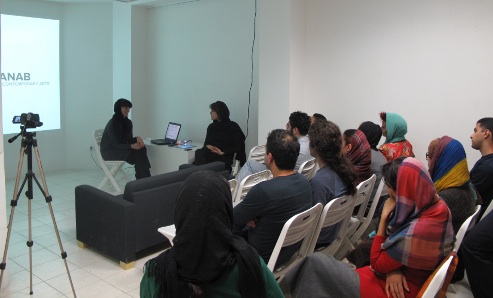
Artist talk by Anahita Razmi at Sazmanab Platform for Contemporary Arts. Courtesy Frieze Blog

by Daria Kirsanova, Frieze Blog

Tehran is a strange city: a huge metropolis of 12 million people with an impressive network of highways hosting overwhelmingly unruly traffic, it is at the same time the capital of a religious state hell bent on restraining its society with the straitjacket of tradition. Contradictory and against the odds are terms that can be equally applied to Tehran as a city, Iran as a country and the Iranian contemporary art world as a social phenomenon. A multitude of difficulties – lack of funding, lack of public institutional structure, unpropitious university curricula (neither contemporary art nor related theory are welcomed as topics of academic research), have not prevented the emergence of a vibrant and diverse contemporary art scene, including a growing gallery system that aspires to the ‘professional’ status it holds in the West.

I first went to Iran in 2010, after having heard a lot about the censorship and other troubles that artists and filmmakers encounter in the country, and was surprised to discover a number of galleries showing interesting and sophisticated conceptual art works charged with a political message. It was exactly a year after the suppression of the groundbreaking ‘Green Movement’ uprising of 2009 and artists including Amir Mobed, Shahab Fotouhi, Barbad Golshiri, Neda Razavipour, Mahmoud Bakhshi and Rozita Sharafjahan were trying to make sense of what happened during the months of protests. It was a moment both of reflection on the events and mourning for the individual victims, though not for the Green Movement as a political force.

This freedom of expression was – and very much remains – possible because of the marginal position of the visual arts in Iran; it is pretty much a world of its own. The galleries’ audience consists primarily of people involved in the arts in one way or another. Even now, the general public remains unaware of the existence of the galleries and to a large extent finds conceptual art practices unapproachable. Oddly, this position of contemporary art within the Iranian social context has been a huge advantage; it has allowed artists and galleries to work with degree of creative freedom. But things are changing.

Saturday, 19 January 2013

Iranian Cinema – national domain or part of the world cinemas?

by Ulla Fudge

The broader framework of cinemas of the world combines certain ideas and ideologies, defining the main attributes yet in the same time often going beyond the basic understanding of its definition. One thing is certain, world cinema works as oppose to the hegemonic Hollywood paradigm. Instead of commodification and standardization, world cinema underlines their tendencies towards originality and self-depiction. Nagib Lucia argues that: ‘At the core of this proposal is the belief that different cinemas of the world can generate their own, original theories. They do not depend of paradigms set by the so-called Hollywood classical, narrative style and in most cases are misunderstood if seen in this light’ (Nagib, 2011). The world cinema tends to focus on the question of realism that is present outside and within the frame.  Certain representations and depictions of social constrain and values from a national point of view connoted onto a cinematic image, play against the artifice and wide spread disneylazation.

Yet this notion of different film practises that involve more complex narrative, lack of stars, location in deprived areas, low budgets and therefore less commercially driven distribution, defines those films as ‘the other’. Lucia Nagib disagrees with the definition, saying that: ‘In multicultural, multi-ethnic societies like ours, cinematic expressions from various origins cannot be seen as ‘the other’ for the simple reason that they are us. More interesting than their difference is, in most cases, their interconnectedness’ (Nagib, 2011). By opening and show casting the national aspects of particular countries to worldwide audiences the film makers of world cinemas not only reveal the unknown territories but interlink the image with the viewer, creating an experience that can also include an emotional or identification involvement. However the term ‘the other’ doesn’t always connotes isolation as such. It can also open the doors to foreign, unknown territories. Michael Chanan argues that: ‘From time to time we’re reminded of this otherness by new cinematic waves from countries previously beyond the horizon, like Iran or China, which stimulate great interest precisely because there is nothing like cinema to create new imaginary geographies of far-away and unknown places’  (Chanan, 2011). Indeed cinemas of the world through their forms of realism often show cast a different approach to stylistic and narrative notions, applying their own, separate set of rules, indicating a flow towards hybridisation rather than influenced by hegemonic film making. Especially film makers from nations that have strong ethnical, political and religious clashes like Muslims or countries with strong social injustice and disturbing past, found their niche within the frame of world cinema. One of them is Iran.

This essay will examine the Iranian film directed by Rakhshan Bani – Etemad ‘Under the City’s Skin’ (2001) as an example of a film that can be located within the framework of world cinema, beginning with a brief glance at the Iranian cinema as a whole. Further on I would like to focus on the world audiences and their experience in viewing ‘Under the City’s Skin’, also addressing the term of ‘national’ and the distribution processes employed within the global frame.

Friday, 18 January 2013

Can non-Europeans think?

What happens with thinkers who operate outside the European philosophical 'pedigree'?

Why is European philosophy 'philosophy', but African philosophy 'ethnophilosophy'?

The world at large, and the Arab and Muslim world in particular, is going through world historic changes - these changes have produced thinkers, poets, artists, and public intellectuals at the centre of their moral and politcial imagination.

In a lovely little panegyric for the distinguished European philosopher Slavoj Zizek, published recently on Al Jazeera, we read:
There are many important and active philosophers today: Judith Butler in the United States, Simon Critchley in England, Victoria Camps in Spain, Jean-Luc Nancy in France, Chantal Mouffe in Belgium, Gianni Vattimo in Italy, Peter Sloterdijk in Germany and in Slovenia, Slavoj Zizek, not to mention others working in Brazil, Australia and China.
What immediately strikes the reader when seeing this opening paragraph is the unabashedly European character and disposition of the thing the author calls "philosophy today" - thus laying a claim on both the subject and time that is peculiar and in fact an exclusive property of Europe.

Even Judith Butler who is cited as an example from the United States is decidedly a product of European philosophical genealogy, thinking somewhere between Derrida and Foucault, brought to bear on our understanding of gender and sexuality.

To be sure, China and Brazil (and Australia, which is also a European extension) are cited as the location of other philosophers worthy of the designation, but none of them evidently merits a specific name to be sitting next to these eminent European philosophers.

The question of course is not the globality of philosophical visions that all these prominent European (and by extension certain American) philosophers indeed share and from which people from the deepest corners of Africa to the remotest villages of India, China, Latin America, and the Arab and Muslim world ("deep and far", that is, from a fictive European centre) can indeed learn and better understand their lives.

That goes without saying, for without that confidence and self-consciousness these philosophers and the philosophical traditions they represent can scarce lay any universal claim on our epistemic credulities, nor would they be able to put pen to paper or finger to keyboard and write a sentence.

Thinkers outside Europe 

These are indeed not only eminent philosophers, but the philosophy they practice has the globality of certain degrees of self-conscious confidence without which no thinking can presume universality.

Thursday, 17 January 2013

A ‘Hamlet’ Based on Brevity, the Soul of Wit, and Little Toys

Afshin Hashemi in “Hamlet, Prince of Grief,” a production by the Leev Theater Group of Iran, in the Under the Radar festival at the Public Theater. Courtesy NYTimes


It’s easy to think of activities that could reasonably be completed in a half-hour. You could cook a pasta puttanesca, get a solid workout on the treadmill, buy a tube of toothpaste at Duane Reade. 

But perform “Hamlet”? 

And yet that is the challenge met, after a fashion, by “Hamlet, Prince of Grief,” a production of the Leev Theater Group from Iran presented as part of the Under the Radar festival at the Public Theater. Performed in Farsi by the actor Afshin Hashemi, with English supertitles, the production is billed as freely adapted from the Shakespeare play. No kidding! 

“Prince of Grief” is a stylized, eccentric riff on “Hamlet” rather than a condensed version of the play, which is probably just as well. A half-hour trot through the text would probably come across as a joke, intentionally or not. 

Still, there’s significant humor in the Leev production, written by Mohammad Charmshir and directed by Mohammad Aghebati. With the exception of Hamlet, personified by Mr. Hashemi, who remains seated at a table throughout the performance, the characters are symbolized by small plastic toys plucked from the battered suitcase that is the primary prop. Mr. Hashemi supplies them with individual voices. 

Gertrude — or rather the protagonist’s mother, since no character names are used — is a tiny elephant, who pours the poison into her husband’s ear with the help of her long curved trunk. That’s one point where the story intersects directly (more or less) with the original. But for the most part there is little continuity between the contemporary (though not particularly Iranian) story being told and Shakespeare’s grand tragedy. 

Wednesday, 16 January 2013

Iran and 'Resistance'

by Nirmala Nataraj, SFGate


Visual culture has, for centuries, been an important facet of protest, resistance, revolution and social change - from the early caricatures of the 18th century in both Europe and America to the digital media and intentional spectacle burgeoning from the Occupy movement. As cultural historians have noted, pictorial representations of political movements can provoke action, even as they document rapid transformation.

San Francisco-based Iranian artist Taraneh Hemami explores the role of the artist as witness and archivist - particularly in recounting a political movement whose documentation has been all but wiped out. Her new show, "Resistance," draws on the history of resistance in Iran, focusing on decades of activism and revolutionary actions following the 1953 coup d'etat.

Hemami's collection of found and collected material reflects the sensibility of the student activists of that era, "who were very much influenced by the freedom movements across the globe," she says. Hemami, who has been involved with collective and community projects for more than 20 years, says she is motivated "by a personal need to make sense of my own history and that of my community - the layered historical circumstances that have led to our migration to the U.S."

After moving to the Bay Area in 1982, Hemami became involved with some of the Iranian Student Association of Northern California's cultural programming; at the time, she says, it was the only active Iranian group that organized community programs and cultural celebrations.

"They provided a sense of community for the many Iranians who had moved to the U.S. for school and had remained in the country unable to return to Iran after the revolution," she says. "An image that has stayed with me all these years is the walls of the entire center gradually filled up with portraits of young activists arrested or executed."

Twenty years later, Hemami attempted to create an archive of the community of Iranians in the Bay Area by collecting images and personal narratives. Aside from the collected print material Hemami compiled, her works employ a variety of media that draw upon the ways that objects both mundane and culturally specific can provoke an emotional response.

Tuesday, 15 January 2013

Persian Rugs and the Iranian Everyday

Photographer Jalal Sepehr in Yazd

“Two Windows” from Knot series (Yazd, 2011) by Jalal Sepehr. Courtesy of the artist.

Jalal Sepehr’s Knot series (2011) is comprised of 12 images all including a Persian rug (1m x 70cm) taken in the historic city of Yazd in central Iran. Contrary to initial intentions, some of the images in Knot make use of the historic scenes and examples of architecture found in Yazd. In this series, Sepehr strove to depict a space in between traditional and everyday life in his pictures. To do so, he made use of the rug and architecture as representative of tradition in opposition to the individuals pictured, dealing with the issues of everyday life.

Sepehr creates visual excitement by placing valued Persian carpets which are normally used as beautiful floor coverings in unusual and unexpected environments like on ancient stairs, sandy beaches, roof tops, and floating  in water and air between two buildings.  Liberated from their role as mere home furnishing, the carpets become idealized in Sepehr’s photographs which further suggests the carpets as the connecting tissue of Iranians and their environment.  “What inspired me to take these photos was creating new moments, in which the rugs float and dance in the water” the artist explains.  

The colors’ silent whisper
The wool’s palpitation of blood through the knot’s vessels
And the fingers’ sweet souls which are trampled …

Monday, 14 January 2013

Irandokht: Daughters of Iran

How an accidental find prompted an art project to document a forgotten era before the Iranian revolution
Courtesy of the Tehran Bureau, Guardian, Link to the pictures

by Sourena Parham for the Tehran Bureau, Guardian

In the autumn of 2005, Najaf Shokri was on his way to work when he made an intriguing discovery in a rubbish bin near his house in downtown Tehran. The bin, outside a branch of the National Civil Registrations Organisation, was filled with old national identification documents, all issued in 1942 and long expired.

"It was like discovering a mass grave," says Shokri. "They could have gone away and faded into history with no remaining trace."

He decided to create an art project out of his find, a collection of ID photographs that documents a generation. Shokri called the project Irandokht - "daughter of Iran" - after he noticed so many women by that name among the documents. It used to be a common first name in Iran.

Shokri's presentation focuses entirely on the photographs, revealing no names or personal information. The original meaning-making process is reversed, turned on its head as it were. The ID portraits no longer refer to specific individuals but to what we now call "meta-data": the postures in front of the camera, the hairdos, the makeup, the outfits, and even the photographic style of the time. All this meta-data evokes the era between the second world war and the Iranian revolution, an era that already seems very distant.

Before their replacement with more modern ID cards, Iranian identification documents consisted of four-page birth certificates issued without photographs. A holder was required to add a photograph to the document before using it for various legal purposes such as marriage, the national university entrance examination (known as the concours), or voting. Though the documents Shokri found were issued in 1942, the images in Irandokht are largely drawn from the period between the late 1950s and the late 1970s, when most of the women pictured added their photographs to their IDs.

Sunday, 13 January 2013

Restoring Iran’s Heritage of Magnificent Homes in an Age of High Rises

The largest restored palace in Kashan has several courtyards and is a tourist attraction. Photo by Newsha Tavakolian, courtesy of  The New York Times.

by Thomas Erdbrink, NYTimes

A petite woman in gray boots and a checkered scarf, Shanaz Nader had spent much of her adult life abroad, with long stretches in Tokyo, London and New York. But here she was braving a cold wind in this desert city three hours south of Tehran, making her way through a maze of high mud-brick walls.

Black-clad women waited at a small bakery as the rattling noise of a motorcycle in the distance echoed through the alleys. Finally, Mrs. Nader, an interior designer in Tehran, reached her destination: a large, two-panel wood door that opened up to her fully renovated weekend home, a majestic old Iranian house with four bedrooms, colored-glass windows, a separate office, two garden areas and a large rectangular marble fountain. 

After boiling tea, Mrs. Nader, 68, sighed and sat down under an arched passageway. The sun reflected in the fountain, as the wind blew in faint sounds of the midday call to prayer. 

“Whenever I dreamed of Iran while being in some faraway place, I dreamed of owning such a house,” she said. 

For thousands of years, houses with secluded gardens and courtyards have been a cornerstone of Iranian architecture, which strongly influenced structures like the Alhambra and the Taj Mahal. Similar dwellings are described in literature from Achaemenid times, around 700 B.C., and their old Persian name is the root for the word “paradise.”

Wednesday, 9 January 2013

Pop Goes the East

Eric Parnes on Pop Culture, Being Iranian-American, and the 15th Islamic Arts Festival

by Joobin Bekhrad, REORIENT

Currently exhibiting in Sharjah is the 15th Edition of the long-running Islamic Arts Festival. Featuring over 1,700 works of art from a variety of mediums, including painting, installation, and video art, and showcasing pieces from 45 local and international exhibitions from 18 countries, the festival is among the most prominent of its kind in the Middle East.

Over the holidays, I chatted with the festival’s headlining artist, Eric Parnes, about the exhibition, his artistic journey, and the concept of ‘Islamic Art’, among other things. 

What themes and ideas were most prominent in the festival?

This was the first year I was actually approached by Sharjah’s Art Directorate of the Department of Culture and Information – the Islamic Arts Festival’s designated coordinators – and asked to participate through a solo show featuring my work, so I don’t have any previous experience with the Festival to accurately assess exactly how the 15th Edition differs from the previous ones. However, at this year’s private inauguration event (which took place on December 12), the Ruler of Sharjah – His Highness Sheikh Dr. Sultan Bin Mohammed Al Qasimi – reiterated the ideals for the program to be a global pioneer in its comprehensive embrace of, and showcase of, authentic examples of Islamic Art from different periods and regions, wherever they happen to originate from.

The 15th Edition of the Islamic Arts Festival’s promoters also expressed that this year’s production aimed to offer a balanced presentation of ‘classic art’ based on traditional foundations, along with ‘contemporary-like’ [sic] art that will offer fresh concepts, but that are held to the standards of what they believe to be ‘Islamic Art’. I intentionally quoted the phrase ‘contemporary-like’ from the Festival’s official press release simply to demonstrate the underlying hesitations that permeate all modern-day considerations when Islamic Art is poised to be reintroduced in the languages of contemporary art.

Ultimately, if applied correctly, contemporary Islamic Art should be created in a thoughtful way that is truly meaningful to our present human condition. It shouldn’t just simply utilise ‘innovative modern techniques and mediums ruled by digital technology’ [sic].

I think this has probably been the primary challenge for the Festival this year, or for anyone working with new voices in Islamic Art being introduced anywhere today. At this Festival, there was even an official presentation of a special seminar entitled The Versatile Compositions of Islamic Arts, which brought together various scholars, who specifically discussed how contemporary art has surfaced in Islamic Art projects within the past twenty years, amongst other subjects that needed to be addressed when reassessing the question, what exactly is ‘Islamic Art’ now?

Monday, 7 January 2013

A Rose Garden Of Verse

Persian identity and culture survived the loss of an empire, the obliteration of a faith and the pressure exerted by the Arabic language.

by Eric Ormsby, WSJ

Sometimes a servant can teach his masters a thing or two. In AD 652 Arab armies toppled the Sasanian Empire, ending four centuries of Persian rule in the Middle East. A century later, an author named Ibn al-Muqaffa' opened his treatise on practical ethics, written in elegant Arabic, with slyly exaggerated praise of the "ancients." The men of old, he wrote, had bigger bodies than ours. They had sharper intellects. They knew how to balance the affairs of this world and the demands of the next. By "men of old" this author meant the Persians, his forebears, who would have regarded the victorious Arabs as little more than upstarts, crude and swaggering "lizard-eaters" fresh from the desert.

Ibn al-Muqaffa' was one of the first in a long line of Persian-born writers who effectively created Islamic literary culture. Others include the grammarian Sibawayhi (c. 760-c. 796), author of the authoritative grammar of Classical Arabic, as well as the philosophers Razi (c. 865-c. 925) and Avicenna (c. 980-1037), both Persians who wrote almost exclusively in Arabic. In his ambitious overview of Persian culture from the fall of Sasanians to the Islamic Revolution of 1979, Hamid Dabashi, a professor at Columbia University, discusses all these men as early exemplars of "literary humanism."

By "literary humanism," Mr. Dabashi seeks to convey a key concept in medieval Islamic culture, especially in its Persian manifestations. In eight detailed and sometimes dense chapters, he aims to explain how Persian identity and culture survived the loss of an empire, the obliteration of a faith (Zoroastrianism) and the pressure exerted on the Persian language by the overwhelming dominance of Arabic, the language of scripture and all-conquering Arab armies. Indeed, Persian didn't merely survive, it flourished to such an extent that it served as the language of courts from Central Asia to India and gave birth to an enduring literary tradition, especially in poetry, equal to any in the world.

Saturday, 5 January 2013

The Familiar Transformed With the Unexpected

by Susanne Fowler, NYTimes

The manipulation and vulnerability of images are the central themes in “Light From the Middle East,” a thoughtful and layered photography exhibition at the Victoria and Albert Museum through April 7.

Focusing on the inventive ways that artists use images to tell stories, the show also documents the challenges that have unfolded — and continue to make headlines — in the region, from the now iconic scenes captured by Abbas of the Iranian revolution in the 1970s to Nermine Hammam’s candy-colored and digitally altered shots of Egyptian soldiers in Tahrir Square in 2011. 

The curator, Marta Weiss, has divided 95 works from the V&A and the British Museum collections, plus acquisitions using an Art Fund grant, into three categories — recording, reframing and resisting — using pictures of historic events, photographs of other photographs and photographs that reflect how the medium is used by societies. Thirty-one artists from 13 countries are represented. 

“We all know that photographs can be manipulated and that we can’t really trust them,” the curator said, “and yet there’s also something very instinctive about relying on a photograph and that’s something a lot of these artists are engaging with.” 

During a private tour of the exhibition, Ms. Weiss said the works included “references to studio portraits, to postcards, to propaganda images, to news photography and to the fact that a photograph is a vulnerable object.” 

The first section — recording — “brings together photographs that are using photography in the most kind of direct way possible,” Ms. Weiss said. “We think of it as factual, we think of it as authoritative. This exhibition certainly explores in lots of ways the reliability of photography.” 

The opening images from Tehran of powerful ayatollahs, executed generals, and rioters burning a portrait of the shah are by Abbas, based in Paris and part of the Magnum cooperative. He photographed the Iranian revolution from 1978 to 1980, and later focused on the resurgence of Islam throughout the world. 

Another example of recording is the “Mothers of Martyrs” series from 2006 by Newsha Tavakolian, a self-taught photographer who worked early in her career for a women’s daily newspaper in Iran. 

Thursday, 3 January 2013

A Soul Aflame

Sashar Zarif and Alim Qasimov Take the Azerbaijani Art of Mugham to New Heights:   
Zarif beautifully melded together the various aspects of his multifaceted identity, taking the audience on a spiritual journey from the mountains of Azerbaijan and the gardens of Persia to the steppes of Turkistan
Detail of a Persian miniature depicting the defeat of Sheybani Khan and the Uzbeks at the hands of Shah Ismail and the Safavids. Courtesy REORIENT

by Joobin Bekhrad, REORIENT

The Caucasus – that mythical land of mountains, valleys, and steppes – has always held a peculiar, inextricable place within the depths of my soul. Don’t bother asking me why, though, as I myself have yet to relate the beginnings and sparks of this romance. I didn’t fall in love with a picture, as the Persian lovers of old often did, nor was my imagination made fertile by the apple of a wandering dervish or the devices of a wily matchmaker. Perhaps something long dormant within the recesses of my being was set alight when I read of the picaresque adventures of the rebellious Koroghlu, the flowery affair of Taher and Zohreh, the tribulations of David of Sassoon, the plight of Rusthaveli’s Man in the Panther’s Skin, or the valorous deeds and escapades of the nomadic Turks of old, as sung to the sounds of the kopuz by the bard Dede Korkut. Or, maybe it was the cry of the itinerant asheghs, and the hauntingly beautiful folk melodies of a region likely older than history itself. As they say in the Persian Sufi tradition, however, where there is love, there is no room for reason.

Of all the fabled lands of the Caucasus, Azerbaijan has perhaps intrigued me the most. The land of fire (as it translates from the Persian) where Zarathustra’s flame once burned bright, is a fascinating hybrid of sorts. Having been an integral part of the Persian Empire, once served as a bastion of the Zoroastrian faith, and given rise to illustrious Persian poets such as Nezami (of Leila & Majnun fame) and Khaghani Shirvani, there’s an unmistakable Iranian element at play in the culture and identity of this nation. At the same time, however, there also exists a strong Turkic undercurrent, which has beautifully merged with the former. Through waves of migration by Turkic nomads from Central Asia, as well as Iranian politics, the outward Persian identity of Arran – as the land was referred to by throughout the annals of time until only recently, owing to political reasons – was slowly displaced by a new Turkic one. Although the Seljuks first laid the foundations in the 11th Century during their exodus from the ancestral Turkic homeland in Central Asia through Iran towards Byzantium, it was perhaps the Persian Safavids – a dynasty with Turkic origins – who brought about the ‘turning point’, when they replaced the ancient Iranian Azari language in Azerbaijan (i.e. the western Iranian province) and Arran with a Turkic tongue, and zealously promoted Turkic culture and customs among the populace – not to mention making Shia Islam the official state religion of Iran, as an affront to their bitter rivals to the West, the Sunni Ottomans.

Tuesday, 1 January 2013

Generations of Modern Iranian Art: A New Exhibit

by Roshanak Taghavi, The Huffington Post

On January 1, the Virginia-based Hermitage Art Gallery will ring in the New Year with an exhibit dedicated solely to contemporary Iranian art.

Curated from the collection of gallery owners Mehri and Nasser Hosseini, the exhibition will feature more than 40 works of modern art by seven Iranian artists. It is an assemblage of different generations of artists, all born and raised in Iran during different decades and now based in the United States.

Two of the artists -- architect Farshad Farahi and master of Persian Rug Design Mohammad Darehbaghi -- completed their studies well before Iran's 1979 Revolution, when the country was still ruled by monarch Mohammad Reza Shah Pahlavi. The remaining five artists, which include Bahar Behbahani, Shahla Moghaddam, Baltimore-based painter Fariba Gheisour, and Mohammad Darehbaghi's brothers Mostafa and Morteza Darehbaghi, were each born before 1979, but studied and honed their artistic craft after Iran became an Islamic Republic.

The exhibit's juxtaposition of generations conveys how differently the seven artists have translated their respective experiences, as individuals and as Iranians, into their creative works. "Each artist has a different background and interacts with society in his or her own way," says Hermitage curator Mehri Hosseini. "We put their works together here in order to create a dialogue between them. A visitor can compare them to one another and witness the different generational trends."