Wednesday, 30 January 2013

A View from Afar

‘You Ask Yourself A Thousand Questions Plus One: Who Am I?’

Chador-dadar, by Haleh Anvari – London. Courtesy Galerie Kashya Hildebrand and REORIENT.


by Joobin Bekhrad, REORIENT

As the bombs from Babylon fell from above across the hazy Tehran skyline, dotting the skirt of the mountain whereon Arash once let his felicitous arrow fly, my family and I made for strange and foreign realms. Leaving the land of roses and nightingales for the shores of Albion, we first settled in England before heading further east towards the New World. Despite the fact that many of my mother’s relatives were in London at the time, my parents nonetheless opted for a new life in Canada, being more accustomed to the North American lifestyle they had enjoyed as students in the United States. True, we would be far from ‘home’ and the bulk of our ilk, and my father would not be given free reign to practice as an architect and civil engineer, but one thing was certain: we would be safe, dignified, and free.

As an immigrant child in Toronto in the early 90s, I had it made. My classrooms were always brimming with a melange of kids from far-flung corners of the earth, just like me, each with stories as unique and colourful as their accents. Not once did any one of us ever feel that we were different or peculiar in any way, even vis-à-vis our friends of Western European descent. Of course, there was no doubt that my parents spoke a funny language at home, pointed fingers at strange, bearded men on the television from time to time, and on more than one occasion sent me off to school reeking of ghormeh sabzi; but then again, stinky stews aside, that was more or less the case with everyone at the time. We didn’t make anything of it. We were kids. We just were. 

Looking back, though, perhaps I wasn’t just another immigrant child with dark hair and eyes who seamlessly integrated into Toronto’s social fabric. Unlike most of the other families we knew from ‘elsewhere’, we weren’t exactly what you’d call giveaways. My mother and father both attended University in the States in the mid-70s, where they met before returning to Iran. They spoke English without the languid, seemingly opium-induced Persian drawl, preferred ski slopes to shopping malls, and made trips to the local Iranian supermarket only when faced with dire shortages of pistachios and basmati rice. People knew we were from somewhere else; they just didn’t know where. We were often taken for Italians or Greeks, or, if someone felt they had really caught on to us, Armenians. Thus, as far as I can recall, I had a relatively Western upbringing, devoid of any of the typical feelings of displacement or awkwardness that usually rear their ugly head in the immigrant experience.

Wednesday, 23 January 2013

Iranian artists hit by sanctions

A crumbling economy mean fewer sales for the established – but fresh opportunities for young creatives
Two visitors to Tehran's Museum of Contemporary Art during a recent exhibition of western art. Photograph: Kaveh Kazemi/Corbis. Courtesy of the Guardian.

by Sune Engel Rasmussen, Tehran Bureau, Guardian

International sanctions imposed against Iran over its disputed nuclear program are affecting all areas of Iranian life. Lately, inflation and a severely depreciated currency have begun to bite in a segment of society that seems far removed from debates over uranium enrichment and "possible military dimensions": Tehran's artistic class.

As the economy crumbles, artists find that many erstwhile collectors now treat their work as a dispensable luxury. To maintain sales, galleries try to put a limit on prices while the cost of daily commodities rise. But while some artists struggle, the barren economy provides fertile ground for young creatives willing to settle for smaller profits – and for those who appeal to an international audience.

With the rial losing half its foreign-exchange value over the past year and hard-currency reserves dwindling, the power to purchase art is concentrating in the hands of foreigners and Iranians with access to foreign currency. "Sales have dipped and general interest in the art industry has waned," said an art analyst in Tehran, who asked not to be named. Foreigners are a growing presence in the local art market, he said. "Expats and embassy workers have a stronger currency and they can haggle with galleries."

In a city where public socialising is severely restricted beyond the realm of coffee shops, restaurants and the odd flirtation through car windows, art spaces serve a crucial role for Tehranis. Gallery openings are among the few public events not run by authorities, and every Friday afternoon, art exhibitions attract crowds of mingling youths. As aesthetic trends turn increasingly towards conceptual art and installations, galleries more than ever serve as social rather than commercial forums.

According to experts, inflation climbed to at least 50% in 2012, fueled by a combination of sanctions and failed government policies. In addition to ebbing sales, the costs for art materials, studio rent, gallery space, and transportation have shot up, slashing profits further. Galleries in Tehran recommend artists not increase their prices in step with inflation, and rather than boosting local sales, the artificially low price tags open the market to buyers outside the country.

Tuesday, 22 January 2013

Postcard from Tehran

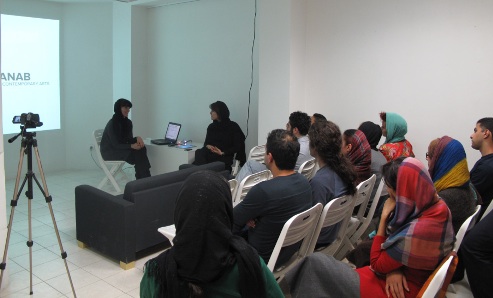
Artist talk by Anahita Razmi at Sazmanab Platform for Contemporary Arts. Courtesy Frieze Blog

by Daria Kirsanova, Frieze Blog

Tehran is a strange city: a huge metropolis of 12 million people with an impressive network of highways hosting overwhelmingly unruly traffic, it is at the same time the capital of a religious state hell bent on restraining its society with the straitjacket of tradition. Contradictory and against the odds are terms that can be equally applied to Tehran as a city, Iran as a country and the Iranian contemporary art world as a social phenomenon. A multitude of difficulties – lack of funding, lack of public institutional structure, unpropitious university curricula (neither contemporary art nor related theory are welcomed as topics of academic research), have not prevented the emergence of a vibrant and diverse contemporary art scene, including a growing gallery system that aspires to the ‘professional’ status it holds in the West.

I first went to Iran in 2010, after having heard a lot about the censorship and other troubles that artists and filmmakers encounter in the country, and was surprised to discover a number of galleries showing interesting and sophisticated conceptual art works charged with a political message. It was exactly a year after the suppression of the groundbreaking ‘Green Movement’ uprising of 2009 and artists including Amir Mobed, Shahab Fotouhi, Barbad Golshiri, Neda Razavipour, Mahmoud Bakhshi and Rozita Sharafjahan were trying to make sense of what happened during the months of protests. It was a moment both of reflection on the events and mourning for the individual victims, though not for the Green Movement as a political force.

This freedom of expression was – and very much remains – possible because of the marginal position of the visual arts in Iran; it is pretty much a world of its own. The galleries’ audience consists primarily of people involved in the arts in one way or another. Even now, the general public remains unaware of the existence of the galleries and to a large extent finds conceptual art practices unapproachable. Oddly, this position of contemporary art within the Iranian social context has been a huge advantage; it has allowed artists and galleries to work with degree of creative freedom. But things are changing.

Saturday, 19 January 2013

Iranian Cinema – national domain or part of the world cinemas?

by Ulla Fudge

The broader framework of cinemas of the world combines certain ideas and ideologies, defining the main attributes yet in the same time often going beyond the basic understanding of its definition. One thing is certain, world cinema works as oppose to the hegemonic Hollywood paradigm. Instead of commodification and standardization, world cinema underlines their tendencies towards originality and self-depiction. Nagib Lucia argues that: ‘At the core of this proposal is the belief that different cinemas of the world can generate their own, original theories. They do not depend of paradigms set by the so-called Hollywood classical, narrative style and in most cases are misunderstood if seen in this light’ (Nagib, 2011). The world cinema tends to focus on the question of realism that is present outside and within the frame.  Certain representations and depictions of social constrain and values from a national point of view connoted onto a cinematic image, play against the artifice and wide spread disneylazation.

Yet this notion of different film practises that involve more complex narrative, lack of stars, location in deprived areas, low budgets and therefore less commercially driven distribution, defines those films as ‘the other’. Lucia Nagib disagrees with the definition, saying that: ‘In multicultural, multi-ethnic societies like ours, cinematic expressions from various origins cannot be seen as ‘the other’ for the simple reason that they are us. More interesting than their difference is, in most cases, their interconnectedness’ (Nagib, 2011). By opening and show casting the national aspects of particular countries to worldwide audiences the film makers of world cinemas not only reveal the unknown territories but interlink the image with the viewer, creating an experience that can also include an emotional or identification involvement. However the term ‘the other’ doesn’t always connotes isolation as such. It can also open the doors to foreign, unknown territories. Michael Chanan argues that: ‘From time to time we’re reminded of this otherness by new cinematic waves from countries previously beyond the horizon, like Iran or China, which stimulate great interest precisely because there is nothing like cinema to create new imaginary geographies of far-away and unknown places’  (Chanan, 2011). Indeed cinemas of the world through their forms of realism often show cast a different approach to stylistic and narrative notions, applying their own, separate set of rules, indicating a flow towards hybridisation rather than influenced by hegemonic film making. Especially film makers from nations that have strong ethnical, political and religious clashes like Muslims or countries with strong social injustice and disturbing past, found their niche within the frame of world cinema. One of them is Iran.

This essay will examine the Iranian film directed by Rakhshan Bani – Etemad ‘Under the City’s Skin’ (2001) as an example of a film that can be located within the framework of world cinema, beginning with a brief glance at the Iranian cinema as a whole. Further on I would like to focus on the world audiences and their experience in viewing ‘Under the City’s Skin’, also addressing the term of ‘national’ and the distribution processes employed within the global frame.

Friday, 18 January 2013

Can non-Europeans think?

What happens with thinkers who operate outside the European philosophical 'pedigree'?

Why is European philosophy 'philosophy', but African philosophy 'ethnophilosophy'?

The world at large, and the Arab and Muslim world in particular, is going through world historic changes - these changes have produced thinkers, poets, artists, and public intellectuals at the centre of their moral and politcial imagination.

In a lovely little panegyric for the distinguished European philosopher Slavoj Zizek, published recently on Al Jazeera, we read:
There are many important and active philosophers today: Judith Butler in the United States, Simon Critchley in England, Victoria Camps in Spain, Jean-Luc Nancy in France, Chantal Mouffe in Belgium, Gianni Vattimo in Italy, Peter Sloterdijk in Germany and in Slovenia, Slavoj Zizek, not to mention others working in Brazil, Australia and China.
What immediately strikes the reader when seeing this opening paragraph is the unabashedly European character and disposition of the thing the author calls "philosophy today" - thus laying a claim on both the subject and time that is peculiar and in fact an exclusive property of Europe.

Even Judith Butler who is cited as an example from the United States is decidedly a product of European philosophical genealogy, thinking somewhere between Derrida and Foucault, brought to bear on our understanding of gender and sexuality.

To be sure, China and Brazil (and Australia, which is also a European extension) are cited as the location of other philosophers worthy of the designation, but none of them evidently merits a specific name to be sitting next to these eminent European philosophers.

The question of course is not the globality of philosophical visions that all these prominent European (and by extension certain American) philosophers indeed share and from which people from the deepest corners of Africa to the remotest villages of India, China, Latin America, and the Arab and Muslim world ("deep and far", that is, from a fictive European centre) can indeed learn and better understand their lives.

That goes without saying, for without that confidence and self-consciousness these philosophers and the philosophical traditions they represent can scarce lay any universal claim on our epistemic credulities, nor would they be able to put pen to paper or finger to keyboard and write a sentence.

Thinkers outside Europe 

These are indeed not only eminent philosophers, but the philosophy they practice has the globality of certain degrees of self-conscious confidence without which no thinking can presume universality.

Thursday, 17 January 2013

A ‘Hamlet’ Based on Brevity, the Soul of Wit, and Little Toys

Afshin Hashemi in “Hamlet, Prince of Grief,” a production by the Leev Theater Group of Iran, in the Under the Radar festival at the Public Theater. Courtesy NYTimes


It’s easy to think of activities that could reasonably be completed in a half-hour. You could cook a pasta puttanesca, get a solid workout on the treadmill, buy a tube of toothpaste at Duane Reade. 

But perform “Hamlet”? 

And yet that is the challenge met, after a fashion, by “Hamlet, Prince of Grief,” a production of the Leev Theater Group from Iran presented as part of the Under the Radar festival at the Public Theater. Performed in Farsi by the actor Afshin Hashemi, with English supertitles, the production is billed as freely adapted from the Shakespeare play. No kidding! 

“Prince of Grief” is a stylized, eccentric riff on “Hamlet” rather than a condensed version of the play, which is probably just as well. A half-hour trot through the text would probably come across as a joke, intentionally or not. 

Still, there’s significant humor in the Leev production, written by Mohammad Charmshir and directed by Mohammad Aghebati. With the exception of Hamlet, personified by Mr. Hashemi, who remains seated at a table throughout the performance, the characters are symbolized by small plastic toys plucked from the battered suitcase that is the primary prop. Mr. Hashemi supplies them with individual voices. 

Gertrude — or rather the protagonist’s mother, since no character names are used — is a tiny elephant, who pours the poison into her husband’s ear with the help of her long curved trunk. That’s one point where the story intersects directly (more or less) with the original. But for the most part there is little continuity between the contemporary (though not particularly Iranian) story being told and Shakespeare’s grand tragedy. 

Wednesday, 16 January 2013

Iran and 'Resistance'

by Nirmala Nataraj, SFGate


Visual culture has, for centuries, been an important facet of protest, resistance, revolution and social change - from the early caricatures of the 18th century in both Europe and America to the digital media and intentional spectacle burgeoning from the Occupy movement. As cultural historians have noted, pictorial representations of political movements can provoke action, even as they document rapid transformation.

San Francisco-based Iranian artist Taraneh Hemami explores the role of the artist as witness and archivist - particularly in recounting a political movement whose documentation has been all but wiped out. Her new show, "Resistance," draws on the history of resistance in Iran, focusing on decades of activism and revolutionary actions following the 1953 coup d'etat.

Hemami's collection of found and collected material reflects the sensibility of the student activists of that era, "who were very much influenced by the freedom movements across the globe," she says. Hemami, who has been involved with collective and community projects for more than 20 years, says she is motivated "by a personal need to make sense of my own history and that of my community - the layered historical circumstances that have led to our migration to the U.S."

After moving to the Bay Area in 1982, Hemami became involved with some of the Iranian Student Association of Northern California's cultural programming; at the time, she says, it was the only active Iranian group that organized community programs and cultural celebrations.

"They provided a sense of community for the many Iranians who had moved to the U.S. for school and had remained in the country unable to return to Iran after the revolution," she says. "An image that has stayed with me all these years is the walls of the entire center gradually filled up with portraits of young activists arrested or executed."

Twenty years later, Hemami attempted to create an archive of the community of Iranians in the Bay Area by collecting images and personal narratives. Aside from the collected print material Hemami compiled, her works employ a variety of media that draw upon the ways that objects both mundane and culturally specific can provoke an emotional response.

Tuesday, 15 January 2013

Persian Rugs and the Iranian Everyday

Photographer Jalal Sepehr in Yazd

“Two Windows” from Knot series (Yazd, 2011) by Jalal Sepehr. Courtesy of the artist.

Jalal Sepehr’s Knot series (2011) is comprised of 12 images all including a Persian rug (1m x 70cm) taken in the historic city of Yazd in central Iran. Contrary to initial intentions, some of the images in Knot make use of the historic scenes and examples of architecture found in Yazd. In this series, Sepehr strove to depict a space in between traditional and everyday life in his pictures. To do so, he made use of the rug and architecture as representative of tradition in opposition to the individuals pictured, dealing with the issues of everyday life.

Sepehr creates visual excitement by placing valued Persian carpets which are normally used as beautiful floor coverings in unusual and unexpected environments like on ancient stairs, sandy beaches, roof tops, and floating  in water and air between two buildings.  Liberated from their role as mere home furnishing, the carpets become idealized in Sepehr’s photographs which further suggests the carpets as the connecting tissue of Iranians and their environment.  “What inspired me to take these photos was creating new moments, in which the rugs float and dance in the water” the artist explains.  

The colors’ silent whisper
The wool’s palpitation of blood through the knot’s vessels
And the fingers’ sweet souls which are trampled …

Monday, 14 January 2013

Irandokht: Daughters of Iran

How an accidental find prompted an art project to document a forgotten era before the Iranian revolution
Courtesy of the Tehran Bureau, Guardian, Link to the pictures

by Sourena Parham for the Tehran Bureau, Guardian

In the autumn of 2005, Najaf Shokri was on his way to work when he made an intriguing discovery in a rubbish bin near his house in downtown Tehran. The bin, outside a branch of the National Civil Registrations Organisation, was filled with old national identification documents, all issued in 1942 and long expired.

"It was like discovering a mass grave," says Shokri. "They could have gone away and faded into history with no remaining trace."

He decided to create an art project out of his find, a collection of ID photographs that documents a generation. Shokri called the project Irandokht - "daughter of Iran" - after he noticed so many women by that name among the documents. It used to be a common first name in Iran.

Shokri's presentation focuses entirely on the photographs, revealing no names or personal information. The original meaning-making process is reversed, turned on its head as it were. The ID portraits no longer refer to specific individuals but to what we now call "meta-data": the postures in front of the camera, the hairdos, the makeup, the outfits, and even the photographic style of the time. All this meta-data evokes the era between the second world war and the Iranian revolution, an era that already seems very distant.

Before their replacement with more modern ID cards, Iranian identification documents consisted of four-page birth certificates issued without photographs. A holder was required to add a photograph to the document before using it for various legal purposes such as marriage, the national university entrance examination (known as the concours), or voting. Though the documents Shokri found were issued in 1942, the images in Irandokht are largely drawn from the period between the late 1950s and the late 1970s, when most of the women pictured added their photographs to their IDs.

Sunday, 13 January 2013

Restoring Iran’s Heritage of Magnificent Homes in an Age of High Rises

The largest restored palace in Kashan has several courtyards and is a tourist attraction. Photo by Newsha Tavakolian, courtesy of  The New York Times.

by Thomas Erdbrink, NYTimes

A petite woman in gray boots and a checkered scarf, Shanaz Nader had spent much of her adult life abroad, with long stretches in Tokyo, London and New York. But here she was braving a cold wind in this desert city three hours south of Tehran, making her way through a maze of high mud-brick walls.

Black-clad women waited at a small bakery as the rattling noise of a motorcycle in the distance echoed through the alleys. Finally, Mrs. Nader, an interior designer in Tehran, reached her destination: a large, two-panel wood door that opened up to her fully renovated weekend home, a majestic old Iranian house with four bedrooms, colored-glass windows, a separate office, two garden areas and a large rectangular marble fountain. 

After boiling tea, Mrs. Nader, 68, sighed and sat down under an arched passageway. The sun reflected in the fountain, as the wind blew in faint sounds of the midday call to prayer. 

“Whenever I dreamed of Iran while being in some faraway place, I dreamed of owning such a house,” she said. 

For thousands of years, houses with secluded gardens and courtyards have been a cornerstone of Iranian architecture, which strongly influenced structures like the Alhambra and the Taj Mahal. Similar dwellings are described in literature from Achaemenid times, around 700 B.C., and their old Persian name is the root for the word “paradise.”

Wednesday, 9 January 2013

Pop Goes the East

Eric Parnes on Pop Culture, Being Iranian-American, and the 15th Islamic Arts Festival

by Joobin Bekhrad, REORIENT

Currently exhibiting in Sharjah is the 15th Edition of the long-running Islamic Arts Festival. Featuring over 1,700 works of art from a variety of mediums, including painting, installation, and video art, and showcasing pieces from 45 local and international exhibitions from 18 countries, the festival is among the most prominent of its kind in the Middle East.

Over the holidays, I chatted with the festival’s headlining artist, Eric Parnes, about the exhibition, his artistic journey, and the concept of ‘Islamic Art’, among other things. 

What themes and ideas were most prominent in the festival?

This was the first year I was actually approached by Sharjah’s Art Directorate of the Department of Culture and Information – the Islamic Arts Festival’s designated coordinators – and asked to participate through a solo show featuring my work, so I don’t have any previous experience with the Festival to accurately assess exactly how the 15th Edition differs from the previous ones. However, at this year’s private inauguration event (which took place on December 12), the Ruler of Sharjah – His Highness Sheikh Dr. Sultan Bin Mohammed Al Qasimi – reiterated the ideals for the program to be a global pioneer in its comprehensive embrace of, and showcase of, authentic examples of Islamic Art from different periods and regions, wherever they happen to originate from.

The 15th Edition of the Islamic Arts Festival’s promoters also expressed that this year’s production aimed to offer a balanced presentation of ‘classic art’ based on traditional foundations, along with ‘contemporary-like’ [sic] art that will offer fresh concepts, but that are held to the standards of what they believe to be ‘Islamic Art’. I intentionally quoted the phrase ‘contemporary-like’ from the Festival’s official press release simply to demonstrate the underlying hesitations that permeate all modern-day considerations when Islamic Art is poised to be reintroduced in the languages of contemporary art.

Ultimately, if applied correctly, contemporary Islamic Art should be created in a thoughtful way that is truly meaningful to our present human condition. It shouldn’t just simply utilise ‘innovative modern techniques and mediums ruled by digital technology’ [sic].

I think this has probably been the primary challenge for the Festival this year, or for anyone working with new voices in Islamic Art being introduced anywhere today. At this Festival, there was even an official presentation of a special seminar entitled The Versatile Compositions of Islamic Arts, which brought together various scholars, who specifically discussed how contemporary art has surfaced in Islamic Art projects within the past twenty years, amongst other subjects that needed to be addressed when reassessing the question, what exactly is ‘Islamic Art’ now?

Monday, 7 January 2013

A Rose Garden Of Verse

Persian identity and culture survived the loss of an empire, the obliteration of a faith and the pressure exerted by the Arabic language.

by Eric Ormsby, WSJ

Sometimes a servant can teach his masters a thing or two. In AD 652 Arab armies toppled the Sasanian Empire, ending four centuries of Persian rule in the Middle East. A century later, an author named Ibn al-Muqaffa' opened his treatise on practical ethics, written in elegant Arabic, with slyly exaggerated praise of the "ancients." The men of old, he wrote, had bigger bodies than ours. They had sharper intellects. They knew how to balance the affairs of this world and the demands of the next. By "men of old" this author meant the Persians, his forebears, who would have regarded the victorious Arabs as little more than upstarts, crude and swaggering "lizard-eaters" fresh from the desert.

Ibn al-Muqaffa' was one of the first in a long line of Persian-born writers who effectively created Islamic literary culture. Others include the grammarian Sibawayhi (c. 760-c. 796), author of the authoritative grammar of Classical Arabic, as well as the philosophers Razi (c. 865-c. 925) and Avicenna (c. 980-1037), both Persians who wrote almost exclusively in Arabic. In his ambitious overview of Persian culture from the fall of Sasanians to the Islamic Revolution of 1979, Hamid Dabashi, a professor at Columbia University, discusses all these men as early exemplars of "literary humanism."

By "literary humanism," Mr. Dabashi seeks to convey a key concept in medieval Islamic culture, especially in its Persian manifestations. In eight detailed and sometimes dense chapters, he aims to explain how Persian identity and culture survived the loss of an empire, the obliteration of a faith (Zoroastrianism) and the pressure exerted on the Persian language by the overwhelming dominance of Arabic, the language of scripture and all-conquering Arab armies. Indeed, Persian didn't merely survive, it flourished to such an extent that it served as the language of courts from Central Asia to India and gave birth to an enduring literary tradition, especially in poetry, equal to any in the world.

Saturday, 5 January 2013

The Familiar Transformed With the Unexpected

by Susanne Fowler, NYTimes

The manipulation and vulnerability of images are the central themes in “Light From the Middle East,” a thoughtful and layered photography exhibition at the Victoria and Albert Museum through April 7.

Focusing on the inventive ways that artists use images to tell stories, the show also documents the challenges that have unfolded — and continue to make headlines — in the region, from the now iconic scenes captured by Abbas of the Iranian revolution in the 1970s to Nermine Hammam’s candy-colored and digitally altered shots of Egyptian soldiers in Tahrir Square in 2011. 

The curator, Marta Weiss, has divided 95 works from the V&A and the British Museum collections, plus acquisitions using an Art Fund grant, into three categories — recording, reframing and resisting — using pictures of historic events, photographs of other photographs and photographs that reflect how the medium is used by societies. Thirty-one artists from 13 countries are represented. 

“We all know that photographs can be manipulated and that we can’t really trust them,” the curator said, “and yet there’s also something very instinctive about relying on a photograph and that’s something a lot of these artists are engaging with.” 

During a private tour of the exhibition, Ms. Weiss said the works included “references to studio portraits, to postcards, to propaganda images, to news photography and to the fact that a photograph is a vulnerable object.” 

The first section — recording — “brings together photographs that are using photography in the most kind of direct way possible,” Ms. Weiss said. “We think of it as factual, we think of it as authoritative. This exhibition certainly explores in lots of ways the reliability of photography.” 

The opening images from Tehran of powerful ayatollahs, executed generals, and rioters burning a portrait of the shah are by Abbas, based in Paris and part of the Magnum cooperative. He photographed the Iranian revolution from 1978 to 1980, and later focused on the resurgence of Islam throughout the world. 

Another example of recording is the “Mothers of Martyrs” series from 2006 by Newsha Tavakolian, a self-taught photographer who worked early in her career for a women’s daily newspaper in Iran. 

Thursday, 3 January 2013

A Soul Aflame

Sashar Zarif and Alim Qasimov Take the Azerbaijani Art of Mugham to New Heights:   
Zarif beautifully melded together the various aspects of his multifaceted identity, taking the audience on a spiritual journey from the mountains of Azerbaijan and the gardens of Persia to the steppes of Turkistan
Detail of a Persian miniature depicting the defeat of Sheybani Khan and the Uzbeks at the hands of Shah Ismail and the Safavids. Courtesy REORIENT

by Joobin Bekhrad, REORIENT

The Caucasus – that mythical land of mountains, valleys, and steppes – has always held a peculiar, inextricable place within the depths of my soul. Don’t bother asking me why, though, as I myself have yet to relate the beginnings and sparks of this romance. I didn’t fall in love with a picture, as the Persian lovers of old often did, nor was my imagination made fertile by the apple of a wandering dervish or the devices of a wily matchmaker. Perhaps something long dormant within the recesses of my being was set alight when I read of the picaresque adventures of the rebellious Koroghlu, the flowery affair of Taher and Zohreh, the tribulations of David of Sassoon, the plight of Rusthaveli’s Man in the Panther’s Skin, or the valorous deeds and escapades of the nomadic Turks of old, as sung to the sounds of the kopuz by the bard Dede Korkut. Or, maybe it was the cry of the itinerant asheghs, and the hauntingly beautiful folk melodies of a region likely older than history itself. As they say in the Persian Sufi tradition, however, where there is love, there is no room for reason.

Of all the fabled lands of the Caucasus, Azerbaijan has perhaps intrigued me the most. The land of fire (as it translates from the Persian) where Zarathustra’s flame once burned bright, is a fascinating hybrid of sorts. Having been an integral part of the Persian Empire, once served as a bastion of the Zoroastrian faith, and given rise to illustrious Persian poets such as Nezami (of Leila & Majnun fame) and Khaghani Shirvani, there’s an unmistakable Iranian element at play in the culture and identity of this nation. At the same time, however, there also exists a strong Turkic undercurrent, which has beautifully merged with the former. Through waves of migration by Turkic nomads from Central Asia, as well as Iranian politics, the outward Persian identity of Arran – as the land was referred to by throughout the annals of time until only recently, owing to political reasons – was slowly displaced by a new Turkic one. Although the Seljuks first laid the foundations in the 11th Century during their exodus from the ancestral Turkic homeland in Central Asia through Iran towards Byzantium, it was perhaps the Persian Safavids – a dynasty with Turkic origins – who brought about the ‘turning point’, when they replaced the ancient Iranian Azari language in Azerbaijan (i.e. the western Iranian province) and Arran with a Turkic tongue, and zealously promoted Turkic culture and customs among the populace – not to mention making Shia Islam the official state religion of Iran, as an affront to their bitter rivals to the West, the Sunni Ottomans.

Tuesday, 1 January 2013

Generations of Modern Iranian Art: A New Exhibit

by Roshanak Taghavi, The Huffington Post

On January 1, the Virginia-based Hermitage Art Gallery will ring in the New Year with an exhibit dedicated solely to contemporary Iranian art.

Curated from the collection of gallery owners Mehri and Nasser Hosseini, the exhibition will feature more than 40 works of modern art by seven Iranian artists. It is an assemblage of different generations of artists, all born and raised in Iran during different decades and now based in the United States.

Two of the artists -- architect Farshad Farahi and master of Persian Rug Design Mohammad Darehbaghi -- completed their studies well before Iran's 1979 Revolution, when the country was still ruled by monarch Mohammad Reza Shah Pahlavi. The remaining five artists, which include Bahar Behbahani, Shahla Moghaddam, Baltimore-based painter Fariba Gheisour, and Mohammad Darehbaghi's brothers Mostafa and Morteza Darehbaghi, were each born before 1979, but studied and honed their artistic craft after Iran became an Islamic Republic.

The exhibit's juxtaposition of generations conveys how differently the seven artists have translated their respective experiences, as individuals and as Iranians, into their creative works. "Each artist has a different background and interacts with society in his or her own way," says Hermitage curator Mehri Hosseini. "We put their works together here in order to create a dialogue between them. A visitor can compare them to one another and witness the different generational trends."

Wednesday, 26 December 2012

Iranian Artist's 'Pill Protest' Highlights Harmful Side Effects of Sanctions

by Courtney Brooks, RFE/RL

Young Iranian artist Sanaz Sohrabi has a mission: to raise awareness of the impact crippling international sanctions are having on ordinary Iranians, especially those living with illnesses.

She took the first step this week, setting up a small performance-art protest across the street from UN headquarters in New York.

Sohrabi, 24, sat silently before thousands of pill capsules filled with strips of paper telling the stories of 40 Iranians who say they have not been able to attain medicine or medical help as a result of the sanctions. The aim is to show that each drug shortage affects a large number of people.

Speaking before the protest, Sohrabi said her sister, who works as a pharmacist in Tehran and sees the medicine shortage firsthand, inspired her to raise awareness of the problem.

"I'm really hopeful that this project will raise awareness among people, and also that [it will fill] an empty part of the puzzle of the sanctions -- which is only a word but it involves people's actual lives," Sohrabi says. "I wanted to fill that empty place in the puzzle of the sanctions, because that was a very, very empty part, because no one knows what happens in the daily life of people who have to go to drugstores, have to go to the hospitals."

Sohrabi says she eventually hopes to fill 26,000 capsules. Photo courtesy of RFE/RL

Tuesday, 18 December 2012

The Crossroads of Art and Human Rights: Sketches of Iran

by Omid Memarian , The Huffington Post

The following is excerpted from the introduction to Omid Memarian's new book Sketches of Iran: A Glimpse from the Front Lines of Human Rights:


One day in January 2003, my friend and colleague Ali Reza Eshraghi republished an old American cartoon in the Hayat No newspaper -- a cartoon the Special Court for the Clergy deemed insulting to the Islamic Republic's founding cleric Ayatollah Khomeini because they thought its character looked like him. The cartoon was actually an American satire of Franklin Roosevelt, drawn in the 1930s long before Iran was even an Islamic Republic, but that made no difference. Ali Reza was sent to Evin Prison where he spent two months behind bars; the Hayat No was banned and dozens of journalists lost their jobs.

Three years earlier, in January 2000, another cartoonist friend of mine, Nikahang Kowsar, drew a cartoon depicting a crocodile whose name rhymed with Mesbah Yazdi, an extremist cleric in Qom. The cartoon angered the powerful cleric's supporters to the point where they took to the streets. Mesbah supporters gathered for three days in Qom and other cities and did not end their protest until Nikahang was arrested and the Supreme Leader Ali Khamenei issued a statement ordering the end of the gatherings.

Ministry of Culture authorities, Iran's security apparatus, and extremist conservative media could not tolerate even the vague similarity of cartoon characters to the country's officials, much less an attempt to actively caricature them. Both of my friends received death threats, though thankfully both escaped that fate.

For me, these two incidents illuminated the power of political cartoons: the depth of their penetration, the breadth of their reach, and their capacity to cause a cartoonist or editor to face the prospect of death.

Monday, 17 December 2012

MesoCity Tehran Workshop: Art, Ecology and the City

Photo courtesy of Tavoos

by  Sara Kamalvand, Universe in Universe

Tehran is the biggest city between Istanbul and Mumbai, a city of 13 million in the desert. Like all other cities in Iran it was positioned strategically at the foot of a mountain in order to source water. But all this is forgotten today, and the urban sprawl has come to erase the memory of the underground water irrigation network: the qanat. It isn’t surprising that this organic water infrastructure was disregarded in the sixties when models of western modernization were pasted for the growth of Central-Asia’s capital. But today’s numbers are shocking: over six hundred abandoned underground galleries flush two hundred million cubic liters of wasted water annually.

HydroCity, an international research lab at the intersection of art, ecology and the city recently led a workshop on Tehran’s qanats at the University of Tehran, School of Architecture. HydroCity has a mandate to offer visionary proposals for real time challenges. The workshop was in partnership with Paris’s Ecole Spéciale d’Architecture, through French philosopher Chris Younès’s Sustainable Development Project for Cities program. The question wasn’t how to re-vive Tehran’s qanats in their traditional form, but to imagine what place this infrastructure can play in a contemporary context.

Iran is a desert but with mountains, a condition that allowed the Iranian civilization to invent the qanat, an ancestral underground irrigation infrastructure that led to the invention of the garden and by extension the city. The qanat directs water from the underground aquifers deposited at the foothill of a mountain by infiltration of melted snow. Seventy percent of all cities in Iran are thus by a mountain. Imitating the movements of water on soil, an underground gallery is dug directly in the bedrock, with a well every twenty or so meter. So the qanat is basically an invisible line punctuated by dots. Relying purely on gravity, the natural slope of the ground is used to distribute fresh water to lower sources. When it makes surface, the water is generally distributed in the city through a network of open-air canals. In fact in Tehran, the historic city starts exactly where the qanats end, where the water makes surface.

Sunday, 16 December 2012

On Iranians, Drinking Wine, and Cultural Stereotyping

by Touraj Daryaee, Tehran Bureau

Foreign fantasies of excess versus a tradition of moderation.


From archaeological excavations that suggest northwest Iran was one of the earliest places where wine was produced -- more than 6,000 years ago -- to the tale of medieval French knights bringing grapes from the city of Shiraz, where the great Persian poet Hafez lived and wrote about his love of drink, there are many historical associations between wine and the land of Iran. In more recent times, Chateau Sardasht is still remembered by those who lived in Iran before the 1979 Revolution. Nowadays, visitors to Napa Valley can view the Persopolitan-looking Darioush Winery, one of California's leading vintners.

But there are other, more fanciful observations that inform the Western notion that Iranian culture was veritably drowning itself in wine in antiquity. Athenaeus, a Greek author who wrote about all things related to food, mentions that the Achaemenid king Darius the Great had the following inscription on his tomb: "I was able to drink a great deal of wine and to bear it well." Such an inscription is nowhere to be found. A similar picture is painted of Xerxes the Great in the biblical Book of Esther (1:10), where we read that the "heart of the king was merry with wine." Some commentators have suggested that the Achaemenid ruler was drunk when he ordered the beautiful young girls brought before him, so he could choose a new queen.

The fifth century BCE historian Herodotus claimed not only that the Persians were very fond of wine, but that they routinely made important decisions while drunk on it. According to Herodotus, the day after such a drunken deliberation, the Persians would reconsider their decision and if they still approved, adopt it. This is, to put it mildly, a highly unlikely image of a group of people who were able to carve out one of the largest empires in antiquity and sustain it for two centuries. Are we to think that they just got lucky over and over again when they were drunk out of their minds? This is certainly the view that the Greeks promoted and Iranian irrationality remains a topos in Western culture. A striking recent example comes in the 2009 movie by Bill Maher, Religulous, in which as soon as Iranians are mentioned, there is a scene of a party and people drinking alcohol out of the bottle in a frenzy.

Saturday, 15 December 2012

A Gulf, a Strait, and a Sea

Images of Bandar-e Abbas, Chah Bahar, Hormuz, and Qeshm. 

by Riccardo Zipoli, Tehran Bureau

In January 1975, having left Tehran and my university lessons for a short vacation, I set off on my first journey in the Persian Gulf. My destination was the island of Hormuz, where I wanted to see the colored mountains, which some friends had described to me.

I arrived around noon and rented a scooter to tour round the island. This trip was to deeply influence my subsequent experience of Iran. I discovered a set of very suggestive forms and colors: crusts of brilliant white salt, iron-rich red soil, dark volcanic rocks, springs and ponds with transparent water colored by minerals, some bushes, isolated trees, jagged hills, at times rising up sharply, and an intense blue sky.

My initial impression was that I had been plunged into a world of unreal landscapes. Now, so many years later, I understand the reason for this better. Those landscapes rich in forms and colors were as if stripped of that third dimension which usually characterizes our everyday world. Perhaps it was the strong, very clear light, the incredibly bright hues, the limpidness and almost complete absence of shadows, the deep silence and the total solitude, but those scenes seemed to be contrived. They appeared to have been portrayed on a canvas, but with no perspective, in a style reminiscent of miniature painting.

Since then that type of landscape has stuck in my mind as a kind of ideal model that I have always sought to find again and to photograph on my many trips to Iran. At that time, however, photography had not yet become a predominant part of my education, a part that eventually coincided with my way of observing the world. So I took only a few shots and was more interested in admiring and trying to understand rather than record my feelings for aesthetic purposes. I am particularly fond of some of those photographs (shot in Bandar-e Abbas and Hormuz), which are now included in an exhibition that opens this week on Hormuz itself.

I returned to the area twice: in 1980 (the photographs of the island of Qeshm and some photographs of Bandar-e Abbas are from that time) and 1995 (when I visited and photographed the area of Chah Bahar). In those circumstances, too, I only made brief trips, characterized more by the pleasure of the experience than by my efforts to take photographs. Inspired by the idea of the current exhibition, I searched my archives of these two last journeys for some images to set beside those of Hormuz. The aim was to construct a small collection that, apart from being my own personal travelogue of those three distant journeys, would also convey an idea of the places in a blend of memory and documentation. At that time I was still working with slides which, because of the many years that have elapsed, now inevitably show signs of aging (especially the grain and the colors). But overall the material is in a satisfactory condition.

Friday, 14 December 2012

From Kiarostami to Panahi: The spellbinding films of Iran


The following article is based on a reproduction of a piece by Vaibhav Vats from 2009, published in the op-ed pages of the Indian Express. It was written at the height of the Green Movement; often politics does lead to the production of spellbinding art.


Through an astute lens

As the crisis in Iran escalates, the pictures of protests and unrest would not have surprised those who follow Iranian cinema closely. Since the 1979 revolution, Iranian cinema has developed a subtle language of dissent, circumnavigating the dreaded censors of the Ministry of Islamic Guidance and Culture and holding a mirror to the country’s fissures. Film critic Godfrey Cheshire wrote in Newsweek, “Iranian films show us a society struggling with itself, trying to reconcile cultural traditions with political choices, vaunted ideals with thorny realities.”

The most visible struggle, for those of us who view Iran from the outside, is the issue of women’s rights. Samira Makhmalbaf’s The Apple, a film about the forced confinement of two women, and Jafar Panahi’s Offside, which trained its lens on the exclusion of women from football stadiums, are among several such acclaimed films.

But to understand how Iranian cinema articulates its political protest, Abbas Kiarostami’s Ten is particularly revealing. In the film, a dashboard cam eavesdrops on a divorcee’s impromptu conversations with fellow passengers in car journeys across Tehran which bring Iran’s sexual and social policies into sharp focus. In one scene, a camera focusses on a character as she scratches wildly around her hijab in the summer heat. In another, the veil drops in a moment of catharsis but is quickly put back on — Kiarostami has made his point by showing us the exhilaration of the unlocked genie. In an environment where dialogue can swiftly be clamped down upon, Iranian cinema has mastered the art of subversive suggestion, without leaving any footprints.

Wednesday, 12 December 2012

The Impact of Sanctions on Iranian Society and Artists

Economic sanctions are not only shattering the lives of the Iranian people but also strangling Iran’s social and cultural development. Iran is headed for a humanitarian catastrophe unless steps are taken to avert it. 

by Mehrnaz Shahabi, Fair Observer°

For 33 years now, since the 1979 Iranian Revolution, Iran has been the target of US economic sanctions, which have increased in scope and severity over time. The impact of sanctions on populations is not always quantifiable and can be contradictory. Despite their negative impact in isolating and hindering Iran’s economic progress, and the tragic loss of life due to the boycott of spare parts for the aging Iranian airline, in so far as necessity is the mother of invention, sanctions in many instances have acted as an impetus for technological progress; and the experience of success and survival through adversity has infused a collective sense of empowerment and self-confidence.

When I was asked in July to talk about the impact of sanctions on Iranian society, the idea was to place some emphasis on the arts and artists. Since then, the reality of the humanitarian catastrophe unfolding as a result of the economic warfare on Iran has shifted the emphasis, by necessity, from the artists to their audience, since it is inconceivable to think of arts separately from the audience at which it is directed.

The current sanctions by the US and the EU, under the pretext of a manufactured dispute over Iran’s civilian nuclear programme, are comprehensive sanctions against Iran’s economy for inflicting intentional collective punishment. The damage to the economy and the injury inflicted on the lives of the population in all respects is unambiguous and lethal.

Tuesday, 11 December 2012

The Veil: Visible and Invisible Spaces

An Interview with Jennifer Heath, Writer, Activist and Curator

by Valerie Behiery, Islamic Art historian, Ph.D., IAM


"My motivations are complex, even somewhat convoluted, but in a nutshell, I grew up in veiling cultures –both heavily Roman Catholic and Muslim– and thus know from experience that what the West perceives as the whys and wherefores of veiling –primarily oppressive, antiquated customs of the “Other”– are often distorted. I wanted to dispute those notions." (Jennifer Heath)
 
Jennifer Heath is an independent scholar, award-winning cultural journalist, critic, curator, and activist. Her most current exhibitions are “The Veil: Visible & Invisible Spaces,” which has been touring the United States since 2008 and “Water, Water Everywhere: Paean to a Vanishing Resource,” which began traveling this year. Others include the renowned “Black Velvet: The Art We Love to Hate.” She is the author of eleven books of fiction and non-fiction, including The Veil: Women Writers on its History, Lore, and Politics and Land of the Unconquerable: The Lives of Contemporary Afghan Women (with Ashraf Zahedi) both published by the University of California Press. Children of Afghanistan: The Path to Peace (with Ashraf Zahedi) is forthcoming from the University of Texas Press, and her collection, The Jewel and the Ember: Love Stories from the Islamic World, is currently under consideration. Future art exhibitions include “The Map is Not the Territory: Parallel Paths-Palestinian, Native American, Irish,” to launch at The Jerusalem Center Gallery in September 2013.
 
The exhibit, The Veil: Visible and Invisible Spaces, is part of a larger project of yours to unpack the veil which also includes a book. Why did you find it important to address what has become a charged symbol of supposed cross-cultural conflict with both words and images? Tell us also bit about what made you want to address the veil.
 
I love that you say “unpack the veil” – because that is precisely what we’re doing. Unpacking the history and the universality of the veil and veiling practices, so as to bring it to light, engage received wisdom and challenge stereotypes. My motivations are complex, even somewhat convoluted, but in a nutshell, I grew up in veiling cultures –both heavily Roman Catholic and Muslim– and thus know from experience that what the West perceives as the whys and wherefores of veiling –primarily oppressive, antiquated customs of the “Other”– are often distorted. I wanted to dispute those notions. This is also why I wrote The Scimitar and the Veil: Extraordinary Women of Islam. In order to understand the multiple truths inherent in any issue, and speak those truths to power, we must contextualize. The book, The Veil: Women Writers on Its History, Lore, and Politics (University of California Press, 2008) tackled the veil from as many cultural and historical angles as possible –Islam, Judaism, Christianity, Hinduism, various secular and pagan and pre-Abrahamic points of view, male veiling, mourning, the arts– by writers who approached the topic via personal, political and/or scholarly paths. Having had a visual arts, as well as a literary background, I wanted also to see what artists were thinking and doing. And since I am interested in issues of social and environmental justice, I wanted to combat what I perceive as violations of civil liberties and discrimination against veiling practices, particularly in Europe.

Sunday, 9 December 2012

The Iranian unconscious

Is psychoanalysis possible in the Islamic Republic of Iran? This is the question that Gohar Homayounpour poses to herself, and to us, at the beginning of “Doing Psychoanalysis in Tehran”; a memoir of displacement, nostalgia, love, and pain.

by Christopher de Bellaigue, TLS

Freudian psychoanalysis may have lost ground in the West, but not, according to Gohar Homayounpour, in Tehran, where “today’s sexuality is still Freud’s sexuality”. Over the past five years of ushering patients on to her couch in the Iranian capital, Homayounpour has analysed more than enough Oedipus complexes and incestuous dreams to inspire this short, perky, Persian-hued homage. Indeed, as she notes, Freud’s sexual theories have a distinctive strain in Tehran, where the collective fantasy is “anchored in an anxiety of disobedience that wishes for an absolute obedience. The sons, while desiring to rebel, know unconsciously that if they do so they might get killed, and so in a way they settle for the fear of castration”.

Is Doing Psychoanalysis in Tehran the novel that Homayounpour, as she tells us, promised her own father? The diary he recommended she write instead? We are never quite sure, but whatever the precise blend of fact and fiction, as the book advances and an agreeably varied selection of Tehranis troop through – a combative francophone painter; a butch lorry driver who is scared of the dark; someone’s moll who informs her, “I have a very analyzable character” – it becomes clear that Homayounpour’s literary goal is less to map the Freudian unconscious of her patients, their repressed wishes and memories, than to shine a light on a subject that interests her even more. The book, as she writes in her introduction, is “a note to myself”.


The author takes an original approach to the ruling theocracy: ignore it 

Much of what Homayounpour has to say about her own story, as an Iranian exile who returns home from America to find that she feels like a stranger, is interesting and revealing. There are a few awkward notes, such as her repeated low bows to eminent Freudians (“as Julia Kristeva tells us so elegantly”) and an ill-advised detour into literary criticism. Mostly, though, Doing Psychoanalysis in Tehran uses the interaction between analyst and patient to administer a laudable corrective to received wisdom. The image of Iran nurtured by most of our media consists of an unspeakable government bent on destroying Israel and repressing ordinary Iranians. This is not to say that the image is without truth – only that it is incomplete to the point of travesty. Doing Psychoanalysis in Tehran features no nukes and Homayounpour’s account of her patients’ neuroses concedes little to cultural specificities. Hers is an original approach to the ruling theocracy: to ignore it. One foreign friend to whom she showed an early draft wondered where the ayatollahs were. “How about you change your title to Going Crazy in Tehran?”

Friday, 7 December 2012

Life's pain and beauty written on the wall

Parastou Forouhar is channelling her art through elaborate calligraphy.

 Parastou Forouhar at Brisbane's Gallery of Modern Art. Photo: Paul Harris. Image courtesy of The Age

by Linda Morris, The Age

FROM her vantage point on a ladder against a wall in the Gallery of Modern Art, Brisbane, Parastou Forouhar is applying paintbrush fragments of Farsi script.

Unrestrained by paper, lines drift down walls and cross the grey floor. The effect is tendrils of tree roots and branches reaching for sunlight. Standing in the centre of the installation, The Written Room, the gallery's acting director, Suhanya Raffel, thinks of it as ''stepping into music. It's a unique piece of work. It's truly wonderful.''

The intricate calligraphy carries no literal meaning, its intentionally figurative and ornamental abstractions drawing on the ancient heritage of text and decoration in Persian culture, and personal trauma in the region of modern-day Iran.

The Written Room is one of the most arresting of the new works commissioned for the 20th anniversary of the ground-breaking Asia Pacific Triennial of Contemporary Art, a celebration of contemporary artistic life in Australia, Asia and the Pacific.

Forouhar's growing international reputation includes two New York exhibitions: Global Feminisms at the Brooklyn Museum of Modern Art (2005) and Iran Inside Out at the Chelsea Art Museum. She has previously shown in Melbourne and her Swanrider (2004) photograph was acquired by GOMA in 2009 after its showing in the exhibition 21st Century: Art in the First Decade.

''The work is like a second skin for the architecture,'' Forouhar says of The Written Room. ''It uses the architecture to spread itself in the space, but at the same time breaks the rule of architecture because it is not obeying the up-down direction that architecture might have. It's got a lot to do with me as an immigrant trying to redefine the space for myself, but also dealing with the situation that my mother tongue loses its function in everyday life … it becomes a memory, it becomes a kind of ambiguity between sadness and injury and open to other kinds of perceptions.''

Thursday, 6 December 2012

Iranian Writers, Poets Call For End To Book Censorship

"Iran is one of the rare countries at the beginning of the 21st century where authors have to ask for a license from the state in order to publish their books, even though the requirement is not stated in the constitution," the letter says.
 
by Golnaz Esfandiari, RFE/RL

More than 100 Iranian writers, poets, and translators have called for an end to book censorship.

The call was made in an open letter published on December 2 on the Pendar website that calls for an end to the requirement that writers obtain authorization from the Culture Ministry before publishing.

The needed authorization is increasingly difficult to obtain, according to writers and publishers, who say censorship has intensified in the Islamic republic in recent years.

The group of intellectuals  -- some based inside and some outside Iran -- includes prominent poet Simin Behbahani and writer Mohammad Ghaed.

In the letter, they write, "Iran is one of the rare countries in the beginning of the 21st century where authors have to ask for a license from the state in order to publish their books, even though the requirement  is not stated in the constitution."

The letter says increased censorship in Iran has led to a decrease in the number of books that are being published.

It goes on to say, "In reality, this method amounts to hostage taking of freedom of expression, creativity, and the livelihood of writers by the government in order to impose its ideas on the authors."

Writer and poet Farkhondeh Hajizadeh, a signatory, told RFE/RL Radio Farda correspondent Mohammad Zarghami that the situation had led to self-censorship among writers and publishers.

Currently the publishers have turned into censors because if their books have issues, it is considered negative for them. Only two pages of my last book got a license for publication. We've all turned into censors in a world where nothing remains secret. Those who are censors have no understanding for books. It's also worth noting that fortunately some of the censors have become writers.

Wednesday, 5 December 2012

Taking Back the Streets: Iranian Graffiti Artists Negotiating Public Space

Icy and Sot; “The Old” Tehran, Iran, Image courtesy of Ajam

by Rustin Zarkar, Ajam Media Collective

On the eve of Iran’s 1979 Revolution, the Iranian public sphere was transformed into places where information could be exchanged verbally, textually, and visually. The walls came alive with opinions and the chants of the masses. After revolutionary forces under Ayatollah Khomeini triumphed and became institutionalized, these same walls became the space for the dissemination of new revolutionary values. This co-optation, however, meant silencing other views from finding space on the walls. Despite this, since the late 1980′s Iranian street art culture has emerged again and has refused to be silenced. Today, Tehran’s walls are the site of competition between the messages of government murals, graffiti artists, Green movement political activists, and pro-government Basiji groups.

During the 1970’s, a sizable percentage of the Iranian population was illiterate. Printed literature were of little use to the masses of urban poor, thus increasing the role of visual and audible revolutionary sources. Ideologues soon realized the power of pictorial imagery and dramatically delivered anti-Pahlavi sentiment. Since then, Iranians from all walks of life have been bombarded with revolutionary slogans, themes, and motifs represented by images. The public square and open street have served as living canvases for artists– whether state-sanctioned or independent– to express emotion and ideas through the art of persuasion.

Since the 1960’s, visual street art in North America and Europe has traditionally been associated with youth, counter culture, and bohemianism. However in the Iranian case, the revolution and subsequent events led to the eventual domination and co-optation of the public sphere by the state, and thus was utilized by the government to display aspects of the ideological grand-narrative of the Islamic Republic. While the city was not entirely devoid of independently produced visual art, the most visible forms of graphic representation were articulated by the powers-that-be to instill the populace with mobilizing conviction. The most apparent expressions of this tactic were produced during the Iran-Iraq War, where buildings and walls were covered with the faces of Iranian youth who lost their lives in the 8-year-long bloodshed.

Tuesday, 4 December 2012

Mémoire d’Éléphant

Memory, Martyrdom, and Mourning in the Land of the Noble
Sayeh Sarfaraz, mémoire d'éléphant, 2012, exhibition view, Image courtesy of Galerie Antoine Ertaskiran

by Joobin Bekhrad, REORIENT

Looking out the window of a decrepit Peykan taxicab cruising through Tehran, inhaling a noxious medley of exhaust, esfand, and Bahman cigarette smoke as your sweat-soaked shirt melds with disintegrating faux leather and the late summer sun singes your brow, a truth dawns upon you: the martyr lives. No, you think to yourself, as you stare into a pair of youthful, forlorn eyes on a decaying edifice, he is not dead. He did not willingly walk over an Iraqi mine in vain. He did not give his childhood hopes and dreams to the wind. Regarding him and his fallen brethren whose faded, ever-present faces adorn almost every other wall and building, you realise that in this moribund, ashen city, he is more alive than ever. He is not dead, he doth not sleep. He hath awakened from the dream of life – or so Shelley once remarked.

Like the proverbial murals and posters of Ayatollah Khomeini and the current Supreme Leader, the shahid (martyr) occupies a central, unflinching position in the Tehran cityscape. His solemn, almost omniscient gaze follows you everywhere. Virtually every street, passage, and alleyway is named after him or one of his fallen brothers in arms. The tulips sprouted from his blood are strewn everywhere, it seems, embellishing the otherwise drab and industrial complexes dotting the city with an aura that is as romantic as it is banal. You can run, but you can’t hide. The martyr doesn’t want you to forget him. His mother, who visits the Behesht-e Zahra cemetery every week to wash the dust from his grave doesn’t want you to forget him. The authorities don’t want you to forget him, and in your heart of hearts, neither do you; although, with a presence like that, is there any way you could forget him?

The martyr in question made his sacrifice during the Iran-Iraq war (1980 – 1988) – a scathing memory which ever remains burned in the modern Iranian psyche, and a lasting reminder of Iran’s unlikely victory against all odds. The ‘imposed war’, as it is still popularly referred to, was yet another violent, bloody episode in Iranian history, which occurred only a few decades ago. Having been invaded myriad times by neighbouring nations and foes – Greeks, Arabs, Mongols, and Turks, to name a few – and having had its fair share of tyrants recline on the imperial throne, the martyr has always been a familiar face among the Iranian people. Among its many resplendent sons, it is perhaps the wronged heroes of a bygone age that have tenaciously endured in the hearts and minds of Iranian everywhere. The legendary Sivayash, the brazen patriots Babak-e Khorramdin and Mirza Kuchak Khan, the visionary Amir Kabir, as well as the Shi’a Imams Ali, Hossein, and Reza are but a few martyrs whose exploits are ever praised, and their tragic fates lamented. Since time immemorial, the land of the noble has been a nation of martyrs and mourners.

Monday, 3 December 2012

Reports from Tehran

Aerial view of Tehran, 2012. Photo by Mohsen Shahmardi. Image courtesy of ArtAsiaPacific

by
from Issue 81 (Nov/Dec 2012), ArtAsiaPacific

On June 14, 2009, the municipality of Tehran stated that three million protestors had taken to the streets. This number was unprecedented in recent times. People marched against Mahmoud Ahmadinejad’s disputed reelection, his failed economic programs and his strict upholding of barriers on freedom of speech. He had, in the first four years of his presidency, faithfully continued the Islamic Revolution’s restrictive cultural agenda.

The Islamic Republic of Iran’s policy toward art and culture was indomitable from the start. The definition of arts in primary and secondary school curricula was, and remains, limited to calligraphy, still-life drawing and graphic-design fundamentals. The word “music” is completely absent from school texts. The Ministry of Culture and Islamic Guidance keeps a tight rein on all exhibitions, events and performances, displaying extreme sensitivity to nudity, political remarks or anything that might capture the public’s attention.

After a phase of “social realist painting” in the 1980s came a protracted tendency toward abstraction in art practice and art education. Perhaps the form made it easier to evade official constraints, or maybe it was an attempt to stay up-to-date with Western trends, of which abstraction was considered an outstanding achievement. At the turn of the millennium, however, strategies of visual representation underwent a crucial shift. In a sweeping movement, the art scene of Tehran embraced new artistic media and began to reflect on sociopolitical topics and everyday issues.

This tendency received support from Tehran’s Museum of Contemporary Art (TMoCA), which in its heyday from 1998 to 2005 under director Alireza Sami Azar hosted several “New Art” exhibitions as well as retrospectives of Iranian modernists. This ambitious program culminated in 2005 with an exhibition drawing on its extensive collection of 19th- and 20th-century Western art.