Monday, 9 May 2011

Graphic Content | Neshan


Iran’s stunning contemporary graphic design is virtually unknown in the West. But there is some light emerging. Over the past few years, books showcasing Iranian graphic design, posters, calligraphy and typography have been published in the West, opening a very rich vein of design that combines tradition and modernity. And one of the best places to view this work is Iran’s first and only graphic design magazine, Neshan. (Full disclosure: I’m a contributor to the magazine.)

A cover design for Neshan, the Iranian graphic design magazine.

Smartly designed and edited in Farsi with English summaries, Neshan made its debut in 2003 after a group of graphic designers decided that Iran needed a design magazine that was aimed at both domestic and international audiences. It was founded by the leading players in Iran’s design scene: Majid Abbasi, Saed Meshki, Morteza Momayez (who died in 2005), Ali Rashidi, Firouz Shafei and Iraj Zargami. The most important role was played by Momayez, a renowned Iranian book and book-cover designer, as editor in chief. He formatted Neshan to be at once distinctly Iranian and decidedly modern in its simplicity. “He exerted his entire knowledge and expertise for the improvement and enrichment of Neshan,” says Abbasi, who now lives in Canada. (After Momayez’s death, the magazine’s editorial board took over his responsibilities.)

A spread from an article on contemporary Iranian graphic design.

Neshan is available in a beautiful print edition and in an online version. The magazine showcases the diversity of the Iranian graphic design community and its projects, covering subjects like the Tehran Metro Signage System or Iranian magazine title design, but also focuses on Western influences, including stories on “visual research” in Amsterdam.

Neshan is essentially a contemporary journal, but it also looks back at Iran’s visual-script heritage, which encompasses miniatures, page decoration and calligraphy. As a rule, Abbasi explains, “Neshan presents a new description of them in today’s context. But it is not always very fruitful to look at these sources and use them.” He insists that history only goes so far in defining contemporary design: “Originality does not have the past values as its only source; it is a concept related to the present time, which is rooted in a fruitful past with all its heritage.”

Neshan also covers international graphic design; shown here is an interview with the designer Luke Hayman, a partner in Pentagram.

Modern graphic design started in Iran about 80 years ago, with the advent of machine printing and its ability to produce faithful copies of works of art. During the last 50 years, illustration has become more simplified and stylized in a contemporary manner, or what Abbasi calls “a post-Islamic originality of Iranian arts through today’s techniques and definitions of graphic design.”

Since Neshan is independent of the official government, religious or cultural establishment, it is financed by its founders, some advertising and subscriptions in Iran. But Neshan is still subject to social, religious and cultural limitations. “Sometimes our friends who visited Iran compared it with Eastern European countries during Socialism in the ’50s though the ’70s,” says Abbasi, referring specifically to the poster explosion in Communist Poland, “which is the same with a situation in Iran.”

“Limitations,” he continues, “are causes of finding creative solution. So, we know very well the way of censorship and adapt ourselves with it.”

Abbasi is optimistic about Neshan’s future, within reason. “The main problem is budget. We couldn’t pay the cost of writing to anybody. Actually each of the five [surviving] co-founders are working on the magazine with all their passions. So, I am sure that Neshan is one of the best professional and artistic magazines, not only in Iran but in the Middle East.”

Thursday, 5 May 2011

An art from the far edge of illness


In his best-known works the iconic Iranian artist Fereydoun Ave has constantly investigated historical turning points, ancient motifs and the social aspects of his ancestral mythology – aspects that move through historical and contemporary narratives. 

Through his 2003 series, “In search of Heroes,” Ave merges the figures of Iranian wrestlers with ancient reliefs of Persian kings and warriors, a selective collage that conflates the relationship between ancient Persian heroes and those of our own time.

In a more metaphorical approach to the same method of investigation, the next two series, “Rostam in late summer” and “Rostam in the dead of winter,” betray a strong continuity with “Heroes.” As he unifies the ancient masculine personage, Rostam, he introduces a criteria he calls “macho-mystic” as a means of opening up the interpretative range of the work.

Though his works use Persian mythological discourse as their codex, Ave has also used more global paradigms. In his “D-Art boards For Tibet,” he depicts the Chinese-Tibetan conflict in twin dart boards, Maos and Mandelas. Throughout his oeuvre, Ave has often interwoven local fable and history with memories of a wider world.

“Recent Works,” Ave’s latest show in Khak Gallery, represents something of a departure from this earlier work, illustrating his own personal history – a tale of survival after a long battle with illness.
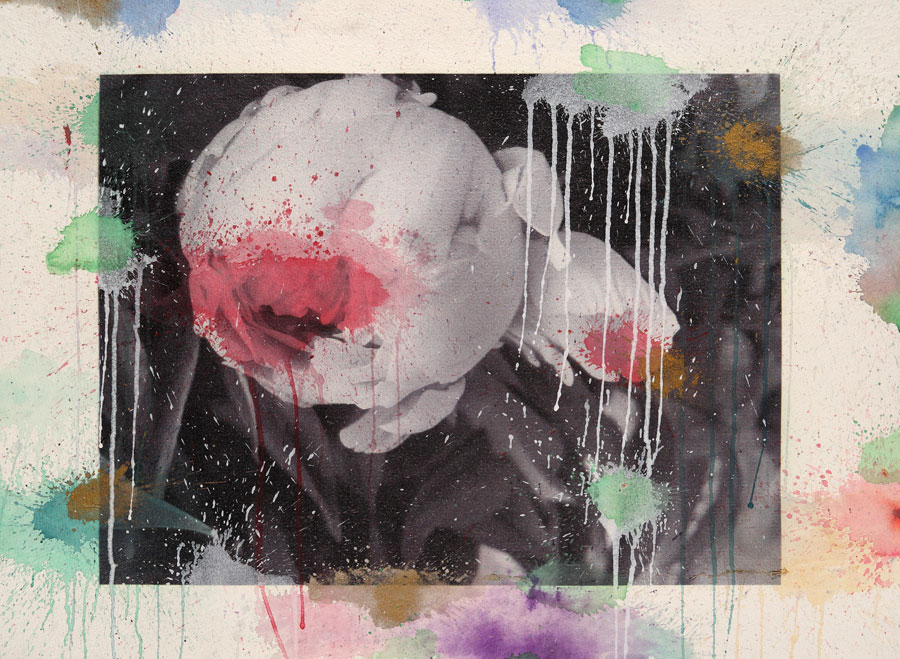
“Recent Works” consists of 11 mixed-media pieces and seven sculptures. Each of the mixed-media works begins with haphazard schemas and splashes of watercolor. The artist then prints familiar snapshots of daily life. Finally he over-paints them with new watercolor splashes.

Based on the evidence of this show, Ave’s personal history includes a half-naked figure, flowers and wreaths, colorful world atlases with bunches of flowers, a still photo of a chair and a closed window with blinds, a reclining figure of the artist, a chalice, furrowed pillows and family portraits. 

From one standpoint, at least, these motifs represent the artist’s personal history. But they are also universal, in that they can evoke images that would spark in any spectator’s imagination.

Born in 1945, Ave belongs to the first generation of Iranian contemporary artists who in the 1970s challenged the art of the Middle East and western Asia generally. His works are often intuitive responses to Iran’s social and political conditions. The work is hardly parochial, though, since ancient mythology and history are not limited to the Iranian experience alone.

Ave is one of those figures whose oeuvre has been characterized as an extreme form of contemporary art. He strongly believes in the “pure idea of [the] arts.”

The artist has said he regards his new series of work to be akin to a poem. These works create words and clauses, as if the poetic lexicon were located within this world. Like a poem, Ave’s art is capable of provoking multiple readings. 

A nude figure may depict the champion of ancient Persian mythology, or symbolize an inter-textual indicator for critics – or even a link to his older works. For Ave, the figure is a diary-like realization of a Turkish wrestler he once met in Paris. An antique Persian photograph surely relates to Qajar-era photography, though it is a family portrait of Ave’s ancestors in Yazd.

Ave’s “Divas” both address an era of fear and stability, as referenced in “Haftan Amshaspandan” (“Amshaspand” means “blessed immortal”) and gigantic sphinxes. Ave builds a contemporary legion of sphinxes in which fear and security are nurtured in a parallel and equal fashion. 

As he names these creatures, he tends to depict the paradoxical nature of fear and security, a mixture that is born in an inconsistent organism, that has pushed its way through aeons, surviving in the socio-political patterns of our time.

Ave exhibits these works without an appendix. He releases anonymous lived experience to blend itself into our common history. Just as these pictorial clauses are reinterpreted from time to time, different senses of these anonymous memories transform into a sort of poetic text.

Archaeology and reliance on the encounter of similes makes this body of work a set of “chansons imaginaires.” Ave’s works tend to divulge oblivion, an oblivion where things are neither forgotten nor remembered, where the wax idol of his contemporary life, and common sense, melt and congeal under the sun.

Fereydoun Ave’s ”Recent Works” is up at Tehran’s Khak Gallery until May 16.


A version of this article appeared in the print edition of The Daily Star on May 05, 2011, on page 16.


 Divas 6, Fereydoun Ave, composite + gold leaf 1/10, 2011, 50 x 30 x 110 cm

 Divas 7, Fereydoun Ave, composite + gold leaf 1/10 , 2011, 100 x 60 x 25 cm 

 Fereydoun Ave, mixed media on paper, 2011, 120 x 84cm

Fereydoun Ave, mixed media on paper, 2011, 95 x 77 cm 

Fereydoun Ave, mixed media on paper, 2011, 120 x 84cm

Fereydoun Ave, mixed media on paper, 2011, 120 x 84cm 

Fereydoun Ave, mixed media on paper, 2011, 120 x 84cm 

 Fereydoun Ave, mixed media on paper, 2011, 120 x 84cm 

 Fereydoun Ave, mixed media on paper, 2011, 120 x 84cm  

Fereydoun Ave, mixed media on paper, 2011, 120 x 84cm  

 Fereydoun Ave, mixed media on paper, 2011, 120 x 84cm  

 Fereydoun Ave, mixed media on paper, 2011, 120 x 84cm  

 Fereydoun Ave, mixed media on paper, 2011, 120 x 84cm 

Wednesday, 4 May 2011

Iranian artist completes designs for shrine of the third Shia Imam


Miniaturist Mahmoud Farshchian presented his designs for a religious shrine of the third Shia Imam in Iran at a local ceremony this week. The 81-year-old artist has expansive experience working within the religious creative industry, with paintings such as Prophet Abraham and Flagbearer of Truth receiving critical acclaim, and was commissioned for the project in 2007. It is thought that work will begin shortly. 

Farshchian furthered: “I have always been eager to work on religious topics. The board of trustees provided great help in completing this project. Master of the art of embossing Mostafa Khodadadzedeh collaborated in this great project, and master Mohammad Movahhed is currently working on its calligraphy work.”

 Mahmoud Farshchian explains his designs for the shrine of third Shia Imam, Hussein (PBUH).

Farshchian is known as Iran's master of miniatures, whose works have been displayed in numerous galleries and museums around the world such as the British Library, Freer Gallery of Art, Bibliotheque Nationale, Metropolitan Museum and Harvard University. He was chosen as an outstanding 21st century intellectual by Cambridge and has received an honorary doctorate in fine arts. 

Tuesday, 19 April 2011

Inside Iran: The art of resistance — the photographs

Part 3: Despite government restrictions, there is a renaissance taking place in Iranian photography, art and music.

by

Members of a thrash metal band, called Zax, practice in a hidden studio on Nov. 5, 2010 in Tehran, Iran. Photo by: Maryam Rahmanian/GlobalPost.

TEHRAN, Iran — As a little girl, Newsha Tavakolian dreamed of being a singer. There was only one problem: this wasn’t a career open to females in the Islamic Republic of Iran.

So now, some 20 years later, Travakolian, has found a different way to express herself. She’s become one of Iran’s most accomplished photographers, covering news and documentary projects. Her career started at the tender age of 16, shooting for various women’s publication in Tehran.

She has covered wars in Iraq, Afghanistan and Lebanon, shot the Hajj in Mecca, and her images have appeared in many influential publications in the United States, including TIME, Newsweek and National Geographic. Her images often depict the lives of women in Islamic societies.

In recent years, however, Tavakolian, 29, grew tired of shooting subjects, which she increasingly considered boring.

“They always wanted to show the clash between modernity and tradition, and all of these cliches,” she said. “And I was a part of that. I was taking pictures of the same things, and it wasn’t interesting for Iranians, because this is what they see all the time.”

As she’s matured in her craft, she has begun looking closer to home with a more localized eye.

“I realized that if I wanted to be respected in my own country I should do something with more layers,” she said. “I used to feel like I had to cover far away subjects, but I’ve changed. For this exhibition I chose a subject that’s only millimeters away from me.”

Tavakolian is part of the contemporary Iranian photography community, which is the artistic outlet in which many believe Iranians excel most. The current generation learned from a crop of Iranian photographers who covered the 1979 revolution, the eight-year war with Iraq, as well as the more mundane aspects of life in Iran — a nation that, although ruled with a heavy hand, is undoubtedly one of the most richly photogenic on the planet.

The restrictions of photography have become infamous, and many of the journalists jailed after the 2009 presidential election were arrested for taking pictures. Besides those news photographers who ended up behind bars, many others have since fled the country.

Those who have stayed have decided to turn their lens away from such politically charged subjects — the kind that land their images on the cover of Western newsweeklies — and instead pointedly document the critiques of Iran’s social fabric, which is ultimately much more powerful than yet another image of Iranian President Mahmoud Ahmadinejad giving a speech.

For her first exhibition, Tavakolian did a series of portraits of Iranian female singers like the kind Tavakolian once dreamed of becoming, who are still not allowed to perform in public.

The six portraits display a range of emotion from passion and ecstasy to rage and longing, and each was shot in front of a glittery backdrop that evokes a sad showbiz feel that is about as off-Broadway as one can imagine.

Opposite the portraits is another series, all of the same young woman in a variety of public settings, with sullen looks, not of despair, but often resignation. Each one is intended to represent the cover of an imagined album by one of the featured singers.

In one photograph, her model stands knee deep in the Caspian Sea fully clothed, completely in observance of Islamic tradition. The album title is, “Do You Remember This Is Not You?”

In another, the model’s head is encased in a transparent box, with the title “Glass Ceiling.”

The youngest singer in the series, Maral Afsharian, is represented by an image of the woman standing alone in the middle of an empty Tehran street wearing large red boxing gloves. Its title is, “When I was 20.”

In a separate room within the gallery, silent videos of each of the women played on a loop in the dark, providing a stark reminder that, although they might not be heard in public, they exist, which was ultimately one of Takavolian’s main objectives in the exhibition.

“I really don’t care about the results,” Tavakolian said in an interview several days before the opening. “The important thing is that it’s been 32 years that women cannot sing solo in Iran. And there are so many hopes and dreams lost in this period of time.”

“How can you say women can’t sing? It’s like saying a doctor can’t operate. It’s necessary in a society, so we’re missing something. And people have forgotten about that. It’s become normal for them,” she added.

The varied local responses to the exhibition provide a unique window into contemporary Iranian life. Some viewers did not understand the point of the soundless videos or the images captured in the album covers. Others were impressed.

“I really like Newsha’s work a lot,” said a local photographer who asked not to be named. “She’s very good at capturing subtle things that the rest of us miss.”

Another photographer, whose work relies heavily on the intimate details of his local surroundings, is Mohammad Ghazali, who uses very urban, often mundane, situations to tell different stories about Tehran. In one exhibition all of the shots were comprised of images from within Iran’s metro stations, another included images of the famed murals of those martyred in the war with Iraq.

His most recent project is comprised of photos from the points of view of statues of historical figures throughout Tehran. He said he chose the subject to help him tell how the capital has changed, and how the legacies of these important figures have evolved.

For example, the statue of a very famous poet was facing a garbage can. Of the statues he said, “They’re all over town and they tell a bright story, each is from a specific period of history”

“The viewer can form an opinion from the POV of the statue, as they view the conflict between present and past,” he added.

In a sense his work is predictive of an evolving society, but it also serves as a documentation of life in Iran’s frenetic capital. Locals might find it hard to understand what it is he is trying to capture, but that does not seem to have much impact on his desire to go after these seemingly obscure images.

In yet another series, he shot the windows of various Tehran shops after they were closed for the day, which got the attention of the police, who warned that if any of the shops he photographed were robbed in the coming days, he would likely be the prime suspect.

While others have used such intimidation to build a case for asylum, Ghazali sees it as a fact of life.

“These things have become normal for us. We know the challenges we face. I know sometimes when I go out and shoot I will get detained. So I'll bring a few photos of other examples from the same project I'm working on,” he said.

The constant struggle between photographers trying to capture images of life in Tehran and the city’s authorities who try to stop them has for many become indicative of the struggle for greater freedom of expression. Those who continue to work under these arguably stifling circumstances, though, find considerable inspiration from the challenge.

Ghazali and Tavakolian said they remained undeterred, and in their perseverance and that of other photographers working in Iran, one can hope for an ever clearer picture of the young and dynamic society living inside this oft unseen and equally misunderstood land.

“A lot of people get upset about the police stopping us, but it's part of the reality. I just think to myself ‘he's doing his job and I'm doing mine,’” Ghazali said.

Members of a country music band, called Bomrani, practice in their home on Oct. 24, 2010 in Tehran, Iran. Photo by: Maryam Rahmanian

 Faraz Jabbari, a member of the thrash metal band called Zax, walks by the picture of an Iran-Iraq war martyr on Dec. 6, 2010 in Tehran, Iran. Photo by: Maryam Rahmanian

Iranian female singer Maral Afsharian practices in a recording studio in Tehran, Iran on Nov. 12, 2010. Photo by: Maryam Rahmanian

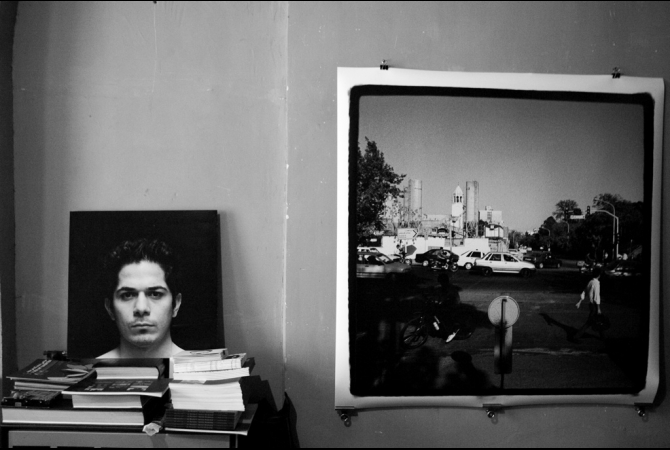
A self-portrait of the Iranian photographer Mohammad Ghazali, left, in his studio in Tehran, Iran. Photo by: Maryam Rahmanian

Iranian painter Amir-Hossein Zanjani in his studio on Dec. 12, 2010 in Tehran, Iran. Photo by: Maryam Rahmanian

 Iranian painter Ala Dehghan in Asar Gallery on Dec. 1, 2010 in Tehran, Iran. Photo by: Maryam Rahmanian

Iranian art enthusiasts visit a painting exhibition in Asar gallery in Tehran, Iran. Photo by: Maryam Rahmanian

 Newsha Tavakolian stands next to her images a day before her first solo exhibition at the Aran gallery on Dec. 23, 2010 in Tehran, Iran. Photo by: Maryam Rahmanian

 Newsha Tavakolian stands next to her photographs a day before her first the opening of her solo exhibition at Aran gallery on Dec. 23, 2010 in Tehran, Iran. Photo by: Maryam Rahmanian

Via GlobalPost

Inside Iran: The art of resistance — the paintings

Part 2: Painting has become one of the leading means of protest in Iran.

by


Iranian painter Amir-Hossein Zanjani in his studio on Dec 12, 2010 in Tehran, Iran. Photo by: Maryam Rahmanian/GlobalPost.

TEHRAN, Iran — On Dec. 21, the longest night of the year, and a holiday in Iran that far predates Islam, a few dozen people gathered in the home of Tehran-based curator Simin Dehghani.

Among the guests were local painters, photographers, writers and friends enjoying an evening amidst a collection of work by some of Tehran’s most promising young artists.

Dehghani, who studied art in the United States, returned to Iran, the country of her birth, in the late 1990s to begin a career promoting local artists and their work. In the years since Iranian President Mahmoud Ahmadinejad took office, the clock has been rolled back on many restrictions governing artists, both in granting permission to create their work, and then again to exhibit it.

But despite these conditions, there is a renaissance taking place in Iranian art, and its inspiration comes from the many struggles facing today’s youth.

Most notably, the aftermath of the 2009 election has also left an indelible imprint that artistically cannot be ignored.

“People experienced something amazing last year in Iran,” Dehghani said, referring to the mass protests against the reelection of Ahmadinejad and the subsequent government crackdown in 2009. “They saw things they will never forget. They felt things they had never felt before. It affects you. You can’t help but be affected by powerful images. Not just in a photographs or news footage, but in things you witnessed firsthand.”

While many artists understandably chose to leave Iran permanently after Tehran’s season of unrest, others have stayed, demanding their right to express themselves, although it is a liberty clearly not protected by Iranian law.

Still, there is room to create in Iran even amid the limitations, and many in and around the industry question the real reason so many artists have fled in recent months.

“I think some artists who left because they claimed their “lives were in danger” perhaps were too influenced in their work by recent social and political events and knowingly did something to upset the authorities and used this as an excuse to flee and emigrate,” Dehghani said.

The working conditions for artists in Iran have deteriorated immensely since reform-minded president Mohammad Khatami was replaced by the hardliner Ahmadinejad in 2005. The Khatami period was considered the golden era of expression inside Iran, and that was most visible in the arts and the relative ease with which artists could exhibit their work.

Despite the tighter restrictions, though, a new maturity is appearing in Iranian painting and this has signaled a new interest in up and coming Iranian artists.

“Now what I’ve come to, after everything that’s happened here, I organize exhibitions and try to promote young artists as much as I can, especially the ones who aren’t creating work that you see in the auctions. It’s not just a girl in a chador,” said Dehghani.

She was referring to art that simply reinforces long held stereotypes of what “Iran” is. A trend that increasingly belongs to the past, as a new wave of Iranian artists are creating groundbreaking work that not only questions the wisdom of a system that claims divine rule, but deals with subjects that go beyond longstanding cliches about the Iranian condition.

Of the artists who continue to work in Iran, many use strong messaging to point out the hypocrisy and inconsistencies within the power structure. While their work may not be easily shown, the essential point is that they are still producing.

One of them is painter Shahpour Pouyan, whose work usually depicts figures that resemble phalluses, including skyscrapers and horse hooves.

“I was born in the early days of the revolution and I spent eight of my first years living through a war,” he said, adding that his work largely deals with, “The relation of money and power and their affect on human life.”
Although Pouyan’s work has been the subject of government censorship — and actually was the reason several exhibitions were closed — that hasn’t deterred him from continuing to paint his graphic subjects or pushed him to leave Iran.

In the face of such difficult working conditions, he echoes a sentiment shared by many Iranian artists, stating that, “My work is completely dependent on Iranian and Middle Eastern cultural factors.”

Others take a different view of how local factors and Western aesthetics interact to form a contemporary Iranian style, but there is some consensus on the social factors that inform most artists’ work.

Indeed the tumultuous history of modern Iran that has included periods of democracy, monarchy and theocracy as well as one of the 20th century’s bloodiest wars, provides a large canvas, especially for young artists eager to move beyond the country’s heavy past and express themselves in all the ways that have become commonplace in the rest of the world. It should be no wonder, then, that sex, gender roles, violence and power are recurrent themes.

As Iranian artists resist leaving the seat of their inspiration, preferring to stay true to these homegrown visions, Western collectors are beginning to have a more profound appreciation for the messages within Iranian art. In the process a language of its own is developing.

Increasingly, art lovers have come to understand the often-subtle symbolism alive inside an Iranian painting. In central Tehran, near the city’s university, several galleries surround a municipality-funded center dedicated to the arts known as the House of Artists.

At the Assar gallery an exhibition curated by up and coming, and often controversial, local artist, Vahid Sharifian, displays some of these images steeped with subtle messages of subversion.

In one piece, a blurry eye chart descends into the colors of the Iranian flag, a pair of inverted capital E’s resemble a bearded face, the lower letters forming a robe that might be the silhouette of a mullah. To the casual viewer the message is unclear, but definitely no accident, according to Sharifian.

Another of the artists displayed in that show was Ala Dehghan, 29, a painter trained in the classical Persian miniature painting.

“I have grown up in the paradoxical environment of present day Iran. I have chosen to recreate some of these contradictions in my artwork,” she said.

Explaining how she uses these old techniques to depict themes relevant to contemporary Iranians, Dehghan said, “My work embodies the two aesthetics of Western and Eastern cultures. Both have enriched me; the Eastern narratives and magical imagery alongside Western contemporary practices.” In juxtaposing the two forms, she said of her painting, “often depicts the absurd and the darkness, which is reminiscent of the clash of modernity and Eastern cultures and arts.”

That clash continues to play out in the lives of many Iranians, and far from finding the often repressed atmosphere of Tehran too stifling to work in, these young artists find their creative inspiration in this charged environment.

“Personally, I think that unless you’re a political activist you can live and work in any society,” said Simin Dehghani, the show’s curater. “If people are clever, they can find their way around the limitations and say what it is that they want to say.”

Via GlobalPost

Inside Iran: the art of resistance — the music

Part 1: With street demonstrations in Iran effectively crushed, a desire for change is now expressed in music.

by


 Iranian singer Maral Afsharian practices her music in a recording studio in Tehran on Nov 12, 2010. Photo by: Maryam Rahmanian/GlobalPost.

TEHRAN, Iran — On a cold, gray afternoon, the members of a heavy-metal band called The Zax are thrashing out a practice in an industrial warehouse that appears to be a distribution center for smuggled cigarettes on the outskirts of Tehran.

They’ve wallpapered the warehouse with pieces of foam and other muffling materials to create an acoustically acceptable environment to hammer out a style of music inspired by Metallica without disturbing the neighbors, or alerting Iran’s notorious “Ministry of Culture and Guidance,” which would like nothing more than to shut them down.

Ako Raoofi, 22, the band’s drummer admits almost apologetically, “We just want to make music that we can listen to in our cars.”

While the desire to make music that they enjoy is paramount, the other main objective of Iranian bands, just like bands anywhere, is to perform in front of an audience, ideally inside Iran — and that is a very rare occurrence.

“It’s our dream to play for thousands of people, but obviously we’d rather play for 20 people right here in Tehran,” said Farraz Jabbari, 20, the bassist for The Zax. “We always want to do something here, in Iran.”
Ironically, though, the combination of legal restrictions along with the connective power of the internet and downloadable tracks means that Iran’s most successful underground artists achieve their initial successes outside the country.

For the better part of the past three decades, the only way Iranian musicians could have their music heard was to flee their homeland and record abroad, which meant a life destined to be spent in the diaspora, playing for crowds nostalgic for their homeland.

Quite a lot has changed, though, since the 1979 Iranian revolution, which led to the prohibition of many activities including listening to music in public. The effects of Ayatollah Khomeini’s edicts were far reaching, even inspiring the 1979 concept album "Joe's Garage" by American musician and free speech activist, Frank Zappa. In the liner notes Zappa writes, “just be glad you don't live in one of the cheerful little countries where, at this very moment, music is either severely restricted ... or, as it is in Iran, totally illegal.”

Over time, though, the prohibition of certain activities has flowed up from beneath the surface of the city and Tehran’s rich, albeit disjointed, music scene is a thriving example. Furthermore, the introduction of file sharing technology and Iran’s notorious lack of copyright laws, have provided conditions optimum for music produced in Iran, mostly without government permission, to be recorded locally and listened to throughout the world.

Impromptu studios and jam spaces have cropped up throughout the Iranian capital. Finding them isn’t always easy, but it’s by no means impossible, and the sounds emanating from inside these cocooned walls are growing in maturation and reach. For the first time since Iran’s 1979 revolution, Iranians are listening to popular music produced both inside the country and among its scattered diaspora.
The demand for music produced in Iran is steadily on the rise, and will continue to grow, according to the editors of a leading online resource for Iranian underground music, the Seattle-based Zirzamin.org, which literally means underground in Farsi.

“Should the Iranian government be more flexible, Iran would have a huge music industry as it consists of a young population hungry for new experiences,” one of Zirzamin's editors said.

Sites like Zirzamin highlight various acts from Iran, offering reviews of the latest underground recordings and ensuring that there is an audience for these fresh talents that in past years might have gone unnoticed.

Maral Afsharian, with her ranging voice, powerful lyrics — sung in English — and her stunning features, is the perfect example of an artist from Tehran’s underground that is in many ways ahead of the times within her own musical community.

Her unique brand of electronic rock, first as the lead singer of the group Plastic Wave, and now as a solo artist, has begun to achieve attention worldwide. The band was even invited to play at the prestigious and avant-garde South-by-Southwest (SXSW) festival in Austin, Texas. Ultimately the members of the band were denied visas to attend SXSW.

In her funky Tehran flat that feels more East Village than Islamic Republic, home to a variety of animals, including a yard long iguana that often roams freely, Afsharian explained her feelings about the transformation taking place within Iranian music and her own decision to continue playing in Iran, rather than trying to flee as so many other artists have in recent years.

“Most of them have no art in their music or at least nothing new in their music, so they need a very attractive story to get famous. They use this standard story: We cannot play music in Iran. Technically that’s true, but they can make music here and perform in other countries if they’re good,” she said.

Afsharian chooses to sing exclusively in English because, she says, “Farsi is very melodic. It doesn’t really fit the riffs and chords of rock music.”

Her accent alone signals to listeners that she’s singing of experiences had in a far off place. Her lyrics possess a rhythm that sticks long after the song finishes, as in Autotomous, a track on Plastic Wave’s [Re]action record in which she sings:

I had to dress like a clown just to walk around.
To have a room to feel safe in this fuckin' town.
I couldn't run couldn't hide couldn't help myself.
I had to not talk about the way I felt.


A perfect messenger of Iran’s young women trying to get their frustrations out, although Afsharian herself knows she wouldn’t be the first choice as a representative of her generation.

“I would really love to perform here, but at the moment I’m not sure I have enough of an audience. Even if I had the opportunity, I don’t know if many people here are really interested in my music,” she said.

Contrary to homegrown musicians in most countries who gain local notoriety before ever even dreaming of making it big, Afsharian said that the majority of her fans are outside of Iran, adding in her unavoidably contrarian fashion, “It’s not that strange. Most ordinary people here look at me like a weirdo. So it’s not really surprising.”

Bomrani is a group that plays, “blues and country from America, from your country, but in Farsi,” according to guitarist Jahan Qorbani, 24. Bomrani's album “Yellow Sky Blue Sun” was recently accepted by iTunes, demonstrating the widening appeal of music produced in Iran.

Although their lyrics often deal with the more mundane aspects of Iranian life, the mandatory military service for example, Bomrani’s sound is fun and the pleasure they take in playing has led to them being invited to play for more audiences in Tehran than some other acts.

The band’s lead singer and its namesake, Behzad Omrani, shuttles between Dubai and Tehran, as his band mates are unable to travel abroad.

“I’m the only one who’s been to the military,” he said, “so I’m the only one with a passport. They can’t go anywhere. So for now we’re going to keep playing right here.”

All men in Iran must serve nearly two years in the country’s military and are not eligible to have passports until they have completed this compulsory service.

While playing live shows in Iran is a rarity, the opportunity is one that these acts cherish regardless of the obstacles they face, and in fact sometimes because of them.

“Once we were playing at a cafe, and it turned out it was one of the days that they were bringing martyrs back (remains of soldiers killed in Iraq war,)” Omrani said. “We were in the middle of a song and someone told us, ‘turn it off, turn it off!’ So we did. And all of a sudden there was total silence. Just then we saw the turbans of a couple of mullahs passing by, once they were gone we just picked up in the middle of the song. It was great!”

Iranian President Mahmoud Ahmadinejad has made playing modern forms of popular music more difficult in recent years, but harmonica player Mani Mozakka, who still wears a green ribbon around his wrist to show his personal support for last year’s protest movement says, “When a door closes, people open up another path. We’ll always find a way to keep doing what we do.”

This attitude is taking root in Tehran and it appears as though a growing number of musicians are choosing this less traveled path.

“I used to think if I leave Iran and go to live in some other country, I’d be really successful and I would find a way to do what I want to do,” Afsharian said. “But I changed my mind. You know, I found that I’m always inspired by Iran.”

The reflections offered by bands in Iran run counter to the now accepted story of Iranian underground music, as delivered by Iranian director Bahman Ghobadi’s 2009 film “No one knows about Persian Cats,” which introduced global audiences to Tehran’s underground music scene.

The film paints a vivid picture of young musicians in the Iranian capital struggling to produce their art, constantly searching for reliable places to record, but ultimately failing to do so, instead hopelessly looking for escapes to Western countries, where presumably they would be free to perform.

Such themes work well with long-standing perceptions of Iran as an impossibly intolerant society, but to artists still working inside the Islamic Republic, the victimization does them no justice.

“We don’t have it as bad as the characters in that film,” Jabbari said. “We do this for the sake of music, and for that we went through some hardships, and we’d like more people to know about it.”

Via GlobalPost

Wednesday, 13 April 2011

Iranian Female Artists Unveiled:


Robert Adanto's Pearls on the Ocean Floor Screening at the Pacific Design Center, Los Angeles

Afsoon, "Shirin"

By Mahasti Afshar 

Sixteen "pearls" are featured in this groundbreaking documentary by Robert Adanto that will be screened at PDC's SilverScreen Theater in LA on April 26. I encourage everyone to go see it, especially if you need a morale boost. Come early if you like surprises, and plan to stay for the post-screening panel discussion; the director will be on hand along with the celebrated performer Sussan Deyhim and noted scholars Farzin Vahdat and Nasrin Rahimieh.

Adanto, who earned his MFA at NYU's Graduate Acting Program, began making documentaries in 2006 with an eye-opening look at China's explosive contemporary art scene, in The Rising Tide (2008).
He taped his first interview with a female Iranian artist only a week after the sham election in 2009 and completed the film that same dazing year. In the process, he produced sixteen illuminating self-portraits and unveiled a collective personality as well. For Pearls on the Ocean Floor gives us a glimpse into the character not only of the artists but by extension of the masses of women protesters in Iran who spilled into YouTube channels and our hearts in the spring and summer of 2009; it is easy to recognize the same spectacular honesty, courage and clarity of mind in both communities. 

Pearls -- a reference to a poem by Hafez -- isn't as much about the art of the artists interviewed as it is about why they make art. Three commentators, including Baroness Haleh Afshar, thread historical and social perspectives into the feature-length film as it unfolds. If you're like me, you will not tire of watching and will want to know even more. For that, you can consult the film's website for succinct and informative doses of biographical and art-critical profiles on the artists.

Most of the artists in Pearls say they make art to express themselves. One experience they express in common is 'identity theft': being robbed of Iran and their past, of their rights, of their womanhood, of modernity, of personal security, of individuality, of color, of music. The sense of loss is found in their work and in the irresistible naturalness of their words. "When I was born, the lion and the sun were still part of the Iranian flag," says Mona Hakimi-Schüler, a German-based artist who was born in Iran in 1979, the year revolution happened. "That's why the lion started appearing in my art and I continue using it. It stands for the nation, the people, and the spirit of Iran." 

Mona Hakimi-Schüler, "Untitled," The Memory Trace Series

Another artist, Malekeh Nayini, drags Iran home to Paris by colorizing old family photos -- and less cheerfully, by superimposing icons of the past onto the image of a demolition site in Paris, e.g., the cover of the Tehran Mosavar weekly featuring a popular singer, and of Towfiq, a satirical journal.

Malekeh Nayini, Updating a Family Album Series, "Aunty Iran and Aunty Touran"

Malekeh Nayini, Past Residue Series

In all, there is a running commentary of the pain of being cut off from one's roots. The experience is intensely personal, but what the artists tell us is that the expression is ultimately political. Afsoon, who lives in London, cherishes her freedom, feels guilty that it is denied others, and stresses that her work is non-political and autobiographical. "But I am a woman and I am Iranian," which by default renders her work political. That is because by exercising her freedom of expression, she's challenging the religious ideology that governs, targets and limits women's lives in Iran today. In that light, her innocent rendering of a smiling, tiara-clad Googoosh, whose fêted singing career started at age three but who is now prohibited from performing in public because of her gender, becomes a political statement.

Afsoon, "Fairytale Icons"

Personally, I never thought of the absence of freedom as something violent. That changed as I watched and listened to Parastou Forouhar, the daughter of the intellectual couple Dariush and Parvaneh Forouhar who were savagely stabbed to death by elements of the regime in 1998 during the Chain Murders. 

Calm, articulate, and strong, yet hurting more deeply than we can imagine, she is more imaginative than can be conveyed in a few words. "There's a vacuum where one cannot have a healthy relationship with one's home country," she says, "it's like the memory of an abuse that one feels." Her "Freitag" (Friday) is a terrifying commentary on the violent experience of abuse -- the shroud that robs women of their identity and buries them alive in its funereal bleakness. 

Parastou Forouhar, "Freitag"

Another nightmarish iteration, Forouhar's Swanrider series, was on exhibit in New York earlier this year. 

Parastou Forouhar, "Swanrider III"

In fact, we owe Frorouhar's appearance in Pearls to Rebecca Heidenberg who originally introduced Adanto to her and hosted her debut solo exhibition at the RH Gallery in NY, Nov. 2010-Jan. 2011. "Her commitment to justice and her incredible strength of character are perhaps the foundation for the power emanating from her work," Heidenberg wrote of Forouhar in the exhibit's press release. Agreed.
"I feel like choking. I can't speak. I can't express my existence as a woman. Everything is censored, visually and mentally." That's Bahar Sabzevari speaking of life in Iran. Born in 1980, a year after the Islamic revolution, and living in Paris, Bahar says her work is about "all that has been taken away from me and my generation as human beings and as the second sex, including basic freedoms." Then comes the attitude that I so love and admire about these young women: "My generation has lived with danger under the flag of a religious regime without being terrified by it." Undefeated, she challenges "what religious fundamentalism has done to us" in the distortions she records for history. 

Bahar Sabzevari

Shirin Neshat, whose parents shipped her off to LA at 17 to protect her from political activism, was perhaps the first to shock the world with her take on the imprint of Islam on the feminine body, psyche, and environment. A photo and video artist, she says of her experience going back to Iran in 1996 that "it felt like visiting a communist country; everything was controlled... as if the color was lifted out of this country." She wore green at the Venice Film Festival in September 2009. Haleh Anvari who grew up in a chadori family in Isfahan allows for the veil but qualifies it by outfitting her subjects in vivid colors to convey the lie in the black. "Iranian women are by law required to... render themselves invisible... I wanted to show how colorful Iranian women are, well groomed, and sexy!"

Haleh Anvari, "Chadornama"

And as if to underscore the point, Shadi Ghadirian's "CTRL+ALT+DEL" totally blacks out a woman except for her hands, feet, and face -- parts of her body that are officially allowed to be exposed. "A woman in Iran is a rebel, doing something which is not officially allowed," says Leila Pazooki, a young artist living in Germany, who speaks of "fashion" in Iran as a limitation, a form of censorship. Looking daring and determined, her Persian model illustrates a woman's response to that limitation.


Leila Pazooki, "Tehran Fashion"

Which brings us to the question of how women negotiate the many and varied tensions that they face daily. Gohar Dashti lives in Ahvaz, in southern Iran. She experienced the Iran-Iraq war, 1980-1988, firsthand. It left a mark. Her photographs capture couples who, even on joyous occasions such as their honeymoons, are marked by grief. Life goes on, she says, we cope, but there is always the grief. There is no sense of defeat in what she says, or self-pity, only a hopeful search for staying in the game, perchance to reform the rules. An artist's mission, she says, is to raise public awareness and to make history. "We don't have clear red lines [in Iran]. You can play on both sides of the line. It's very important to know how to play this game... and Iranian artists are good at it." 

Afshan Ketabchi is not as hopeful. "The problem lies in the roots of our society. We have to completely dismantle the structure and rebuild it." Elsewhere she makes a very poignant remark that focuses the problem not on Islam or the regime as most critics do, but on the actors themselves. "The problem is that men still don't respect women." The reason, to cite Baroness Haleh Afshar when speaking of Khomeini and religious leaders, is that women "by their very nature, can be revolutionaries." It may be obvious to enlightened souls that a society where women enjoy freedom and full respect is a more successful and sustainable society. But try to explain that to a raging bigot.

Diaspora artists who live in freedom grapple with issues of their own as well. Take Sara Rahbar, for instance, who, on the one hand, strikes a difficult pose with her Iranian heritage: woman dolled up, significantly alive yet fixed in time and place, with a guard who, though a tiny toy, is a man nevertheless, armed and official.

 Sara Rahbar, "#3 After You"

On the other hand, she grapples with her dual identity and America's role in the Islamic revolution.

Sara Rahbar, "Hossein and I," Oppression Series

But she has bigger aspirations. "I really want to do something great... like Gandhi and Martin Luther King, Jr., not K-Mart or Walmart. We're here for a short period of time." And yes, she wants to be known for her work as an artist who happens to be Iranian, not as an "Iranian" artist. 

In Pearls on the Ocean Floor, Adanto has managed to lift the veil off Iranian female artists and let us discover these genuine, creative, fearless, self-assured, good-humored, honest, independent, and colorful spirits who believe in themselves and in the future. Pearls is a precious record.

The documentary captures a broader trajectory in Iran's history as well, namely, the transition from a traditional to a modern platform among artists that began in the 1970s. Until then, contemporary Iranian artists continued to resort to the traditional language of miniature paintings, calligraphy, and abstract geometric patterns to express themselves; they explored novel forms, but little of the content was contemporary in essence. Art remained by and large ornamental, spiritual, and idealistic; its purpose was to please rather than to provoke or tease. It was rarely realistic, urban, socio-political, or, heaven forbid, personal, autobiographical, or sensual. All that has now changed. The ocean has yielded pearls. If you don't believe me, go take a plunge, see for yourself.