Thursday, 7 July 2011

In Search of [Iran's] National Masculine Identity

Sadeq Tirafkan and his art

Note: In writing this article, Tirafkan’s interviews with Canvas (Art and Culture from the Middle East & Arab World, Vol.3, 2009), and Asian Art News (Vol.18, 2008), his own comments for his various exhibitions stated in the corresponding catalogues have been the sources of inspiration.
Sadeq Tirafkan
Sadegh Tirafkan was born in Karbala, Iraq to Iranian parents in 1965, and like all Iranian families in Iraq at that time, they were expelled by Saddam Hussein in 1971. So they fled to Iran just before the Islamic revolution. From 15 to 18, Tirafkan became a member of the youth militia, basij and participated in Iran-Iraq war in 1980s. The experience left such a deep impression on him that still reverberates in his work. In an interview with Canvas, while showing his snapshots of those years, he says: “Most of these people are dead now and I have lost touch with the others.” HisAshura ongoing series originates from these years of his direct religious experience, when he also made his mind to pursue an artistic career and subsequently entered Tehran University and was graduated in 1989 with a degree in photography. “I began photography by recording what surrounded me, now I take what is around me into the studio and make it into what I see through the prism of my life and culture. An idea starts as photograph, but it may grow into a collage or video.” His simultaneous deep interest in theater and film, frequently makes his work appear as a combination of a staged theatricality (even when he has not actually staged the photo) with a documentarian’s eye, revealing the influence of Cindy Sherman on him. Like her, Tirafkan uses self-portraiture to fulfill narrative ends, but where Sherman adopts various disguises in her photos, he is nearly always recognisable.
“I like the precision and aesthetic of a staged photo and strive for that without actually staging it.” Other influences include Philip Lorca di Corcia and Vik Muniz. Tirafkan is continually absorbing and learning from all around and, as he says, “I’m always a student.”

To some extent this explains Tirafakan’s spontaneous approach to his projects. He constantly works on simultaneous projects and never begins them as a work in isolation with determined start and end date.
Thematic variations consistently weave in and out of Sadegh Tirafkan’s work - Iranian culture, contemporary culture, ancient culture and his identity as a man and as an Iranian. In his photography and videos, Tirafkan draws from the vast several thousand-year-old history of Iran, from the Zoroastrian religion and the Safavid Dynasty to the present, including satellite television and celebrity culture. He subsequently adds layers of his own personal experience to create a rich tapestry of expertly crafted aesthetics and concepts.
Tirafkan is a genial man with salt-and-pepper hair, expressive hands and a quick smile. His boyish looks and energetic demeanour reveal the mature voice of a man who has witnessed a lot in his 44 years.”
He had his first solo exhibition of portraits at Seyhoun Gallery in Tehran, in 1990. In the November of the same year he was invited to participate in Mois de photographie held in Paris. This marked the beginning of his career outside Iran and became the impetus for his move to New York in 1997, where the interaction with Western artists strengthened his belief in his Iranian-ness, bringing him back to Iran to produce the first conceptual video installation produced in Iran, called Persepolis exhibited at Seyhoun Gallery in 1998.
In an interview with Janet Rady from Asian Art News, in reply to her question, why he used Persepolis as a backdrop for images of himself, he exclaims: “... The question of identity of self and of nationality has always fascinated me. The glory and grandeur of any civilization is reflected in the monuments left behind and by picturing myself, I wanted to better understand what it was that the monument exuded both on a personal level and on a national one.”

Perspolis, Black and white print,
1998

While in Iran, he becomes more interested in Pre-Islamic and Islamic cultures, including art, philosophy and literature, giving rise to his series of Choghazanbil (an ancient ziggurat in southwest Iran 1995-1998) and Ashura (the mourning ceremony of martyrdom of the third Shiite Imam Hussein (1989-2004) and Persepolis 2 series in 2002 in which he introduced other people from different historical settings into the frame.
Multitude, 74 x110 cm, Digital photo collage, 2008

Beginning to shoot with a Hasselblad camera, which captures incredibly rich and detailed images, Tirafkan switched to a portable digital format in 2002. That’s why the Ashura series, consists of snapshots which are sometimes the final work of art and at other times, they serve as a preparatory image that the artist then manipulates on a computer. Within the theme of Ashura, Tirafkan has many subcategories, including fashion, generation and gender. The fashion component resulted in the Men in Black series. The first part of Ashura was exhibited at Tehran Museum of Contemporary Arts in 2001. A part of Men in Black first appeared in a book published in 2005, and later exhibited at Waterhouse & Dodd Fine Art in 2008. Altogether according to his own estimate only five percent of the series has been seen by the public, something he hopes to change by publishing a book of all the images in the future.
In 2002 he turns to calligraphy which he considers as “the highest written form of communication for all mankind,” and his Secrets of Words is born, featured in Whispered Secrets, Murmuring Dreams, a group exhibition held in London in 2008. “We all have our sad stories, which we instantly recognize in the glimpse of another. So, the single letters in my work act as a metaphor for these glimpses and set out to show that through our feeling-experiences, we all share something in common.”
Secret of words, 63x90 cm, C print, 2002

In addition to Iranian history and self-identity, masculinity and manhood has been a major subject matter of Tirafkan’s works, dealt with first in Iranian Men (2000) which was later published in Belgium in 2006. A self-portrait photo triptych resembling a sequential comic strip, masking his identity under a red lo-ng, a traditional Iranian sash (originally made of gold and silk threads) used in sporting combats that is known as the warrior wearing symbol of masculinity and according to Tirafkan “of humanity of real man not just in Iran, but in universal society today. In fact, the subject of masculinity is continued in my current series The Loss of Identity.”
“I tried to convey the humanistic message embedded in these ancient symbols of manhood in my culture - lest they are forgotten.
In Zoorkhaneh (2003-4)which is Islamized Mithraic temples where ever since then men made their body as well as their mind, and has been the cradle of many orders of knighthood and other masculine cults, Tirafkan tries to show that although ‘the same environment and looks are kept, but not the same spirit and attitude.
Zoorkhaneh (Traditional Iranian sport club), 60x90 cm, C.print, 2003-04

No wonder that his other simultaneous project, Sacrifice (2003) video is set in a zoorkhaneh, where the red lo-ng wearing wrestlers tumble about center stage.
But just underneath the surface, crimes of passion clash with hidden affairs and madness dances with rage. This is where Tirafkan challenges the taboos of traditional Iranian culture. Inspired by the stories of Abraham nearly killing his favorite son to prove his devotion to God, Rostam, the most well-known ancient Iranian knight unknowingly killing his sole son to prove his devotion to his king and country and Imam Hussein as the classical Shiite emblem of self-sacrifice for one’s faith and ideology, Tirafkan describes this series as “my artistic interpretation of the emotional impact these stories have had on me since childhood.” Later he develops the same theme further in Devotion.
For Tirafkan symbols “have their own values and meaning in every culture,’ while “basic human instincts have common meanings for people all over the world.” To him “pomegranate is the most symbolic fruit in middle east,” covering a wide scope of meanings from love to infinite world and in Temptation dedicated to his favorite filmmaker Sergei Parajanov, he “leaves the audience to interpret it in their own way.”
In Body Signs, Body Curves and Loss of Our Identity, Tirafkan approaches culture as a physical stamp that cannot be removed or altered, thus making a great part of one’s identity. The imagery in these series was inspired by ancient Iranian tattooing practiced among pre-Achaemenid kings, as well as by wooden block print stamps used to decorate cloth. But for Tirafkan, “the blocks have been used here to stamp the human form. Flesh is the canvas branded by culture.”

Body Curves, 60x46 cm, Mixed of stamps and hand written calligraphy on silver print,
2001-02

From another perspective, this series can be viewed as the artist’s lamentation for former glories of Iranian culture now being replaced by contemporary Iranian youth with “the present commercial pervasive satellite broadcasts and the Internet.” As Tirafkan so aptly states, “The first thing war kills is culture. Governments cut budgets for culture but have the means for the satellites that beam garbage directly into peoples’ homes.” The role of cultural heritage in contemporary life is another ongoing subject, Tirafkan deal with in Multitude and Devotion exhibited at Assar Gallery in Tehran in 2008. Both series deal with the leitmotifs of identity and culture.
Multitude looks to a person’s public life and the crowded streets of Tehran one must negotiate when leaving one’s home, taking the initial documentary snapshots of multigenerational group of men sitting on a hillside and transforming them into a work of art by manipulating the hillside into a rich and complex surface of dirt and an earth-toned Safavid carpet. Devotion which is more reserved and contemplative, comprises a series of a sequence of photos of men and women applied to the four walls of the gallery; in the centre is a glowing yellow-and-green glass a ziggurat-like construction referring to Iran’s Zoroastrian past. This sober work is more understated than his previous projects and also incorporates elements of installation art, which is new for the artist, who hopes to develop this project and exhibit it elsewhere.
Whispers of the East (2006-7) deals with the question of democracy and how US has little sensitivity for culture, religion and life style in the region, but is only concerned about military actions. With his interpretation of a classic Persian carpet, Tirafkan seeks to preserve the traditions.
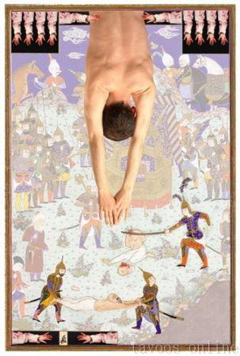
Whispers of the East 3,
2006-07
His most recent project, Human Tapestry is a commemoration of the traditional art and unknown artists of his homeland to tie traditional beliefs and ancient patterns to modern people and contemporary aesthetics. “From 2006 I have been focusing on population and its unbalanced distribution around the world within my works.
I don’t only look at topic from a political aspect, but also and most importantly from an artistic eye - an eye which originates from a thousand year old culture, rich with history and civilization. I have been trying to combine current events with layered and hidden historical art, using new technology in order to ease communication between people living in today’s world and my work.”
Human Tapestry, 97x151 cm, Digital photo collage, 2009-2010

As his body of work elucidates, Tirafkan is very proud of his identity as an Iranian man. He conveys this pride through meticulous art in which every detail is weighed and measured in order to create work that is to the best of his ability. He sees this as the ultimate Iranian cultural trait. “Iranian art reflects a heightened sense of perfectionism. Look at Persepolis, Iranian miniatures and Safavid art!”
Tirafkan’s richly layered art is the work of an incredibly complex man who has been to hell and back and whose work is fearless and poignant.
Perhaps his art is a poetic way to exorcise demons of the past and present.

My goal is to demonstrate that all people regardless of gender, culture and religion are indeed looking for inner peace and sanctity.

Via Peyvand

Wednesday, 6 July 2011

The Art of Being a Gallerist in Iran

Iranian art has been the highlight of many international exhibitions in recent years, the interest both inside and outside the country has been intensifying and the market is thriving.

Although galleries and cultural institutions inside Iran are restricted only to function within a set of tightly enforced rules and regulations, Tehran is now home to many art galleries - about 46 new galleries have opened in past two years alone according to Iran’s director of Visual Arts Office for the Ministry of Culture and Islamic Guidance - and the number keeps rising.

In this interview, Leila Sajjadi talks to three of the most active and best-known Tehran based gallerists about the past, present and future of Iranian visual arts. Lili Golestan of Golestan Gallery is one of the pioneers of the profession in the country, Nazila Nobashari directs Aaran Gallery, a relatively young gallery that is active in promoting avant garde and courageous art in the scene and Omid Tehrani of Assar Art Gallery, who plays an active role in introducing and promoting modern and contemporary Iranian art to the International art scene.

 - How has the Iranian art landscape changed in the past ten years?

LG: The most significant event in my view has been that Iranian art entered the international market through auctions and this has been having both negative and positive effects. Auction houses of London and Dubai introduced new collectors to Iranian paintings; therefore Iranian art found a new market but this on the other hand had a very negative effect on the domestic art market inside the country.  Prices of art works saw illogical price rise in the auctions and this caused artists not to be able to sell in the domestic market. This has had a very negative effect on the business side of running galleries. I personally have tried to hold prices of arts I promote at reasonable level and have been able to carry on selling to public.

NN: A whole generation has come of age, having had to put up with limitations and scarcities and controls in their private lives and at universities. Their language is bold and brazen and they are determined to make their way in the wider world. The international success of some young artists has led the others to believe in themselves and to gain more self-confidence. Access to the Internet, and therefore the international art scene, has contributed a lot to progress of young artists and there are more venues to show art, both at governmental and private spaces.

OT: I think what has been especially significant is the rising number of places that art can now be shown as opposed to how few they were during the war right after the revolution.  Also in the past few years Iranian art have been internationally noticed and praised through auctions and international exhibitions and that has created a whole new market for the arts of this country.
   
- What would you look for in the works of art you decide to promote?

LG: I look for innovation; I like my artists to keep renewing themselves. I don’t like repetition and I stress this point to the artists I promote if I see them repeat themselves and I try to come up with new and fresh ideas for the exhibitions I set up in my gallery.

NN: What interests me is originality of course and unique styles. I prefer multi-disciplined artists with subtle socio-political outlook.

OT: Well,you can’t show everything and anything in Iran and so you are obliged to have a relatively conservative approach in this profession.  I have gained a specific character to the mood of the stuff I have shown throughout the years. What I promote is mainly focused on artists in a specific age group who do figurative painting.  Social subjects attract me but I normally don’t believe or enjoy works which are focused on political and particular traditional aspects of life here that have become fashionable for a while.

- Why paintings are still the leading art form in the Iranian art market? Or has this changed recently?

LG: This is mainly because of old habits and attitudes towards the arts here. We have a long way to go until we can establish other forms of artistic expressions such as sculptures, installations, video art etc in our art market and consider them as important as paintings. Even with paintings there aren’t many buyers. Sales are among a relatively small group of enthusiasts. I like attracting general public to like a piece of art and buy it for their pleasure. I like to be able to cultivate the notion in people, that they can buy art and enjoy having it with the money they have spent on it.

NN: Paintings are preferred here, for a number of reasons. Firstly, it is the ease of appreciation of values of paintings in comparison with photography or installation pieces. Most buyers are in the age bracket of 40 to 60 and not always acquainted with contemporary art. Production costs for installations and sculptural works are quite high and often the final product is not up to acceptable quality that would attract serious collectors, but the market is changing very fast. There is great interest from Iranians living abroad as well as international collectors, who are more inclined towards contemporary pieces these days than paintings.

OT: I think this is very much the case everywhere and not specific to Iran.  Video art or photography are true to be faster to complete and get into the market and a lot more available, but still, I would say 90% to 95% of the real art market’s attention has always been and still is focused on paintings and frankly I think that it will remain this way.
 
- How do you feel about the Auctions and Art Fairs? Are you a participant in selling or buying through them?

LG:  I have never participated in either of them.  The games one should play behind the scenes of auction houses are not to my taste. I am not a player on that level. I don’t like and I don’t have the attitude you must have to get involved.  Once I went to one of Dubai’s auctions just to see the mood and to weigh my judgment and I got the feeling that I was right; so I never participate.  On the other hand I find Art fairs interesting but they are very expensive to participate in and I know that it would be very beneficial to my gallery and to my artists if I do get involved but frankly I don’t have the budget for it.

NN: We have no dealings with auction houses. That is the business of collectors and not galleries or artists. It is a secondary market and not the play field of young artists. As for art fairs, we have participated and although there are quite a lot of hard work and high costs involved, indeed it’s good exposure for galleries and artists.

OT: Art fairs and auctions are two completely different areas! I participate in both for different reasons.  Auction lovers are so different to art fairs goers. People I consult with how and which works of art to invest in auctions are normally people who have the energy but not the patience. These people normally don’t enjoy going to art fairs but love to invest in works of art.  Art fairs are a whole different atmosphere; you would get involved because you love art and love discovering new art.  I like both of these two worlds, I make money in auctions through buying and selling and I spend that money on art fairs.  I very much like for my gallery to be in art fairs and love to carry on being in them.  In art fairs if you’re a relatively young gallery, it will take time for visitors and buyers to trust you in what you show them, I like this challenge. I like to take my time building these relationships. 

- What would you say to new collectors who want to invest in Iranian art? 

LG: I would encourage them to buy works by young artists.  My mission when I started a gallery was to promote young and new talent.  I have so much respect for the masters of Iranian art but I always take pleasure in being able to discover and promote new talent and see them find their way into the scene and this still is what keeps me going in this profession.

NN: My advice is to look for unique artists, timeless pieces, and always check the resume.

OT: Well, I would say, if you have never been here, do come to Iran and feel the artistic atmosphere and visit the galleries and look for what you like.  It all depends on the reasons why you like to invest in Iranian art.  If you like to put your money into something safe, I would say go for artists of the Iranian modern movement of the 70’s.  Alternatively, I would recommend contemporary art to collectors who enjoy seeking out new artists taking the opportunity to develop a collection that may increase in value over time.

- What aspects can improve the quality of the ways galleries function inside Iran?

LG:  The government gives permission to anyone who has got a space to open a gallery but out of all these galleries there are only about 10 -12 galleries that function well.  I believe being cultured and having a professional attitude in this field is a must.  You have to be able to participate in cultural debates; educate and be beneficial to the culture of this country.  I like to see more people who are actually trained for this field to get involved and to bring about a professional attitude to what an art gallery should really do.

NN: We need more good art critics, more good galleries and more buyers.

OT: There have been a lot of licenses issued for galleries but you really only hear from around 20 of them.  There is still a long way to go. I think in about 10 years we reach a point where we can run galleries in a truly professional way here.  I think one important step would be for galleries to clarify which artists they are representing on contract based system and to really build a genuinely professional attitude in their relationship with the artists and with the public.  I would say currently there are only about 5 galleries in Tehran that really work professionally. 

- Where is the best collection of Iranian Modern and Contemporary Iranian art kept?

LG: One would think it has got be the Tehran Museum of Contemporary Art but the museum has not bought additional works for its collection in years! The problem again is that people who manage the museums are not professionals in the field of culture and arts so they waste the museum’s budget and they don’t really
benefit the museum.  I think you will find the best of Iranian art scattered around inside people’s homes.

NN: At Tehran Museum of Contemporary Art, although it’s mostly modern art and the collection is mainly just of paintings. You can hardly call it a contemporary collection.

OT: For Contemporary art we don’t have a well kept and archived collection yet.  For modern Iranian art, I think Tehran Museum of Contemporary Art is a notable location.  Also there are collectors who have very good collections of modern art but not specifically contemporary. I don’t know of anyone or anywhere that has a collection of the best of both combined.  There is a collector based in the Emirates that has a private collection of around 2000 pieces of both modern and contemporary art but it is not a well organized and archived collection and many of the artists in it are unknown.

- Looking ahead 80 years from now, how do you think Iranian art of 21st century be regarded as?

LG: It will be regarded very highly.  We have a lot of young and talented and innovative artists who have entered the art scene and have given it a very exciting twist.  This is amazing because what happens artistically now is very spontaneous. These artists have only the support of galleries and not the government (as it is supposed to be their duty to support art and culture of Iran).  In a way I am glad that they don’t provide support because they will only enforce their own taste and objectives in what they back if they did.

NN: It will be regarded as courageous and interesting.

OT: I think in the next ten years, Iranian art will enter a truly world class level and will be a serious player in the international art scene. But for this we must plan well and have real objectives.  Iranian art has got so much potential. It is eccentric and distinctive and very different to the art of the rest of the region qnd the world.  I also think that Iranian non-decorative art will flourish but I don’t know how this will all be regarded 80 years ahead!

Leila Sajjadi's blog
Via Art Review

Monday, 4 July 2011

Nasseredin Shah & His 84 Wives

In 1842 the 11 year-old heir to the Persian throne, Nasseredin Mirza, received a photographic camera from Queen Victoria of England. In the following decades he documented his life: his many wives, his jesters and clowns, his glorious palaces, and his jewels and treasures. As such he revealed to the public eye, what the public eye never was supposed to see.

Through animated sequences and photos taken by Nasseredin Shah and his court, the film depicts the rivalry and intrigues within the harem, the corruption, the secret murders, the political power struggle, the Shah's obsession with a beautiful calico cat, as well as Persia's troubled relation to Europe.

A film by Beach Petersen 
Related Link:  QAJAR PHOTO ALBUM

Tuesday, 28 June 2011

Armed with a Paintbrush:

Q&A with Farah Ossouli

 Mona Lisa, Photo: Courtesy of Farah Ossouli

By Erin Joyce, Aslan Media Art Editor

Every once and while an artist appears on the international scene whose work hypnotizes an audience, forcing them to stop and take in, in a meaningful way, what they are seeing. Iranian painter Farah Ossouli is one of those artists. The rich patterns and saturated colors Ossouli employs in her work are visually arresting. Ranging in subject matter from autobiographical to quasi-religious, Ossouli lends a breadth and range to her paintings, adding to the multi-faceted quality of this talented artists.

Born in 1953 in Zanjan, Iran, Ossouli has been living the life of an artist since childhood. She received her B.A in graphic design from Tehran University and has not stopped painting since. Ossouli has had several solo-exhibitions in Iran and Germany, and has been featured in many group exhibitions in Paris, the United States, the United Arab Emirates, Belgium, Turkey, and extensively throughout the Arab World. Her work is part of the permanent collection at museums in the Netherlands, Germany, and throughout Iran and Jordan, and she has won several prestigious awards for her artwork.

Ossouli recently sat down with Aslan Media to discuss her life, her beginnings as an artist, what it means to be a woman artist in Iran, and what inspires her to paint.

Aslan Media: You were born, raised and educated in Iran. What was life like growing up there and how has it impacted your life as an adult?

Farah Ossuli: I had a childhood full of joy and love, parents and siblings who filled my life with happiness. The result of an active childhood and adolescence full of travels, games and recreation was a sense of hope and self-confidence. It still gives me an impetus to challenge the problems. I have a painting titled Childhood Paradise which shows my feelings of my childhood. I have many paintings centering on Mother.

AM: Were your parents artists or artistic in any way or involved in the visual arts? What influenced you as a child to begin your work in the art world?

FO: My parents played a major role in me becoming an artist. I inherited a talent for visual arts from my maternal family. Many of the relatives on my mother's side paint as a hobby or are interested in art. Therefore, they always encouraged me to paint. My aunt began to study art when I was born. She is a Painting graduate of School of Fine Arts. She also obtained her MFA in Graphic Design from Art University. She provided me with large papers and diverse colors so that I could make different experiments during my childhood.

One of my sisters is a professional painter who has already graduated from Art University. My other sister and brother are also painters, but studied Drama. Therefore, art runs in the family. During the time I was at the elementary school I used to write short stories and paint a lot. I thought I would become a writer in the future.

AM: That is such an amazing resource, to have such an artistic environment in which to grow up. What age were you when you decided to commit to art as a career?

FO: I participated in national painting competitions as a school student. I was the winner of the first prize at times and received prizes. The prize for one of these competitions was the free admission to a professional painting class. I was fourteen at the time and it was difficult to attend both the painting class and school. It changed my view of painting, though. It ushered me to the great world of painting at an early age.

I was awarded in another competition a year later. This was the beginning of a serious initiation into the world of art. This time, though, I won admission to the summer classes of the School of Fine Arts. The teacher who taught there asked me what field I was planning to study. I said I was planning to study literature and to become a writer. She suggested that I participated in art entrance exam and chose painting as I had a talent for painting.

AM: How much do you feel your training in university influenced your artistic aesthetic?

FO: I entered the School of Fine Arts when I was fifteen and choosing painting, I entered a paradise of which I am, fortunately, yet to be expelled.

AM: Do you feel that to function as an artist in contemporary society that a degree was a beneficial undertaking?

FO: Academic studies do not make an artist, but it is important to go to university if you are looking for the right direction, contacts, discussions, debates, practices and order, and need to live in an art environment along with other students and teachers during an early stage in life when an individual is most influenced by his/her environment.

Childhood Paradise, 76x76, 2005, Photo: Courtesy of Farah Ossouli

AM: On being influenced by one’s environment; to what extent do you feel your Iranian culture and heritage has influenced your art aesthetic?

FO: To a large extent … I am greatly inspired by the standards of Iranian visual arts. Early miniature paintings, architecture, tile work, Pop Art, klims, rugs, literature, philosophy, history, geography, sociology, and psychology of this land are among the subjects that interest me. Therefore, they are directly or indirectly reflected in my work. AM: Who do you create your artwork for? Do you have a specific audience in mind or do you create just for yourself, and people happen to see your work?

FO: I have never been commissioned to produce a work for a specific audience. I have things to say and try to express my ideas in my own way. I try to depict my thoughts as I wish. I assume that there is always an audience for what an artist creates.

AM: As a member of the artistic community (and audience member yourself), specifically the community of artists working in and around the Arab world—what is your impression of Middle Eastern art scene today? What other artists are you a fan of from the Middle East?

FO: Art of the Middle East is going through an important era. Artists are discussing issues that have never been touched upon. In the age of Internet and information technology, artists of this region are also encouraged to express their views and get heard by important people around the globe.

Differences in life conditions, governments, traditions, and standards led to a new art form that introduced audiences in the east and the west to the novelty and distinction of the art of this region.

Shirin Neshat, Mohammad Ehsaei, Shirazeh Houshyari, Parviz Tanavoli, Ghada Amer and Mona Hatoum are among the artists I am interested in.

AM: Has the oeuvre of other artists influenced your-self as a painter? Who were your favorites?
FO: I was inspired by and learned from many artists at the beginning of my studies at the School of Fine Arts and college. Michelangelo, Leonardo da Vinci, Botticelli, Georges Rouault, Henri Matisse, Gustav Klimt, Kate Kolwitz, Marc Chagall, Jackson Pollock, Rothko, and Toulouse-Lautrec are among many others.

AM: I find that my taste in art is always in flux and my favorite artists tend to change over time. Have your favorites changed over the years?

FO: My interest grew over time to include artists such as Reza Abbasi, Kamaleddin Behzad, Otamaro, Hokusai, Judy Chicago, Anish Kapoor, Frida Kahlo, Cindy Sherman, Georg Baselitz, and many other contemporary artists of the east and west.

AM: In your own words, what has the response been to your work? Do you have any interesting accounts of how someone reacted to your art in either a positive of negative way?

FO: Once a European couple came to my studio to acquire an artwork. They had a three-month child and had been waiting for a long time to use their savings to buy a painting. The couple had lost part of their savings for some reason, though. They were at the end of their tenure in Iran and had to return to their country. They explained their financial situation and proposed a price that was a quarter of the original price I had offered. The moment I agreed to the price they had offered, the young man delightedly jumped up and ripped his trousers, while milk trickled off his wife's breast. I will never forget this delightful moment.

AM: What do your parents and/or other family members think of your life as a visual artist? Do you ever discuss your artistic motivation with them?

FO: My family, including my parents and siblings, my children (my daughter studies painting) and my husband (a prominent filmmaker) respect what I do. They encourage me and we always discuss my motivations and ideas as well as other art forms.

AM: What has been your personal favorite work that you have created?

FO: It is not possible to choose a specific painting as my best artwork. I sometimes have ideas, though, that take a long time to become an artwork. I enjoy such challenges and feel happy and at peace when I succeed.

AM: Do you feel that you will ever reach a point where you will become bored with art?

FO: Since I love art, it will never bore me. I have been practicing art for 43 years and am not sure how I can live without it. The hope to paint wakes me up every morning. Creation is an endless, pleasant journey for me.

AM: With all the unrest in the region right now, and the revolutions of the Arab Spring, do you feel inspired or, maybe better phrased, motivated by these events in your painting? Have themes or issues that relate to revolution appeared in your work?

FO: It has often been controversial. Traditional miniature painters believe that my work is riotous and destructive to the miniature painting. On the other hand, conservative Westernized painters consider my work traditional miniature painting. I feel alone and unappreciated by both groups.

During the thirty years I have been mastering miniature painting I have been criticized time and again for not fitting into any categories.

On the other hand, I have enthusiastic buyers and admirers inside and outside Iran. My work is especially interesting to art critics and researchers abroad.

AM: Do you think your work is controversial? What is life like for you right now in Iran? Are you able to openly exhibit your artwork there?

FO: Yes, I can present my work to galleries and museums in Iran. However, some of my works are not presentable in Iran.

AM: Have you ever been in a situation where your artwork has been censored?

FO: My work has never been censured except in rare instances. I myself might have been censured for my ideas and mentality. It seems there will be even more limitations in the future.

AM: To you, what does it mean to be a female artist from the Middle East on a global scale?

FO: Female artists of the Middle East have so much to say. An educated artist from this region is not different from a female artist from the West. We are, however, limited in terms of our personal behavior, words, positions vis-à-vis developments, and presentation of artwork. Therefore, the discomfort that results from such regulations, traditions, and limitations can be wearing. This is the path every artist has to tread in one way or another. What art does is to upset current traditions and norms. Art always criticizes the world around, thus paying a price.

For more information on Farah Ossouli, or to see her complete works, please visit www.farahossouli.com

Via Aslan Media

Saturday, 25 June 2011

'A Wolf Lying in Wait': The Poetry of Abbas Kiarostami

There's more than one way to cut a diamond.
 

by Aria Fani

Classical Persian poetry is characterized by its creative and highly cultivated language as well as strict regularities of rhyme and meter. Ahmad Shamlu, the highly regarded poet and literary critic, famously described Hafez as the brilliant diamond-cutter of the Persian tongue, with his poetic form of the ghazal as the tool. There are endless articles on the difficulty of translating Hafez -- or the "impossibility" of it, as Mohammad Reza Shafi Kadkani says. Those who have attempted the feat all attest to the challenge of transferring both the cultural nuances and the melody of his verse. To an extent, the romanticization of Hafez's musicality has diverted attention from the prismatic world of meanings in his lines. Abbas Kiarostami, among the most celebrated of Iranian filmmakers, has reintroduced Hafez to Persian speakers by removing the musical element -- at least in its classical expression -- and breaking his ghazals into haiku-sized poems. His contemporary retelling highlights the power of Hafez's imagery and invites readers to focus on the meaning of individual narratives. The elimination of rhyme also gives Kiarostami the liberty to convey his perspective through enjambment more effectively.

Kiarostami's international reputation as a filmmaker is well established, but how much do we know about him as an author? He has published two collections of short poems, both in bilingual editions. Within Persian poetry, his style is akin to sher-e sepid ("white," or free, verse). It is unrhymed and, relative to other poetic forms, very close to human speech. It bears many similarities with the Japanese haiku -- it disregards the cultivation of a literary language, places observation at the heart of its generative process, and highlights lifelike narratives and experiences. In contrast to classical Persian poetry, haiku employs language not as an end, but as a means to situate the reader before the heart of its narrative. The reader encounters not dazzling diction, but rather simple, unadorned phrases that make use of a great body of imagery. The serene, nonchalant, and often profoundly philosophical language of haiku allows the poet to swiftly touch on the core of the universal human condition: love, despair, humor, death. The elegant brevity of haiku also prompts readers into an active relationship with the poem -- pleasure is found in locating one's individual perspective on a compact expression that can be viewed from multiple angles. Kiarostami brings these elements of haiku into Persian poetry.

In the introduction to Kiarostami's collection A Wolf Lying in Wait, cotranslator Michael Beard writes, "There are people among us -- bird watchers, photographers, naturalists -- who are at home in the nonhuman world, who can tune in to the rhythms where nature follows its own rules. Out walking with them you may become aware gradually that they are noticing a totally different array of sights -- spotting where the birds are perched, determining which wildflowers are out and when. It is no surprise that Abbas Kiarostami is such a person." Indeed -- patient, perceptive, he alerts us to overlooked narratives and the most delicate of details: "What a pity / I was not a good host / for the snowflake / that settled on my eyelid." His work often makes us feel as if we are looking directly at an image with him: "Moonlight / shining on a narrow path / that I won't take." Although his poetry is most characteristically visual, he continually summons all of our senses: "the smell of burning rue," "the sound of a baby crying," "old wine."

Kiarostami's cinematic sensibility pours into his verse as well. He lightheartedly shifts the vantage point, manipulating his readers' sense of perspective: "The full moon / reflected in water / the water / contained in the bowl / and the thirsty man / deep in sleep." Far from the aesthetic and lyric traditions of classical Persian poetry, hardly closer to Modern Persian verse (sher-e Nimai), his short poems, with their eloquent, cool, and subtle phraseology, are profoundly meditative. Kiarostami is playing an important role in the development of Persian poetry, by turns shining new light on Hafez and Saadi and, as exemplified in the following selections from A Wolf Lying in Wait, sharing his own singular vision.

***
A red dotted line on the white snow
wounded game
limping away.
**
The full moon
reflected in water,
the water
contained in the bowl,
and the thirsty man
deep in sleep.
**
Moonlight
shining on a narrow path
that I won't take.
**
What a pity
I was not a good host
for the snowflake
that settled on my eyelid.
**
White colt
red to his knees
after gamboling
in a field of poppies.
**
Morning is white,
evening is black,
a gray sorrow
in between.
**
A wolf
lying in wait.
**
Flight
is the reward of a caterpillar
that wrapped itself
in a cocoon of silk.
**
A whirlwind
toppled
the shepherd's boiling kettle
set up on top of a hill.
**
The smell of smoke
the smell of burning rue
the sound of a baby crying
An adobe hut.
**
A young moon
an old wine
a new friend.
An apple fell from the tree
and I thought of
the apple's attraction.
**
Recommended reading:
Hafez be Ravayat-e Abbas Kiarostami [Hafez Narrated by Abbas Kiarostami] (Farzan Rooz Publications, 2006).
Saadi be Ravayat-e Abbas Kiarostami [Saadi Narrated by Abbas Kiarostami] (Niloufar Publications, 2007).
Walking with the Wind, translated by Ahmad Karimi-Hakkak and Michael Beard (Harvard University Film Archive, 2002).
A Wolf Lying in Wait, translated by Karim Emami and Michael Beard (Sokhan Publishers, 2005).
Photo by Aria Fani. Comments af@ariafani.com.

Via Tehran Bureau

Friday, 24 June 2011

Censorship or honest mistake at the Intercontinental?

By Mary Louise Schumacher of the Journal Sentinel

Fahimeh Vahdat climbed the 8-foot ladder to untack the ceiling-to-floor artwork that she had up at the Intercontinental Milwaukee's M Gallery on a recent afternoon.

Then, she flipped the long canvas around, so its main image, a woman raising her hands in supplication, would face the wall and no longer be visible to visitors to the gallery space.

"This hurts," she said, stepping off the ladder. "I'm very emotional doing this. I am doing what I shouldn't be doing -- turning my piece the other way."

Vahdat is an Iranian-born artist who has been creating work about human rights for many years. She came to the U.S. 30 years ago after several members of her family were executed for being of the Baha'i faith, she said.

Her artwork, titled "A Prison Called Iran" features a contour drawing of a female nude, her arms raised in supplication. It is a subtle and layered work, with the main image obscured by rows of faint black lines, red script letters that repeat the  work's title and red netting the veil the work from top to bottom.

The work is intended to be a metaphor for the lack of freedom in Iran, particularly for women. It is a beautiful and vulnerable image, hung, not coincidentally, at about the time of the second anniversary of Iran's Green Movement.

"So many women are in prison and tortured," Vahdat said. "Even silent protest can lead to execution."

The Intercontinental informed the organizers of the show that the piece was not appropriate for the space last week, according to Tim Smith, the hotel's general manager.

Asking Vahdat to silence her work, so to speak, is an unfortunate act that never should have happened but was probably inevitable. It raises questions about many well-intentioned art programs in nontraditional locations and how they are managed.

In the last few years, several local hotels have created art programs of various sorts, in an attempt to provide a draw for locals while providing artists with exposure to new and sometimes international audiences.

The Marcus Corp., which owns the Intercontinental, has been the leader in this. It started a residency program at the Pfister Hotel, now in its third year. The Intercontinental created a physical gallery space in its freshly designed lobby and about six months ago entered into a partnership with the Milwaukee Institute of Art & Design for curatorial services. It provides $5,000 toward the art school's scholarship fund as part of the arrangement, which funds a student curator who works with advisers from MIAD. Other hotels, such as the Iron Horse, the Aloft and the Hotel of the Arts Days Inn also have staged exhibitions.

This all sounds wonderful, right?

Well, let's look at what happened at the M Gallery. The gallery is not supervised on a day-to-day basis by an art professional, is also used for events and is a space that will attract casual passersby. In other words, the space has some natural constraints.

In practical terms this means the gallery can't accommodate three-dimensional works (unless you want caterers hauling art around) and time-based mediums such as video also become a challenge. Also, content and didactics need to be thoughtfully considered to accommodate the more public venue, a place that hotel visitors, theatergoers and others will happen upon.

It'd be very easy for a gallery like this to be superficial, to hang art that behaves like scene setting for fundraisers and wedding receptions. In the right hands, though, it's a wonderful opportunity. What's needed in a space like this is curatorial expertise and finesse. And the Intercontinental is to be applauded for recognizing the need for outside curation.

The female form tends to surface in the history of art and nudity is never a straightforward issue when it comes to quasi public venues. This warranted some clear understanding in advance of this incident. A complaint was made by a potential hotel client, who was viewing the space, and a decision was made, according Smith.

This of course raises questions about how easily the human form is by its nature deemed inappropriate, depening on the context. Would a photograph of a classical sculpture have offended anyone? Of course not. Vahdat's image is not overly explicit nor is it at all sexual.

But perhaps the more fundamental point is that the piece is not at all suited to the space. It is a work that deserves a more contemplative setting rather than an on-again, off-again fete location.

MIAD decided to host the "MARN Mentors" show,  which is the culmination of a project in which established artists and emerging ones are paired up for mentorship and collaborations. The exhibit, organized by the Milwaukee Artists Resource Network, tends to feature a large number of artists and diverse works.

I can see why MIAD, which coordinated the show and its installation, and MARN would want to showcase some of the city's better artists in such a high-profile spot, but this may have been where the first error was made. The works in this show are quite varied and at times conceptually dense. I'm not sure the art is served by the informality of the setting.

Perhaps what's important, however, is not that this situation arose but how it gets handled. Before Vahdat turned her piece around, MIAD and MARN made a decision to fold the long canvas up and pin it closed, so that only the woman's face could be seen, according to Vahdat and MIAD and MARN officials. Then an email was forwarded to Vahdat with no direct message, only an image of the pinned-up work. The situation was less than ideal, but the piece could be opened for the opening reception and press visits, Melissa Dorn Richards or MIAD wrote to Melissa Musante of MARN in the email exchange. 

This is offensive. The art school and advocacy group were certainly in a difficult spot, but obliterating the content of the piece -- particularly this piece -- was most certainly the wrong thing to do. To take an artwork that is about creative expression and close it up was a terrible symbolic gesture.

If there was some communication failing on the part of MIAD, MARN and the Intercontinental, as understandable as it may have been, why was the artist the only one asked to comprimise? What message does this send to the emerging artists being mentored and in the show or to the would-be curator who is working with MIAD?

It is not too late to correct the offense. What's the solution? Perhaps the hotel, MIAD and MARN should arrange for an alternative and more full showing of Vahdat's work in a more contemplative setting. I don't know. This is not my area of expertise. What I do know is that asking Vahdat to excise or edit her work communicates a terrible message about what's important in art.

I believe all the parties involved are incredibly well intentioned but have failed to see the maining of their decisions in this case. If Vahdat exhibited this work in the country of her birth, she might be jailed for it. A more thoughtful outcome is warranted. I hope one can be reached by the time the show officially opens to the public on Thursday.