Monday, 4 April 2011

Art review: 'My Super Hero: New Contemporary Art from Iran' at Morono Kiang


by Sharon Mizota

“Abuse of power comes as no surprise,” wrote Jenny Holzer in the late 1970s. It’s a sentiment borne out by the work of the 31 artists featured in “My Super Hero: New Contemporary Art from Iran.” On view simultaneously at Morono Kiang Gallery in L.A. and Aaran Gallery in Tehran, the ambitious exhibition could hardly be more timely. As the ongoing tumult in the Middle East has made painfully clear, the whole question of heroism and leadership — who should lead and how — is fraught with the specters of corruption, oppression and abuse. Aaran Gallery director Nazila Noebashari has assembled a wide range of works notable not only for their debunking of superhero mythology, but also for the often veiled and clever ways in which they get their message across.

Noebashari asked the artists — most of whom live in Iran — to respond to the superhero theme, and each artist created two works, one for each gallery. In some cases, the works are duplicates; in others, they are totally different, reflecting not only the irreproducibility of certain pieces, but the differences in cultural context between Los Angeles and Tehran. For example, the gallery attendant noted that although it seems relatively benign in L.A., Behdad Lahooti’s bronze sculpture of a turban would be problematic in Iran because it could be seen as a disrespectful take on a symbol of religious devotion. Siamak Filizadeh’s image of an inflatable Spiderman whose air valve is in a sexually suggestive location would also be unacceptable. And Maryam Amini’s painting of severed male genitalia — with a pair of scissors stored tidily in a Plexiglas box behind it — is similarly beyond the pale.

Other artists take a more oblique approach to social and political issues. Nasim Davari’s painting of Tlazolteotl giving birth is at once a visceral image of an Aztec goddess and an implicit critique of fundamentalism and sexism. Tlazolteotl presides over filth and midwives, but also purification and forgiveness; she unites rather than polarizes. Arash Fayez also triangulates other points in history to shed light on current events; he has stapled brief, critical comments to archival photographs of erstwhile “heroes” Hitler and Mao.

Still other artists are inspired by Iran’s storied past. In Nazanin Pouyandeh’s delicate painting, a man wearing a golden crown sits atop a mountain of garbage. The armored figures in Ala Ebtekar’s drawings look like Japanese anime characters but are outfitted with ancient Persian headgear and weapons. Ebtekar created them in response to an antique book he bought in Iran featuring some of the earliest known drawings of robot-like machines.

By contrast, some works suggest that real superheroes are everyday people. Newsha Tavakolian’s striking photograph of a young woman wearing a black hijab and bright red boxing gloves suggests untapped potency. And Sahand Hesamyan’s self-portrait, “Me as a Lion, As a Hero,” is a Transformers-esque mirrored mask that is half armor, half disco ball.

Not all of the works are as striking or as eloquent, but that’s to be expected in any show of this size and range. What is remarkable is that these artists continue to have faith in aesthetic strategies as an undercover mode of dissent and critique. It will be interesting to see, if the Middle East’s “superheroes” continue to fall, whether they will always have to be so stealthy.

Selected Works
 Newsha Tavakolian, My Superhero 1, C print, 41x51"

 Newsha Tavakolian, My Superhero 2, C print, 41x51"

 Newsha Tavakolian, My Superhero 3, C print, 41x51"

Jinoos Taghizadeh, Museum of Natural National Heritage, Fiber glass, 10x10x17.75"

 Nasim Davari, Tlazolteotl, Oil on canvas, 51x37"

Behrang Samadzadeghan, My Superhero # 1, Mixed media, Triptych, 22x18" (each panel)

 Nazanin Pouyandeh, Le vent mauvais (The ill wind), Oil on canvas, 63.75x51"

 Abbas Kowsari, My Superhero, C print, 43x51"

 Ali Reza Jodey, From the series "Shahnameh", Mixed media on paper, 28.5x20"

Sara Abbasian, National Geographic 123456789, Print on magazine, 16.5x11"

 Arash Hanaei, Blissful Artist (Series of 1 lightbox and 8 prints), Digital print, 12x8"

 Arash Hanaei, Blissful Artist (Series of 1 lightbox and 8 prints), Digital print, 12x8"

Arash Hanaei, Blissful Artist (Series of 1 lightbox and 8 prints), Digital print, 24.5x19.75"
Arash Hanaei, Blissful Artist (Series of 1 lightbox and 8 prints), Digital print, 12.5x12"
Arash Hanaei, Blissful Artist (Series of 1 lightbox and 8 prints), Digital print on lightbox, 13x9"

Arash Sedaghatkish, Amir Arsalan Namdar disguised as Elias, Oil, reverse painting on plexiglass, 12x16"
Farsad Labbauf, Liquid Light - (A portrait of Gabo), Oil on primed canvas, 90x70"

 Siamak Filizadeh, Blow #2, C print, 39.5x31.5"

Siamak Filizadeh, Super Hero, C print, 55.25x33.75"
 Siamak Filizadeh, Blow #1, C print, 39.5x31.5"

Ghazal Khatibi, Weighing scale with pink flowers, Mixed media on printed paper, 35x19.5"

 Maryam Amini, MY Super Hero, After Shave(d), Oil and charcoal on canvas, plexiglass box + scissors, 72x48"
 Shahram Entekhabi, Fresh "Me?" No. 1, Collage drawing, ink, pencil, ballpoint pen, adhesive foil on paperbaord, 31x23"

 Sahand Hesamyan, Me as a Lion, As a Hero, Stainless steel, 33x31x16"

 Ala Ebtekar, Figure 2 (after Aahangar), Gouache on digital pigment print on Hanemhle paper, 30" x 20 1/4"

Ala Ebtekar, Figure 3 (after Aahangar), Gouache on digital pigment print on Hanemhle paper, 30" x 20 1/4"

 Baktash Sarang, Letters by Anonymous Hero, From series " My Hero ", Silkscreen and Mixed Media, Silkscreen: 60x37", Box: 5x10x3"

 Arash Fayez, Against hermeneutic, Digital photographic print, Dimensions variable
Translation of the poem on the image:  In a second you will receive a beating and will become a HERO

Arash Fayez, Against hermeneutic, Digital photographic print, Dimensions variable
Translation of the poem on the image:  Cannon tank machine gun no longer effective at the time when you were STANDING

Arash Fayez, Against hermeneutic, Digital photographic print, Dimensions variable
Translation of the poem on the image:  streets that are not the same any more, that hold collective memories, have become silent, UNDER the city's asphalt

 Arash Fayez, Against hermeneutic, Digital photographic print, Dimensions variable
Translation of the poem on the image:  this is how you use your childhood TRAUMA to strike with your gun, hateful, kicking; as you smoke. you are even afraid of their lifeless bodies

 Arash Fayez, Against hermeneutic, Digital photographic print, Dimensions variable
Translation of the poem on the image:  Burn To your heart's content, books that will be printed AGAIN

Arash Fayez, Against hermeneutic, Digital photographic print, Dimensions variable
Translation of the poem on the image:  You were the sunshine for your country, for its sun worshippers; a BURNING sun that withers flowers

Arash Fayez, Against hermeneutic, Digital photographic print, Dimensions variable
Translation of the poem on the image:  Your little hands signal victory but what kind of victory? when you hang on a corner your sneakers, mourning mothers WAIL their saddest joy

 Arash Fayez, Against hermeneutic, Digital photographic print, Dimensions variable
Translation of the poem on the image:  See how they watch you they watch your eyes your hands and your WORD

 Arash Fayez, Against hermeneutic, Digital photographic print, Dimensions variable
Translation of the poem on the image:  Every one of you returned home to your stoves and wives, when you were done LEADING others to their graves

Arash Fayez, Against hermeneutic, Digital photographic print, Dimensions variable
Translation of the poem on the image:  Your gaze at us and others' at you is testimony that you are the liveliest of the dead this PHOTOGRAPH is testimony to this statement

Arash Fayez, Against hermeneutic, Digital photographic print, Dimensions variable
Translation of the poem on the image:  You stand listen take commands and you kill without ever asking yourself "Alas, the LOST belief."

 Ala Dehghan, Your tongue, Mixed media, 43x31"

 Amitis Motevalli, Let them eat yellowcake; Love letters to Jeremy, Video (still), 12:30 min.

 Amitis Motevalli, Let them eat yellowcake; Love letters to Jeremy, Video (still), 12:30 min.

 Farhad Fozouni, TEHRAN, Poster print, 27.5x39.5"

 Morteza Zahedi, The Kiss, Bronze, 20x12x16

Behdad Lahooti. No Comment, Bronze, 4.75x8"

Amir Ali Bashiri, And We Shoot Teddy Bears, Stainless steel and brass, Dimensions variable
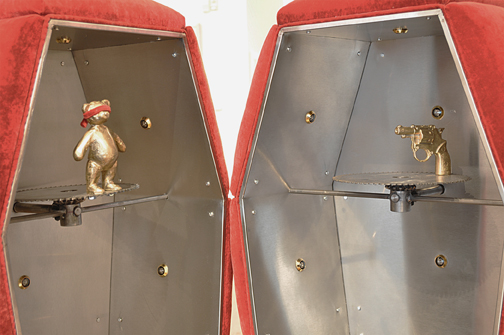
 Amir Ali Bashiri, And We Shoot Teddy Bears (detail), Stainless steel and brass, Dimensions variable

 Elika Hedayat, Untitled, Mixed media on paper, 7x9"

 Elika Hedayat, Untitled, Mixed media on paper, 7x9"

 Narcissus Echoes, Aplastic play, Stainless steel mirrors, megaphone (horn loud speaker), Approx. 40x98x69", Sound: mono, Duration: sempiternal

 Neda Razavipour, Daily Notes: Arabia And Other Social And Cultural Contradictions, Mixed media, pencil , pen on pages of daily calendar, 9x6.5"

Neda Razavipour, Daily Notes: Veiled Footballers In Olympics, Singapore, Mixed media, pencil , pen on pages of daily calendar, 9x6.5"

Morono Kiang Gallery, 218 W. 3rd St., L.A., (213) 628-8208, through April 30. Closed Sundays and Mondays. www.moronokiang.com

Via LA Times

Related Link: My Super Hero Exhibition: Opening simultaneously in Los Angeles and Tehran

Thursday, 31 March 2011

Revolution's Long Shadow Over the Tehran Art Scene

 A preformance of "Come Caress Me, September 2010" at the Azad Art Gallery in Tehran. In the exhibition, Amir Mobed, an artist, invited visitors to shoot him with a pellet gun. 

By Benjamin Genocchio

The paradoxes of Iran are visible at the Museum of Contemporary Art, designed by the Iranian artist and architect Kamran Diba as an inverted version of the Guggenheim Museum in New York.

In the central atrium hangs an Alexander Calder mobile bought for the museum’s inauguration, in 1977, two years before the Islamic Revolution. To the right is an untitled 1966 sculpture by Donald Judd consisting of a vertical array of nine panels of what the wall label describes as “galvanized iron” stacked from floor to ceiling.

The Judd, probably worth $5 million today, is just one of hundreds of Impressionist, modern, and contemporary artworks acquired at the institution’s founding. But it and the Calder are among the few Western pieces still on view; the rest, including works by Monet, Van Gogh, Pissarro, Renoir, Gauguin, Toulouse-Lautrec, Magritte, Miró, Braque and Pollock, are buried in storage. A close look at the Judd sculpture reveals scratches and solvent stains on several of the panels, which are spaced unevenly on the wall and fixed badly — some askew.

Until the revolution, Iran was among the most cultured, cosmopolitan countries in the region. It had a progressive movement in art and literature and a sophisticated film and television industry. The mostly Shiite Muslim population was pious but not fanatical.

“We used to drink in public and pray in private, but today we pray in public and drink in private,” said my guide, who has an engineering degree and whose job was to accompany me everywhere, reporting on my movements.

Having him around was a condition of my entry into a country where foreigners are largely unwanted and unwelcome. Officially, Iran reports that it receives around 10,000 tourists annually, a staggeringly low number considering its cultural attractions; Persepolis, capital of the Achaemenid Persian Empire, is one of the great archaeological sites in the region. Dubai, with little to offer beyond shopping and an annual art fair, gets about a million visitors a year.

These are anxious times for artists in Iran. Some have simply decided to remain outside the country.
In spring 2009, the brothers Ramin and Rokni Haerizadeh were en route to Tehran after a brief trip to Paris for their first show at Galerie Thaddaeus Ropac when, according to an interview published recently in Wmagazine, “they got a call from a friend warning them not to return home.” Their work had been confiscated during a raid on the home of a Tehran collector, and it was feared that they would be arrested. The brothers applied for residency in the United Arab Emirates and now live in Dubai.

Culture is valued here. There are numerous public theaters, museums, galleries and both public and private art schools in Iran. The country annually turns out about 40,000 art-school graduates, including graphic artists. But since the end of Mohammad Khatami’s relatively liberal presidency in 2005, numerous artists, editors, writers, and filmmakers have been jailed.

According to Hamid Keshmirshekan, editor in chief of Art Tomorrow, a new Iranian contemporary art magazine, Tehran has more than 60 private galleries — 100 if you include all the “public” spaces — spread around the city but mostly clustered in the wealthier northern suburbs. Many are in private houses, so the scene has an ad hoc feel. A handful of private individuals back the arts. Most gallery owners are women, as they are elsewhere around the world.

In the course of my stay in Tehran, I visited about a dozen galleries, met many talented artists and saw daring and progressive work. The good news is that Iranian art is alive and well. The bad news is that so much of the work cannot be shown publicly, or can be exhibited only for a few hours during an opening before being whisked into storage.

The Ministry of Islamic Culture and Guidance keeps a tight rein on what can and cannot be displayed, and every gallery owner I met had a story about being called in to the ministry and asked to explain and subsequently remove the artworks on their walls. Pieces deemed offensive or blasphemous expose dealer and creator to prosecution.

Younger artists are especially daring. Many of them employ humor as a weapon in their work, obliquely poking fun at the ruling clique of mullahs or pointing out the absurdities and contradictions of contemporary life in Iran. It is at once heartening and unnerving to see these young people embracing art-making as a mode of protest.

In April, several Tehran galleries hope to stage an impromptu joint exhibition of about 70 artists’ works devoted to flower imagery, an act of solidarity with Mehraneh Atashi, a photographer who was detained in January 2010 for documenting Tehran’s street protests. She was released on the condition that she start taking pictures of something more suitable, like the beauty of local horticulture.

Indeed, photography has emerged as a particularly vital means of social and political engagement. Shirin Aliabadi and Shadi Ghadirian are known for exploring women’s issues in Iranian society. Both have exhibited abroad, and their work is in American and European museum collections. Ms. Ghadirian has recently established an Internet registry of Iranian photographers, fanoosphoto.com, which presents online exhibitions.

The photojournalists Abbas Kowsari and Newsha Tavakolian, who live in Tehran, have had some success exhibiting and selling in and outside the country. Mr. Kowsari likes to portray Iranian society’s absurdities; his images of chador-clad female police cadets valiantly rappelling down the sides of public buildings in Tehran are now famous. Then there is Arash Fayez, 27, a promising young photographer who received some attention at the last Paris Photo fair. For his recent series “Decadence of Memories,” he shot five Polaroids of favorite childhood relics (including a ball and a sauce bottle in the shape of a bear) against the backdrop of Tehran’s crumbling urban landscape, summoning the faded dreams of his youth.

Nazila Noebashari, a collector, opened Aaran gallery on the second floor of a family-owned building in central Tehran two years ago. She has her office on the upper level, which doubles as the gallery storage. Artworks lean against walls, lie on makeshift shelves or rest on the floor among books. Ms. Noebashari is a curator as well, recently organizing a show of Iranian artists at the 18th Street Art Center in Los Angeles. Her gallery shows mostly younger and experimental artists and is one of the few in Tehran that is not overtly commercial.

When “Eshgh,” or “Love” — a Pop-style work in acrylic, Swarovski crystals and glitter on canvas by Farhad Moshiri — fetched $1.048 million at Bonhams Modern & Contemporary Arab, Iranian, Indian & Pakistani Art auction in Dubai in 2008, a proliferation of galleries began looking for ways cash in on a perceived growth market for Iranian works. But leading contemporary artists in Tehran, including Mr. Moshiri, refuse to exhibit with these galleries, who they say lack professionalism.

Another mode of expression that is popular among young, progressive artists is performance. Azad, established a decade ago by Rozita Sharafjahan and Mohsen Nabizadeh, the most avant-garde gallery in Tehran and a frequent venue for such pieces, is in a hard-to-find basement space with black-painted walls and a concrete floor in a quiet residential neighborhood. There, I met Amir Mobed, a 37-year-old conceptual artist. Mr. Mobed earned a name for himself with a performance at Azad, inspired by the American artist Chris Burden, in which he stood in front of a target with a protective metal box over his head and invited gallery visitors to shoot at him with a pellet gun. It was, he says, a symbolic execution, with a message about freedom of speech and the hopes of artists of his generation being silenced.

Most of the best art I saw contained guarded metaphors for national and social issues. Among the country’s emerging stars is Barbad Golshiri, the 29-year-old son of the late Iranian writer Houshang Golshiri. Barbad Golshiri’s powerful 2005 series of postcard-size photographs, “Civil War,” uses the many political, religious and commercial billboards around Tehran as none-too-subtle metaphors for the ideological conflicts at the heart of Iranian society.

An experience at the Silkroad Gallery perhaps best summarizes the perverse position of artists in Iran today. Perusing a portfolio of prints by Peyman Hooshmandzadeh, an artist and prize-winning writer (whose book was just banned), I paused at one showing young people in a Tehran cafe looking though a book of reproductions of photographs by Shirin Neshat, the Iranian expatriate contemporary artist. I asked the gallery owner, Anahita Ghabaian Etehadieh, why they are so interested in Ms. Neshat’s work.

“Because it has never been shown in her own country,” she replied.

Benjamin Genocchio is the editor of Art+Auction magazine. 

Via NYTimes