Friday, 4 June 2010

Despite Tightening Up Of Society, Iranian Art Sees A Boom

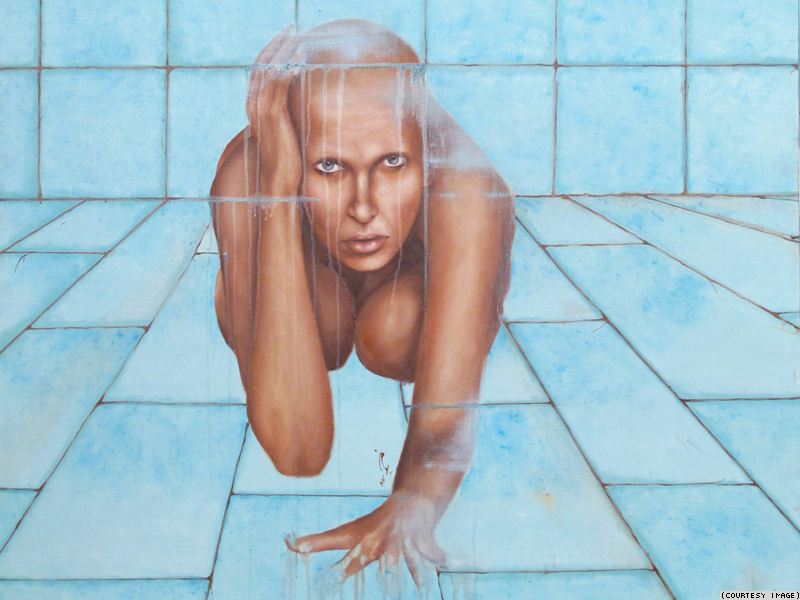
An artwork by Nikoo Tarkhani, titled "This Is Not A Woman"

By Kristin Deasy, Hannah Kaviani
The Persian word for "love" is spelled out in Swarovski crystals and glitter, with a small footnote from the artist: "A picture is worth a thousand words and a word a thousand pictures." The estimate wasn't high enough.

When the acrylic painting on canvas sold at Bonhams in Dubai two years ago for a historic $1,048,000, the Iranian creator Farhad Moshiri became the first artist from the region to break the $1 million price barrier at auction.

It was a breakthrough moment -- not just for Moshiri, but for Iranian art, which for the last few years has been experiencing what experts say is a "golden age." Largely attributable to the stabilization of the Dubai art market and strong ties between the United Arab Emirates and Iran, the boom is also being fueled by a younger generation of artists attempting to push the boundaries of freedom of expression.

Lebanese-Iranian Rose Issa, a gallery owner and art dealer, has spent the last 30 years championing artists from Iran and the Arab world. These days, she says, there's "a real buzz" in Tehran.

The mass demonstrations that broke out following the disputed reelection of Mahmud Ahmadinejad last June are related to a growing demand for self-expression among Iranians, Issa says. She says it is no coincidence that since the protests "many new galleries have opened" in Tehran, calling them "even trendier" and "more luxurious" than before. These galleries, she says, have started publishing catalogues, something she hasn't seen "for decades."
For Iranian artists, the growth of the Dubai art market over the last five years has been a boon. Iranian artists working inside the country now have the ability to network, exhibit, and sell their works in a fine-art market much closer to home. As a result, they have seen the value of their works steadily appreciate.

Sales of Arab and Iranian art in Dubai increased from $2 million in 2006 to $35.7 million in 2008. Iranian artists now represent 74 percent of artwork sales in Christie's Modern and Contemporary Arab and Iranian auctions and 64 percent of sales at Bonhams.

Edward Lucie-Smith, a curator of Middle Eastern art (a category in which Iranian works are often mistakenly placed), writes in an e-mail interview that currently Iran boasts "more artists [and] bigger talents, many [of them] still firmly rooted in Tehran despite the current political situation."

Dubai's high prices for contemporary Iranian art "obviously find an echo in Europe," Lucie-Smith writes, "not least because collectors feel that there is now an established market if they need to sell," but also because "Iran has the richest contemporary visual-arts culture in the region."

Forty-six new galleries have opened in Iran over the last two years -- 26 of them in Tehran, says Mahmud Shaloie, the director of the office of visual arts for the Ministry of Culture and Islamic Guidance. There are about 300 art galleries in all of Iran.

Postwar Generation


Some of the artists now achieving success are part of Iran's burgeoning younger generation born after the country's 1979 Islamic Revolution. Many of these young artists came of age under the 1997-2005 presidency of Mohammad Khatami, a relatively moderate leader who allowed greater freedom of expression and promoted cultural and artistic dialogue between Iran and the West.


(Gallery Walkthrough: "Iranian Bodies" exhibition in Berlin's "Werkstattgalerie," featuring figurative art from five Iranian artists.)

Hamid Dabashi, a culture critic and award-winning author who was born in Iran, says the young generation of artists is bringing something new to the contemporary art scene.

"The impact of the revolution, eight years of war, and the subsequent theocracy is the political and social context in which the current generation of Iranian artists define their own particular mode of artistic expression," Dabashi explains.

Compared with the previous generation of Iranian artists, the works coming out of Tehran today "have aspirations, they have frivolity, playfulness," he says. He also sees a new trend in their work: disillusionment with ideology. "Ideology is no longer as valid, significant, as it used to be," he says. Among young Iranians, "ideological differences have come to a dead end."

The recent boom is also providing Iranian artists who gained notoriety in the 1960s or 1970s, in the years that Iran first opened up to the international art scene, with something of a renaissance. "Finally," Issa says, "credit is being due to people like [Mohammed] Ehsai, like Monir Farmanfarmaian, who is now in her mid-80s and yet is [still] doing fantastic work that she was doing in the late 1960s and early 1970s." Issa calls Farmanfarmaian "the Louise Bourgeois of the Mideast."

Or 73-year-old sculptor Parviz Tanavoli, who made a record-breaking Dubai auction debut in 2008 with the $2.8 million sale of "The Wall (Oh Persepolis)" at Christie's. There is also renewed interest in 69-year-old Tehran-born abstract expressionist Kamran Katouzian, some of whose paintings are in the Museum of Modern Art in New York.

The Iranian artists of this generation remember the 1977 founding of the Tehran Museum of Contemporary Art at the initiative of the last empress of Iran, Farah Diba Pahlavi. The museum houses valuable collections of post-Impressionist, and modern and contemporary art -- some of the finest outside the West.

In 1979, two years after the museum opened, Iran's newly installed Islamic leaders said the works of art symbolized the shah's obsession with the West. The collection has since been opened only rarely to the public. (Watch a rare tour.)

During the Iran-Iraq War in the 1980s, most galleries and museums closed in Tehran. The art scene turned its attention to "survival," Issa says, "but the years following the war were highly productive for documentary arts."

"The film industry moved forward, the photographers moved forward," she adds, explaining that the emphasis was on loss: Eight years of war cost the country at least 300,000 lives and left some 500,000 injured.

By the mid-1990s, the art scene in Iran was slowly opening up, helped along by a more moderate cultural policy on the part of the government. In 1991, Iran held its first painting biennale since the revolution. Galleries reopened and started holding exhibitions, the private sector started to invest, and artists started to form unions. The Iranian Graphic Designers Society first formed in 1997, and is now known as one of the largest in the region.

Political Dilemma

Life in Iran today is much harder on artists. The government responded to the demonstrations last June with a severe crackdown, and artistic activity is now closely monitored.

The combination of an artistic boom and renewed government interest in the art scene has brought new dilemmas. S.M. is a young artist living in Tehran whose work is frequently exhibited in the city as well as galleries in Europe. (Because her artistic credentials inside Iran prevent her from using her real name, she asked to be referred to by the pseudonym S.M.)

She says many artists in Tehran face hard choices over the best way to remain true to their work, seek international recognition, while still being welcome in Iran.

"The question becomes whether I should do some very simple works -- ones that are not socially or politically provocative -- and have the advantage of being able to come home to my country," she says, "or do the works that I want, deeply, to do myself, but be unable to come back home."

Iranian artists who have produced more socially or politically provocative works while living inside the country face a host of problems. Many are unable to show their work, and some are harassed or even imprisoned. Others resort to smuggling pieces across the border in order to exhibit them in the West.

The authorities typically ban works on subjects the Islamic republic finds offensive -- anything from showing kissing or nudity to works treating Islam, or the politics of the Islamic republic, in a critical manner. Despite the restrictions, artists continue producing such work. Often, a gallery will exhibit an artist's moderate works and keep the more controversial pieces out of sight, to be discreetly shown to interested buyers and collectors.

One prominent Tehran-based artist, who has been politically active since June's disputed election and who wishes to remain anonymous, says that he perceives art "as a form of resistance." Now, he says, artists like him are "back to work, holding private gatherings to see what we can achieve [in the country] through art," since it is a medium that "can suggest and point to overlooked sociopolitical issues." He says every time he organizes an exhibition in Tehran, it is closed down or some pieces are removed by the government.

But some art critics say artists are producing overtly political works in order to take advantage of the international attention focused on Iran following its internal turmoil last summer.

Culture critic Dabashi warns that Western observers risk overly politicizing or "anthropologizing" the work of Iranian artists. He says their work "is being taken as an indication of social, political, or ideological aspects." "It is not that their art does not represent those aspects -- it does -- but...there's a difference between a work of art and a political manifesto," he says.

Nasim Manuchehrabadi, a young Iranian artist now working in Berlin, says "the fact that I'm Iranian" makes her works political "whether I like it, or not." She thinks the work of the younger generation reflects the difficulties it faces in Iranian society, as modern ideals face off with conservative values promoted by the Islamic government.

Iran's 2,500 years of artistic history does influence her work, Manuchehrabadi says, but "it's not only [traditional Persian paintings of] flowers that we've grown up with," it's also the fact that "we are the MTV generation."

PHOTO GALLERY: The Renaissance In Iranian Art

Further Reading:

A Conversation With Critic Hamid Dabashi

Background: Why The Art Boom?

Via Radio Free Europe / Radio Liberty

 The interior of S.M.'s studio in Tehran

Monday, 24 May 2010

From Tehran To London: New Painting from Iran


at Jill George Gallery
18 May - 18 June 2010
Curated by David Gleeson and Aras Amiri in collaboration with Azad Gallery in Tehran.

Masoumeh Bakhtiary’s simple, almost graphic pictures are a response to the political turmoil of last summer, exploring political and social unease. Recent graduate, Marzieh Bagheri has produced a fascinating series of paintings that use cars and women to lament the unrealised ambitions of post-revolutionary Iran; and her fellow graduate Azadeh Baluchi has produced beautifully delicate images that examine the position and identity of modern Iranian women. The vividly coloured subjects of Samira Eskandarfar include brief Farsi aphorisms and Kahlo-esque imagery in work that questions the depiction of women everywhere. Khosro Khosravi paints dark and haunting tableaux that paradoxically reveal his skill as a colourist whilst referencing Iranian history and the dichotomy between the public and private realms of its society. Hamed Sahihi’s intriguing paintings, with faceless, confined figures and eerily idealised landscapes, are poetic metaphors for a dreaming, dystopian society. Mohammad Mehdi Tabatabaie’s remarkable panels are a personal diary of family life, commenting on the tension of modernity and tradition in the Islamic Republic.
Since the Revolution of 1979, Iran has been depicted as an oppressively rigid and censorious theocracy, provoking both awe and derision in the West. At the same time, it is acknowledged as a centre of fashionable artistic creativity: the films of Kiarostami and Makhmalbaf, for example, have long been acclaimed as hugely important, and exhibitions of Iranian visual arts have appeared at highly prestigious European venues.
But such examples barely scratch the surface of the hugely vibrant and flourishing creative industries in major Iranian cities. Contemporary Iranian art has come of age and is at last being taken seriously by the Western art world. No longer should it be merely confined to exotic shows by institutions keen to prove the width of their international vision. This exhibition will introduce new work by celebrated Tehrani painters for the first time in London alongside some striking imagery from two recent young women graduates of Tehran’s Sooreh University.

It is, As it is, acrylic on canvas, 39.5" x 59", 100 x 150 cm, 2009

  It is, As it is, acrylic on canvas, 53" x 78.5", 135 x 200 cm, 2009

Denial, acrylic and ink on canvas, 39.5" x 59", 100 x 150 cm, 2010

 Denial, diptych, acrylic and ink on canvas, 39.5" x 39.5", 100 x 100 cm, and 12.5" x 12.5", 30 x 30 cm, 2010

 Utopia Ophelia, acrylic on canvas, 47.25" x 39.5", 120 x 100 cm, 2008

 Utopia Ophelia, acrylic on canvas, 39.5" x 39.5", 100 x 100 cm, 2008

  She Was Alone, oil on canvas, 39.5" x 31.5", 100 x 80 cm, 2008

 It's a Cat's Life, oil on canvas, 39.5" x 47.25", 100 x 120 cm, 2008

Silent, oil on canvas, 67" x 51", 170 x 130 cm, 2008

Silent, oil on canvas, 67" x 51", 170 x 130 cm, 2008

 What Would You Do?, triptych, acrylic on canvas, 15.75" x 51", 40 x 130 cm, 2010

 What Would You Do?, triptych, acrylic on canvas, 15.75" x 51", 40 x 130 cm, 2010

 Street, (detail), sextet, oil and mixed media on canvas, 19.5" x 118", 50 x 300 cm, 2009

 Untitled, triptych, oil on canvas, 47.25" x 68.5", 120 x 220 cm, 2009


Via Jill George Gallery
Related Link: DAVID GLEESON ON 'FROM TEHRAN TO LONDON'

Wednesday, 12 May 2010

Cannes Short Film online contest: FORBIDDEN TREE by Benafsheh Modaressi

Vote until Monday May 17 2010

The National Film Board of Canada, in association with the Cannes Short Film Corner and partner YouTube, welcomes you to this NFB competition, now in its fifth year, and you’re a member of the jury!

Animation work by Benafsheh Modaressi, talented Iranian artist, is now among the 10 finalists.

Watch her 7-min animation about a brave account of those who break taboos and make a city to revolt, and support her by pressing “like” on YouTube page. You have to be logged into your YouTube account (or open an account) to be able to vote.


Synopsis: A story of an imaginary city under a harsh ruler. Love is forbidden, and freedom a distant memory. Few people have the courage to fall in love, challenging the forbidden symbols….This film has no dialogue because the people are too scared to express themselves….in the end the love shines back in to the city, courage of those who dared to love has saved the city and the last clip shows a child, tasting life and freedom by eating the apple (symbol of life) freely.

Bio: Tehranian-born Banafsheh Modaressi worked from 1999 as a freelance photojournalist and reporter for magazines such as Paris Match, Die Zeit, Frankfurter Allgemeine Zeitung, as well as several local newspapers. Government restrictions in Iran hampered her photojournalism career, so Modaressi obtained an M.A. in Graphics and Design in 2005 then began teaching at the University of Applied Science and Technology in Tehran. She has had over 20 photo and mixed-media exhibitions, both inside and outside of Iran, and her love of photography and drawing ultimately led her to animation. Modaressi started film-making in the workshop of Iranian director Abbas Kiarostami in 2008 and followed his workshops from Tehran to Villa Arson.

Other Films:

ANNIE GOES BOATING by Noel Paul

Annie Goes Boating is a laconic portrait of a girl (Alessandra Torresani, Caprica) on a picnic in the park with her friends (including Alycia Delmore, Humpday and Davie-Blue, Bass Ackwards). Shot in stereo 3D, the film provides a restrained yet immersive glimpse into the group dynamics of this boating party.

Bio: Noel Paul is a filmmaker and graduate student in Digital Arts at the University of Washington in Seattle, USA. His work has been exhibited by festivals and organizations such as Slamdance, Los Angeles Film Festival, MTV, and SXSW. Annie Goes Boating is his thesis film.

AWAKE

Dusty paths, broken mirrors, a stopped watch - in "NEXT" an unnamed man is trying to find a little girl only to lose himself in a dream-like state. The film is set far from reality, space or time in an intense atmosphere. "NEXT" feels it's way through deserted corridors and stairs- a subtle journey between dream and reality by Burmese film-maker and cinematographer Thaid Dhi.
Bio: Thaid Dhi, was born in 1983, Yangon, Myanmar (Burma). He's a Cinematographer and Director. He's studying Cinematography at the National University of Art and Culture (Yangon) and recently finished study abroad at FAMU, The Film and TV school of the Academy of Performing Arts in Prague, Czech Republic. He's mostly shooting short documentaries and short films.

CRASH! BANG! WALLOW? by Jon Dunleavy and Keith Wilson-Signer

Crash! Bang! Wallow? is the tale of ex-stuntman Larry LeTan and his fight to find a place in modern world. At the height of his career Larry rubbed shoulders with Hollywood superstars of the 80s. As stuntman to the most popular action heroes, he did all the things the stars couldn't or wouldn't do. He performed Arnie's tumbles, Sly's leaps and Segal's acting. However, with the introduction of computer technology Larry finds himself out of synch with the modern world. Poetry by Luke Wright and Joel Stickley.
Bio: Following the success of directorial debut The Technical Hitch (2006), Jon Dunleavy has been represented by Tandem Films. While working in the commercial field and television, he continues to develop and produce short films, including animated comedy Mummy and Baddy (2007) and fantasy/horror Shadows & Dust (2009). Dunleavy is currently completing work on his new short animation Crash Bang Wallow starring David Soul (Starsky & Hutch) – the bittersweet tale of a suicidal stuntman who tries and fails to stay relevant in a new era of computer-generated imagery.
Keith Wilson-Singer is a writer/director of animated short films. After graduating from Norwich University for the Arts, he directed the short animated comedy Mummy and Baddy (2007), starring Jason Isaacs (Harry Potter). Wilson-Singer followed this up with the twisted comedy short Jacob, which he wrote, produced and directed. He is currently developing a slate of animated and live-action projects for television and film.

LOVE & THEFT by Andreas Hykade

"And I'm still carrying the gift you gave, it's a part of me now, it's been cherished and saved, it'll be with me unto the grave and then unto eternity." (Bob Dylan)
Bio: Andreas Hykade was born in 1968 in Altoetting. From 1988-1990 he studied at the Academy of Fine Arts in Stuttgart, followed by studies at the Baden-Wuerttemberg Film Academy from 1992-1995. Since 1992 he has been working as a freelance filmmaker and since 2000 as a professor of Animation at the School of Arts and Design Kassel. His films include: The King is Dead (1990), We Lived in Grass (1995), Ring of Fire (2000), Tom & the Slice of Bread with Strawberry Jam & Honey (series, since 2003), The Runt (2006), The Bunjes(2007), and Love & Theft (2010) among others.

MOTHER OF MANY by Emma Lazenby

The most dangerous journey needs a helping hand.

Bio: Emma Lazenby graduated in ‘98 and moved to the highlands to work on films based on Scottish legends. After three years - moving to London Emma animated on adverts, pop promos and series before becoming a Designer for the primary series - ‘Charlie and Lola’. In 2007, Emma moved to Bristol where she designs, animates and directs for the ever award-winning ArthurCox. She completed ‘Mother of Many’ a film about midwifery and childbirth - in October 2009.

THE LAST PASSENGER

A young jumps from a cliff. Before leaving forever, his soul pays a visit to to his two impossible loves: a woman and the stage of a concert hall.

THE REPORT CARD

A mother takes her son to visit his father before leaving on vacation. Again this year the man won't be with his family and the child wants to show him his report card. The visiting procedure is always the same: the heavy doors close, the guards' look is severe, the hallways are endless, the rooms are desolate. The mother waits while the child goes to meet his father. The atmosphere is full of tension and the encounter is very emotional.

Bio: Alessandro Celli was born in Rome in 1976 and is an Italian-Canadian graduate from the Master of Arts program at the London Film School directed by Mike Leigh. He has made several short films which have received worldwide critical acclaim, winning more than 30 awards at international festivals. In 2008 his short film "UOVA" won him the David di Donatello, the Academy's highest recognition in the Italian film industry. Among other wins, his work has also obtained special mentions at the Silver Ribbon Awards, Interfilm (Berlin), Expresion En Corto (Mexico City) and has been selected by the French Academy (Cèsar) for the “Short Film Golden Nights - World’s Best Short Films of the Year”. In November 2009 he has been chosen by director Ermanno Olmi to direct “LA PAGELLA” (The Report Card). 

THE STORY OF MY LIFE

Alessandra is walking in the city when she is hailed by a man she doesn't recognize. Even though he keeps telling her about important moments of her life, his face remains totally unknown to her... 

THE TECHNICIAN

A cable guy is called in to repair an old man’s TV set. Once inside the client’s home, the repairman realizes there’s nothing wrong with the TV. Rather it’s the images broadcasted on the screen: wars, famine, illness and kidnappings, that are “broken”. Moved by the client’s naïve request, and against his better judgment, the cable guy will attempt to fix the problem.

Bio: Simon Olivier Fecteau has started his career at Radio-Canada, in 1999, with the group Chick'n Swell and its eponym TV show that was awarded best comic TV show in 2004 (Gemeaux Awards). Then, he directed two shorts: Les derniers jours and Le pouce vert. He co-directed the Radio-Canada's Bye Bye in 2006 and 2007. The same year, he is co-directing with Marc-André Lavoie his first feature film, Bluff. He is actually working on his next feature script but he still had the time to make the short film The Technician.

Saturday, 8 May 2010

“Icons”


Shoja Azari, Coffee House Painting, 2009, Video projection on canvas, 117 x 65 in (297.18 x 165.10 cm)

Video work by artist and filmmaker Shoja Azari are on view at Leila Taghinia-Milani Heller (LTMH) Gallery from May 4-27, 2010.

Shoja Azari’s first solo exhibition in New York City “Icons,” will feature six new video works which examine the role of saints and heroes in modern society.

In the early 20th century, coffee house-style painting flourished in Iran. Based on Persian mythology, the large paintings depicted the heat of battle, the afterlife and martyrdom, truth and justice, and the apocalypse. The paintings expressed respect for religious and traditional beliefs and served as a backdrop for entertainment in the coffee houses of Iran as storytellers would act out the epic scenes depicted in the paintings. Azari has appropriated coffee house painter Modabber’s, The Day of the Last Judgment, a painting dense with imagery and symbolism, and transformed it into a video work projected onto a black canvas, Coffee House Painting, 2009, infused with images of today’s saints and sinners.

In his catalogue essay, Hamid Dabashi, Professor of Iranian Studies and Comparative Literature, Columbia University, writes, “Shoja Azari’s invitation is initially innocuous, familiar, and homely. Then things begin to happen. Pictures begin to move, images start morphing and altering into and out of each other. Wars and mayhems begin to change time, space, history, sides. We are on a move—towards the unfamiliar that is (alas) only too familiar, unhomely that is homely.”

The Icons series, 2010, is comprised of five video works and five photographs on light boxes that appropriate popular posters of saints in Iran. Inspired by how Renaissance painters humanized religious figures, Azari seeks to make icons resonate in a new way.

Dabashi goes on to write, “The raped, burned, and murdered body of Abeer Qasim Hamza al-Janabi, the 14-year-old Iraqi who was gang-raped on 12 March 2006 by the US soldiers from the 502nd Infantry Regiment, was the site of a violation infinitely more sacred than a picture of a saint or an Imam. What is happening to these icons in Shoja Azari’s work is in fact entirely in the opposite direction—a cry of defiance, the iconography of a revolt against the obscenity of violence done in the name of or against those who hold these picture sacred. He does not so much de-iconicize them, as he in fact re-signifies them for a new generation of aesthetic, emotive, and political registers.”

Sam Bardaouil, an independent curator, notes in his catalogue essay: “Shoja continues on his own odyssey to create work that elates one’s perception of the incomprehensible and infinite through the most simple and mundane, and at the end of the day offers us a glimpse into an iconic world where love, not justice, prevails.”

As Benjamin Genocchio, editor in chief, Art and Auction magazine, and former New York Times art critic, sums up in the catalogue, “The English word revolution derives from the Latin revolutio, which means "turn around." That’s pretty much what Shoja does, his versatility and imagination transforming ideas, concepts, images and media so that we see them and the world about face. His ambition is no less than to change art and life.”

Iranian-born Shoja Azari has lived in New York City since 1983. His films and video installations have been screened and exhibited widely around the world. Most recently, his video work has been seen in solo gallery exhibitions in London; Turin, Italy; and Köln, Germany, and at art fairs including Art Basel, Switzerland, and ARCO, Madrid.

Since 1997, he has collaborated with Shirin Neshat on film and video installations including Women Without Men, which won the Silver Lion for best director at the 2009 Venice Film Festival. He has also collaborated with Shahram Karimi on video paintings, which project video on painted surfaces.

Via LTMH Gallery

The Greatest Meeting

The Life Stories of Rumi and Shams-e Tabrizi: Their Tumultuous Times
by Majid Amini


FOREWORD

Delving into an in-depth discussion and analysis regarding the Erfân, Tasavvof, and Sufigary, which in the West, are often collectively referred to as Mysticism, Gnosticism, Sufism, or sometimes Dervishes’ thoughts, would have been beyond the scope of this work titled, “The Greatest Meeting”. Among the numerous books that have appeared in the West in the past few decades (mostly inept translations of Rumi’s poetry, or a few scholarly works on his life and time), it is challenging if not impossible to find a clear and convincing definition for these schools of thought. Even if there has been any sporadic attempt to define Mysticism, these efforts are vague, abstract, or expressed in language in which their meaning cannot be easily discerned from the context of the subjects that were not clearly defined by the founders of this thought in the first place. Therefore, it seems appropriate to attempt to frame a brief definition for these schools of thought; derivatives of Islamic religion, or social movement, particularly when this movement had the potential to change the fabric of Islam, at least in Persia (Iran) and possibly elsewhere. In addition, by presenting a clearer definition for this school of thought it may assist the reader in a better understanding of my work.

Numerous definitions for Gnosticism, Erfân, can be observed from the original torch holders of this form of thought from early years of Islam and onward. Perhaps an acceptable definition is: “Possessing intellectual or esoteric knowledge of spiritual things.” But perhaps Hâfez, the renowned Persian poet of the eighth century, defines Erfân the best in one of his verses.

“There’s only one relevant point,
In the sorrow of eshgh, love,
And surprisingly,
From whomever’s tongue I hear that point,
It is utterly unrepeatable.”

The essence of Erfân is an inner personal experience, a mental transformation, a metamorphosing process, a special feeling of being connected to all beings and the entire universe. It is a sentiment of closeness, connection, and oneness with each and all other beings that one experiences. It is an ambiguous and secretive realization, a feeling of self-actualization that an individual senses that is not expressible, nor transferable to another person. It would perhaps be acceptable to articulate that this kind of experience creates a relationship with life and the process of living that cannot be expressed otherwise. But an Âref, a gnostic person, is naturally receptive to this experience and understands it wholeheartedly. It may also shine more light on this complex and, to some degree, abstract form of thinking if one would relate to what Carl Jung, the renowned psychologist describes as, “Establishing a momentary connection with one’s subconscious.” It is then that this connection would open a vast horizon to the mind of the individual’s vision. The person who attains such an inner experience reaches an almost supernatural level of peace and tranquility, and he lives in harmony and serenity with himself and his surrounding world. In other words, this person’s relationship with the world and everything in it would be based on the eshgh, love. She or he embraces all the world’s events and challenges related to living things with a peaceful and healthy attitude, for she or clearly see the casting shadow of a collective wisdom on this world. The person becomes in accord with Sa’adie, another renowned Persian poet, who eloquently stated,

“I’m elated in this world for it belongs to Him
I’m in love (âshegh-e) with this whole world
For the entire world is derivative of Him.”

Was the evolutionary emergence of Erfân an attempt to give an earthly meaning to the fast-decaying religion of Islam? Did Erfân possess sophisticated secret messages under its cloak that if it could have survived and spread its social and political ramifications would have drastically altered the direction of today’s Muslim societies? Was Erfân a conscientious effort to place the highest unimaginable and immeasurable value on human beings? Was Erfân a manifest, a confirmation that the existence of man on earth was an evolutionary process? Was Erfân advocating a process to take the power from the hands of God and give it back to man; thus, internalizing the locus of what determines human beings’ values, so that the human being would accept responsibility for hers or his actions? Rumi, as the voice of Shams, answers these questions with comprehensive volumes of over seventy thousand verses of poetry. As an example, in the following poem, Rumi addresses three issues movingly: First, the evolutionary process of man’s existence on earth and his destiny. Second, the paramount and unimaginable importance he places on human beings by equating them to God and perhaps beyond. Third, he presents an accurate and perfect definition of Erfân.

“I died as object-form—minerals, transformed to a plant,
I passed on from plant-form and appeared as an animal.
I died from realm of animal and became a human,
Then why should I be frightened of death?
For it would not reduce my stature as a human.
I will die as a human-form in another phase,
Only to metamorphose, growing feathers and wings like an angel.
As an angel, I must also leap over this barrier of water,
For everything except God will perish.
Then again, I will fly and soar as an angel,
And will become one whose entity is unimaginable by all.
Hence, I will be annihilated as the sound of a flute does in the air,
Conveying: Everything except God will perish.”

The two most important features of Erfân that can be attained after this inner experience are eshgh, which is the essence and, at the same time, a valuable fruit of the tree of Erfân, and the harmony a person experiences in hers or his relationship with others and their surroundings. Many texts of Erfân and poetry related to Erfân are artistic and unique expressions of the saga of this eshgh that have been expressed in a variety of forms.

The true Tassavof, Sufism, aside from its subsequent deviation from its original concept, should not have substantive differences with Erfân. In fact, there are many commonalities between these two forms of thinking. The harsh religious, political, and social conditions that persisted from the twelfth century onward caused masses of people to become attracted to Erfân; thus, the creation of various systems of thinking of which Sufism is one.

The influence of Christian monks’ monastic lifestyle, and beliefs in Persian and Islamic Erfân in fragmenting it into different branches and forms of Tassavof, historically seems plausible. This influence becomes especially evident when khâneghâhs, for housing dervishes and Sufis, began to appear throughout the Muslim world, with their primary functions being very similar to monasteries.

To attain personal freedom, a true Sufi would deny himself all worldly possessions, comforts, and pleasures, and would become a dervish, a true Fagheer, a destitute. Since living with this frame of mind would have eliminated the conflict between a Sufi and his unjust surroundings, Sufism became very attractive to those who felt powerless in their struggles against the harsh social, religious, and political conditions. The people under these rigid religious rules and laws, which became the roots of political oppression, hard economic, and harsh social conditions, sought refuge in Sufism because it presented them personal protection, comfort and security. The Sufi’s khaneghâhs adopted the role of protectors and saviors; however, they gradually and invariably created the corrupt Tassavof that instead converted the urgent needs of the people to an opportunity for personal monetary gain and power by the leaders. As early as the thirteenth century we come across statements such as Abul Hassan Boshânji’s, “Tassavof is now a name without the truth, while before, it was a nameless truth.”

If we believe that to become a Sufi, a dervish, there are certain established rituals that one must observe and perform in order to achieve the title, we have inevitably considered the differences between Erfân and Tassavof. Because, to become an Âref, as one can find numerous of them in the histroy of this movement, the observance of these rituals are not required. At least in the language of early Erfân, we see the expression that in order to become an Âref, one can employ the method of a Sufi. And also, though we find many people who wear the Sufi and dervish cloaks, they have never reached the level of insight, knowledge, wisdom nor eshgh of an Âref.

With the accumulated traditional rituals that today’s Tassavof carries as obligations for its practitioners, it has evolved into a lifestyle that appeals only to a certain class of people. The original Erfân, on the other hand, being an inner personal experience and without having the burden of any rituals, differs significantly with Tassavof, a difference that is often ignored.

Faith means people believing in a higher power, a subtle and pleasingly delicate and pure wisdom that can embrace all the facets of their lives. If this faith is not the derivative of an inner religious belief, it is invariably from an inner personal experience, and that is Erfân. The vast majority of people’s beliefs in God are from the religion that is prevalent in that culture and not from a direct inner experience. The religious God appears to differ from the higher being that a person acknowledges and believes in as a result of direct inner personal experience. The God of religion is the sort of God who has the role of a referee and a judge, who possesses polar characteristics. He holds a carrot (heaven) in one hand and a whip (hell) in another. But the God of Erfân, from the inner personal experience, is far from this role of refereeing, judging, rewarding and punishing. He is the essence of giving life, wishing everyone well, and He is the source of eshgh. When a person becomes connected to this inner feeling and opens and maintains a relationship with it, he or she understands it fully but is unable to express it properly. That person’s understanding is not transferable to another being and cannot be acquired through study. The “Unity of Being” of the Sufi’s belief differs from the inner experience of Erfân. The Erfân is noble and true when a person does not lose his own identity and individualism but is able to establish a perpetual relationship and connection with the universe and all living souls.

Rumi often praises and criticizes the Sufis, but always highly praises the Âref. The following poem by Rumi is an example of this claim.

“There is a lock on his lips and his heart is full of secrets.
His lips are silent, and his heart is full of songs.
Ârefs who have drunk the cup of the truth,
They have known secrets, but have hidden them.
Whoever learned the secrets of the truth,
They sew and sealed their lips.”

My curiosity for discovering and revealing the unknown is what motivated me to search and write this work. Since my late teenage years, when I was first exposed to Molânâ Jalâleddin Mohammad-e Rumi’s poetry by my late brother, Hamid, a student of Rumi’s works, and a poet himself, I had been puzzled about the phenomenon of how an ordinary clergy, a jurist at best, Rumi, meets with a wanderer, a revolutionary of his time, Shams-e Tabrizi, for 30 or 45 days in seclusion and thereafter becomes the most prolific renowned poet in Persian literature. The more I read Rumi’s poems, the more I became curious and interested about Shams’ character and life. He undoubtedly was the mentor who created Rumi, and for valid reason, he remained an enigmatic figure in the Persian culture. In winter of 1976, I read “The Third Script,” a scholarly work on Shams, perhaps one of a kind, particularly in the Persian language, by Dr. Sâheb-Zammâni, a psychologist. Dr. Sâheb-Zammâni’s work is an excellent in-depth study of Shams’ life, the details of his psychological makeup, the political, religious, social, cultural, and even the economical environment of Shams’ time. Although, reading the book numerous times certainly shed a bright light on the man’s life and his time, I wondered what took place between those two men when they met on November 29, 1244, in the city of Ghonieh, presently located in Turkey, which was part of the Persian Empire in the thirteenth century.

To satisfy my nagging curiosity as years rolled on, I began to read as many works as I could find about the luminary man, Shams, and the giant among the poets, Rumi. The combination of my intense interest in Shams and Rumi, my cumulative knowledge about the lives and works of these two men, along with acquired experience in the technique of screenplay writing, resulted in the screenplay “The Greatest Meeting” that was completed in the summer of 2002. The other reason for writing the screenplay and not a novel was that rather than shrouding the enormity of these two characters with meandering narratives as most novelists inevitably do, and since there is an extraordinary volume of poetry available from Rumi and some anecdotes and statements from Shams, I thought letting the characters tell their own stories through the media of cinema would serve the subject matter more effectively. However, with my limited contacts in Hollywood, and inability to attract an executive producer for this challenging project that is deemed non-commercial, and since I had a respectable outline of the story in my hands, I decided to convert the screenplay to a story telling arrangement. This decision was reinforced when I realized that there has never been a book in this format narrating the lives of these two giants in a clear and simple language that could be enjoyed by a greater readership.

We have a good deal of knowledge of Shams and his beliefs from his scattered words, and detailed fabric of Rumi’s thoughts as an ordinary clergy, prior to this meeting. This meeting, according to various sources, consisted of 30 or 45 days in seclusion. Also, although we know that there were not substantial changes in Shams’ thoughts after this meeting, there were revolutionary—almost unbelievable changes in Rumi that have been referred to as the, “Rebirth of Rumi.” Then the attempt to unravel the apparent dialogue between those two men that convinced Rumi to abandon his previous approach to religion and spirituality and instead follow Shams became closer to acceptable reality than just mere assumption. It is during this intense and grueling sohbat, private conversation, that Rumi develops an eshgh-o mohebat, love and affection, for Shams that it is unprecedented in the history of mankind, and that does not fit any modern psychological definition. Also, it is as a result of this private meeting that Rumi seemingly becomes Shams’ voice. With thousands of eloquent verses of poetry, he expresses his love for the man in one volume, “The Collection of Shams-e Tabrizi,” and about all other subjects, including poetic interpretations of Qurân’s stories and wisdom in another volume, the “Masnavi.”

Besides the two collections of Rumi’s poetry, the “Maghâlât-e Shams,” there are only four other sources of information available about the lives and works of Rumi and Shams. These four books are by Bahâeddin Valad (1226-1312), the oldest son of Rumi, and three historians—Freydoun-Ebn Sepahsâlâr, who lived in the same period Rumi and Shams were alive, and Shamsoddin Ahmad Aflâki, who wrote his accounts forty years (1318) after Rumi’s death, and Abdul Rahmận Jậmi (1438-1519). All other works are based on theses sources.

Since detailed information is not available about both Rumi and Shams lives, I have also looked at their lives as jigsaw puzzles where big pieces connect with smaller pieces until vivid images of their lives come into focus. By putting these pieces together as authentically as I could, I hope, I have opened a small window into the beautiful and spectacular garden of the Persian culture that has poetry as one of its most important features, poems that bloom like flowers through centuries of time. I also hope that I have put together and rendered an honest and true tribute to these two great sons of Persia, and that Western readers can have a glimpse of my country’s treasures.

Via Iranian.com

Friday, 30 April 2010

1 mile2 at Azad Art Gallery


Mehrdad Afsari, Mahmoud Bakhshi, Andrew Dodds, Bijan Moosavi, Neda Razavipour, Kianoosh Vahabi1mile² is an international program, launched in 2009 by Visiting Arts that addresses the interrelation between culture and the environment within diverse societies, and provides creative learning opportunities through a process shaped by artistic practice.

1mile² asks communities to map their neighborhood exploring the biodiversity, cultural diversity, and aesthetic diversity of their local square mile. Working in collaboration with artists and ecologists, communities will participate in creative workshops and field sessions over a three-year period. Communities are linked across the world through an internet platform that shares and challenges their findings, perceptions, ideas, experiences and creativity and encourages new connections between people.

1mile² was organized in Tehran through a collaboration between Visiting Arts and IOAA (Interdisciplinary Office for Art & Architecture). Five Iranian artists, a guest artist from Northern Ireland and a team of ecologists participated in the program which was launched in December 2009. During the course of 1mile² in Tehran we explored ecological, cultural and social diversities within the selected neighborhood, where urban structures of north and south converge. This area is the meeting point for people from various walks of life in terms of race, culture, economy and social statues due to its specific location at the heart of Tehran where business, culture and social activities are in a constant exchange in a dense urban environment.

Although this crowded and complex setting is apparently an unfavorable environment for natural life, a vibrant ecosystem – which spans from microscopic to macroscopic scales – is consistently adapting itself to various environmental changes resulting from human activities. The team has been observing and discussing these aspects with the help of ecologists during the project.

“Tehran: 1 mile²” depicts our collective and individual reflections on these themes and marks the final phase of our project in Tehran.

Poster Designed by Farhad Fozouni

Via Parkingallery

Saturday, 24 April 2010

Sleep Walking

Paintings of Mehran Saber appear to be reactions to a world apparently without meaning, human control, or even menaced by an invisible outside force. Characters caught in hopeless situations are forced to do repetitive and meaningless actions. In his works, reality is dismissed and even Surrealism is distorted.


The dream-like qualities of the paintings makes you wonder if the painter has worked while in trance, whether he has sleep-walked through creation. 


Hybrid creatures, often twisted and tortured, remind us of the old wounds, and of the bits and pieces of nightmares. The fabulous color palette is wild and exuberant, shocking the viewers at first glance and then challenging them into submission to observe the beauty and harmony of colors, while proving to them that the paintings are truly marvelous as well as wonderfully beautiful. 


An exhibition of Sleep Walking opened on Friday 9th April 2010 at Tehran's Aaran Gallery.
AARAN Gallery
www.aarangallery.com

Thursday, 25 March 2010

Dubai art scene's Iranian expressions

From The National Newspaper, March 23
by Ed Lake
Siamak Filizadeh reworks Persian legends using action movie imagery in the Rostam 2: The Return series.

 
After 1945, a popular joke in US military circles was to say that America’s technological edge over the Soviet Union just meant “our German scientists are better than their German scientists”. Something similar might be said for art in the UAE: the scene is only really as exciting as its Iranians.

The Iranian diaspora has flooded the Emirates with some of the best contemporary talent in the region. Their work is varied but has a distinctive flavour: spluttering, sardonic, punkish. One gets the impression of an artistic culture going for broke. It’s daring because it’s desperate, exuberant because it wants to break out. The Emirati artist Lamya Gargash told me in December: “They’ve got their mark. If you look at their work you can understand where it came from.”

She went on to hope that the UAE’s home-grown artists would develop such a signature of their own.

It so happens that the Farjam Collection at the DIFC has a pretty good overview of the Iranian situation. Iran Inside Out features work from 29 contemporary artists. The show was put together with the help of the Hafiz Foundation and Art Reoriented and has already played in a couple of American spaces – the Chelsea Art Museum in New York and the DePaul University Museum in Chicago – where it picked up warm reviews.

For its Dubai run, some pieces from Dr Farhad Farjam’s private collection are supplementing it. The scene that emerges is not as homogenous as Gargash’s remarks might suggest: there’s a gulf between, for example, Pouran Jinchi’s meditative calligraphy, Iman Maleki’s rather earnest narrative paintings and Khosrow Hassanzadeh’s pop-art shrines, tongue-in-cheek celebrations of that strain of kitsch called javad. But you can see her point: there’s a family resemblance among many of these pieces, recurring preoccupations with memorabilia and trash, iconography and the texture of lived experience, the compatibility of various jostling roles.

The husband and wife duo of Shirin Aliabadi and Farhad Moshiri redesign branded packaging to include stinging slogans: bottles of detergent spell out “We are all Americans”; Toblerone chocolate bars are altered to read “Tolerating intolerance”. This is polemic blunt as Adbusters, and it is echoed in the magazine spoofs of Siamak Filizadeh and Sara Rahbar’s embroidered US flags (you can see more of the latter’s work at Carbon 12 from March 25). Behdad Lahooti cuts cuneiform texts from Iran’s pre-Islamic history into the surface of plastic colanders and dust pans: how else to reconcile the legendary past with the present?

The same dilemma arises in a different form in the fantastical canvases of Rokni Haerizadeh. In his The Anniversary of the Islamic Republic, Revolution, a tightrope walker, reduced to a pair of legs, an archaic collar and a head, walks above a courtyard filled with blind and indifferent consumption: his marvellous feat belongs to another world. Ala Ebtekar, meanwhile, marries hip-hop graphical styles and fashion-magazine photography to mythical subjects and Mogul designs, and Filizadeh reworks Persian legends using action movie imagery, as in his Rostam 2: The Return series. These artists may not be fellow travellers, exactly; they’re too scattered geographically and politically for that. But there are marked tendencies in their approach towards subversion, ironic juxtaposition – even, in the happiest cases, a reconciliation of disparate ingredients.

Aliabadi’s solo show at The Third Line gallery certainly appears more reconciled than her previous work, and to a suspicious degree. Her earlier Miss Hybrid series – photo portraits of Iranian girls with platinum-blonde hair and surgical plasters on their perfect noses, blowing bubblegum bubbles and modelling chic headscarves – asked satirical questions about what modern Iranian womanhood is supposed to be. Her work with her husband, Moshiri, described above, took a still more overtly combative stance. So why is she now making endless pencil-crayon sketches of heavily made-up eyes, accompanied by soppily punning poetry?

“Eye Dream of you / Eye miss you,” says the wall-text in her new show. “Eye am a teardrop / Eye am the endless ocean / Eye want to cry.” The works themselves stick to a narrow and rather puzzling formula: sheets containing two or three drawings of eyes arranged vertically, each brightly coloured as a bird of paradise. In Eye Am a Flower, floral motifs picked out in sequins emerge from their exaggerated lashes. Eye Am the Endless Ocean comes with Care Bear-cute little designs featuring waves, swans and hearts. The larger examples are flanked by foolscap-sized dry runs. The overall impression is of lovesick doodles in an exercise book, blown up to, if not exactly a grand scale, a disproportionate one.

It’s all a bit of a riddle. Moshiri’s work sometimes trades in a similar kind of pallid sentimentality, with its adorable pussycats and iced-gem embellishments and so forth, but the irony feels somehow easier to get to grips with. It’s of a piece with Jeff Koons and Takashi Murakami and their well-established strategy of quarantining vulgarity between inverted commas. Aliabadi’s work here, by contrast, seems unnervingly sincere. Is it simply a subtler expression of the same impulse, a more daring flirtation with naffness? By dwelling so significantly on this trite homophony of “eye” and “I”, is she posing as the kind of artist who would in fact think it was significant? It’s a dangerous game, especially since this is, strange to say, Aliabadi’s first solo show. With some embarrassment I admit I haven’t the faintest idea what she’s driving at. This may or may not be the desired effect.

The other big Iranian show in Dubai at the moment leaves the viewer in no such uncertainty. I’ll Huff and I’ll Puff finds the collage artist Ramin Haerizadeh making war on the icons of imperial and revolutionary Iran alike. The artist, grey-bearded, bespectacled and leering, capers demonically in a black chador through scenes of riots and royal pageantry. He lounges on the grass with Farah Pahlavi, and inserts himself into a gallery of news clippings and Time magazine covers.

His alter ego in these compositions is a character from a children’s television programme. City of Tales was a surreal show that aired in the 1970s, when Haerizadeh was a child. In one story, an elephant falls over in the town and breaks his tusk. The townsfolk, eager to assist, reattach the tusk but end up sticking it onto the animal’s forehead. Making a bad job worse, they cut off his trunk, then explain that, since he no longer looks like an elephant he’ll have to register with the government for a new identity. He becomes “Manouchehr”, a commonplace name at the time.

Images of Manouchehr’s papier-mache face recur throughout the show, now on the shoulders of the Shah, now in place of Haerizadeh’s head, disfigured and absurd but definitely not, from the official point of view, an elephant. The political meaning could hardly be clearer but the savage energy of Haerizadeh’s images, as comic and disturbing as his source story, throw any concerns about subtlety out of the window. He’s trying to blow the house down, after all. No one huffs and puffs like him.

Iran Inside Out runs at the Frajam Collection until June 15.
Eye Love You by Shirin Aliabadi runs at the Third Line until April 22.
I’ll Huff and I’ll Puff runs at Gallery Isabelle Van Den Eynde until April 16.

Monday, 22 February 2010

In&Out

In&Out: An exhibition on Contemporary Iranian Art at PROJECTB, Milan, 23 Februrary 2010 – 02 April 2010.

The exhibition will feature artists representing both spheres of Iranian artists of today: those living and working in Iran and those living and working outside of Iran.

In&Out brings to Italy representative Iranian artists, addressing themes related to identity and history, through a diverse set of media, suggesting how Contemporary Iranian Art needs to be seen as a distinct body: the progeny of a distinct national and cultural identity, and not as part of a body of art from the wider geographical region.

In addition to Iran’s resident artists, which form the core of the contemporary art scene of the country, there is a significant number of Iranian-born artists living and working outside of Iran. The non-resident artists belong to the Iranian Diaspora caught in the events of the Revolution and its aftermath.

Notions of exile, alienation, nostalgia, nationalism, and assimilation or lack thereof permeate this group’s highly sophisticated work.

A unique event for the exhibition: the screening of Abbas Kiarostami 32 minutes docu-film Road that go back over the Iranian director photography and follows his journey, out of Tehran while he is on the road, producing images of pure poetry.

Featured artists:

Navid Azimi-Sajadi; Jamshid Bayrami; Nader Davoodi; Parastou Forouhar; Dariush Gharahzad; Khosrow Hassanzadeh; Mahmoud Kalari & Ali Rahbar; Hossein Khosrojerdi; Abbas Kiarostami; Farsad Labbauf; Malekeh Nayini; Ahmad Morshedloo; Afshin Pirhashemi; Seifollah Samadian, Mitra Tabrizian; Sadegh Tirafkan.

Mitra Tabrizian, From the Series Wall House #2, Digital Print, Kodak Type C, 122x152 cm, 2007

Mitra Tabrizian, From the Series Wall House #2, Digital Print, Kodak Type C, 122 x152 cm, 2007

Khosrow Hassanzadeh, Pahlavan,Silkscreen,Ink and Pastel on Paper,180x70cm, 2002

Malekeh Nayiny, Googoosh, Past Residue Series, Digital C Print on Photographic Paper, 110x74 cm, 2009

Nader Davoodi, Digital Print on Photographic Paper, 100x100cm, Ed.1-3

Parastou Forouhar, Tsunami, Digital print on plexiglass, 50x220cm

Abbas Kiarostami, Untitled, 10x15

Seifollah Samadian, Women of God, digital Print on photographic Paper, 2007

Afshin Pirashemi, Shiraz Wine, Oil on Canvas, 100x200 cm, 2009

Farsad Labbauf, Fire Juggler (Head), Oil on Canvas, 56 x71 cm, 2004

Navid Azimi Sajadi, F9, C print, mounted on plastiblok, 91x146 cm, edition of 3, 2009

Sadegh Tirafkan, Self Portrait, Body Curves Series Ink On Toned Black And White Print, 60x50 cm, 2002

Mamhoud Kalari & Ali Rahbar, Breaking the Mould, 2008

Mitra Tabrizian, From the Series Wall House, 2007


Thursday, 21 January 2010

Vintage Fashion in Iran: Photographs from the first half of the twentieth century

Establishment of the Islamic Republic of Iran in 1979 meant that women were forced to wear Hijab and that it is strictly forbidden for women to be photographed without Hijab.

There was a time, following the military coup of 1920 when women were forced not to wear Hijab. Here are a few photographs from the first half of the twentieth century, the rise of industrial era in Iran.


You may find many more photos from that era in Portrait Photographs From Isfahan.


Via Payvand